
About This Book
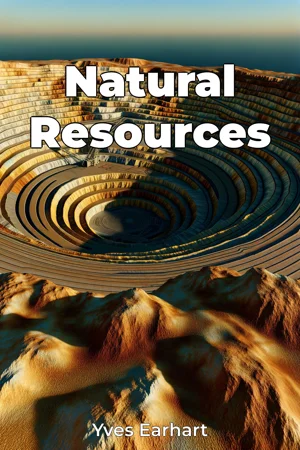
Beneath our feet and scattered across Earth's varied landscapes lies a complex network of resources that shapes human civilization and sustains life as we know it. "Natural Resources" presents a comprehensive examination of Earth's vital materials, from mineral deposits to renewable energy sources, exploring their formation, distribution, and the critical balance between extraction and conservation. The book systematically analyzes three interconnected aspects of natural resources: their geological origins and global distribution patterns, current extraction methodologies and their environmental impact, and sustainable management strategies for future generations. These elements are crucial for understanding how human societies can maintain access to essential resources while preserving ecological stability. Drawing from extensive geological surveys, environmental impact studies, and resource management data, the text provides readers with a solid foundation in resource classification and distribution. The first section maps out the formation of various resource types, from fossil fuels to rare earth elements, explaining how geological processes over millions of years have created today's resource deposits. The second part addresses modern extraction techniques, examining both traditional mining methods and innovative technologies. It presents detailed case studies from different regions, analyzing how factors such as technological advancement, economic demands, and environmental considerations influence resource extraction decisions. The book pays particular attention to the environmental consequences of various extraction methods, providing data-driven assessments of their long-term impacts. The final section focuses on resource management strategies, incorporating principles from environmental science, economics, and public policy. It examines successful conservation programs worldwide and presents frameworks for sustainable resource utilization. The text includes practical models for resource assessment, environmental impact evaluation, and long-term planning. The book maintains a balanced perspective, acknowledging both the necessity of resource extraction for modern civilization and the imperative of environmental protection. It connects geological processes with economic principles and environmental science, demonstrating how these disciplines must work together for effective resource management. Throughout its chapters, the work incorporates recent research findings from international geological surveys, environmental monitoring programs, and resource management initiatives. It features detailed maps, statistical analyses, and case studies that support its key arguments and provide readers with practical tools for understanding resource distribution and management challenges. Written in a clear, technical style accessible to both professionals and informed general readers, the book serves as a valuable reference for environmental scientists, resource managers, policy makers, and students in related fields. It avoids simplified solutions, instead presenting the complexities and trade-offs inherent in resource management decisions. The text addresses current debates in resource management, including the transition to renewable energy sources, the role of new extraction technologies, and the balance between development and conservation. It examines how different nations approach resource management and the implications of various policy frameworks. While focused primarily on physical resources, the book also considers the social and economic factors that influence resource utilization and management. It concludes with a practical framework for developing sustainable resource management strategies, making it relevant for both policy development and practical implementation.
Beneath our feet and scattered across Earth's varied landscapes lies a complex network of resources that shapes human civilization and sustains life as we know it. "Natural Resources" presents a comprehensive examination of Earth's vital materials, from mineral deposits to renewable energy sources, exploring their formation, distribution, and the critical balance between extraction and conservation. The book systematically analyzes three interconnected aspects of natural resources: their geological origins and global distribution patterns, current extraction methodologies and their environmental impact, and sustainable management strategies for future generations. These elements are crucial for understanding how human societies can maintain access to essential resources while preserving ecological stability. Drawing from extensive geological surveys, environmental impact studies, and resource management data, the text provides readers with a solid foundation in resource classification and distribution. The first section maps out the formation of various resource types, from fossil fuels to rare earth elements, explaining how geological processes over millions of years have created today's resource deposits. The second part addresses modern extraction techniques, examining both traditional mining methods and innovative technologies. It presents detailed case studies from different regions, analyzing how factors such as technological advancement, economic demands, and environmental considerations influence resource extraction decisions. The book pays particular attention to the environmental consequences of various extraction methods, providing data-driven assessments of their long-term impacts. The final section focuses on resource management strategies, incorporating principles from environmental science, economics, and public policy. It examines successful conservation programs worldwide and presents frameworks for sustainable resource utilization. The text includes practical models for resource assessment, environmental impact evaluation, and long-term planning. The book maintains a balanced perspective, acknowledging both the necessity of resource extraction for modern civilization and the imperative of environmental protection. It connects geological processes with economic principles and environmental science, demonstrating how these disciplines must work together for effective resource management. Throughout its chapters, the work incorporates recent research findings from international geological surveys, environmental monitoring programs, and resource management initiatives. It features detailed maps, statistical analyses, and case studies that support its key arguments and provide readers with practical tools for understanding resource distribution and management challenges. Written in a clear, technical style accessible to both professionals and informed general readers, the book serves as a valuable reference for environmental scientists, resource managers, policy makers, and students in related fields. It avoids simplified solutions, instead presenting the complexities and trade-offs inherent in resource management decisions. The text addresses current debates in resource management, including the transition to renewable energy sources, the role of new extraction technologies, and the balance between development and conservation. It examines how different nations approach resource management and the implications of various policy frameworks. While focused primarily on physical resources, the book also considers the social and economic factors that influence resource utilization and management. It concludes with a practical framework for developing sustainable resource management strategies, making it relevant for both policy development and practical implementation.
"Natural Resources" delivers a comprehensive exploration of Earth's essential materials, examining the intricate relationship between geological processes, resource extraction, and environmental conservation. The book uniquely weaves together three critical perspectives: the geological formation of resources, contemporary extraction methods, and sustainable management approaches, providing readers with a holistic understanding of how these elements interact in our modern world. Through systematic analysis, the text guides readers from the fundamental processes that created various resource deposits millions of years ago to the complex challenges of modern resource management. Notable insights include the interconnected nature of geological processes in forming everything from fossil fuels to rare earth elements, and how technological advancements are reshaping traditional extraction methods. The book employs real-world case studies and detailed maps to illustrate these concepts, making complex geological and environmental principles accessible to both professionals and informed general readers. The final portion of the book tackles the crucial balance between resource utilization and environmental protection, presenting practical frameworks for sustainable management. What sets this work apart is its balanced approach to controversial topics like renewable energy transition and extraction technologies, backed by current research from international geological surveys and environmental monitoring programs. Rather than offering oversimplified solutions, it acknowledges the complexities and trade-offs inherent in resource management decisions, making it an invaluable reference for environmental scientists, policy makers, and students in related fields.
Book Details
ISBN
9788233980313
Publisher
Publifye AS
Your Licenses
You don't own any licenses for this book
Purchase a license below to unlock this book and download the EPUB.
Purchase License
Select a tier to unlock this book
Need bulk licensing?
Contact us for enterprise agreements.