
About This Book
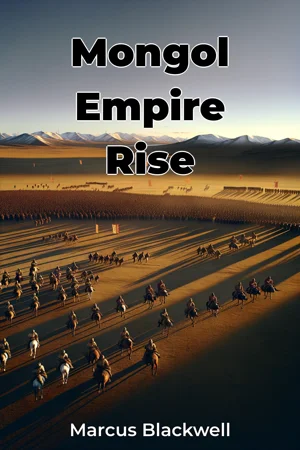
In the 13th century, a collection of nomadic tribes unified under Genghis Khan transformed into one of history's most formidable empires, conquering territories from Korea to Eastern Europe in less than a century. "Mongol Empire Rise" examines this remarkable military and cultural phenomenon through a detailed analysis of leadership principles, battle tactics, and societal transformations that shaped world history. The book presents three interconnected themes: the innovative military organization that revolutionized warfare, the administrative systems that governed diverse populations, and the cultural exchange networks that facilitated trade and knowledge transfer across Eurasia. These elements combine to demonstrate how the Mongols created not just a vast empire, but a sophisticated framework for multicultural governance. Drawing from primary sources including The Secret History of the Mongols, diplomatic correspondence, and archaeological findings, the work provides a comprehensive examination of how Mongol leaders developed their military doctrine. The text details the creation of the decimal-based army structure, the integration of conquered peoples into military units, and the adaptation of Chinese siege technology that enabled urban warfare success. The narrative follows a chronological progression through three major sections. The first explores the pre-imperial period and Genghis Khan's unification of the Mongol tribes, analyzing the social and political innovations that transformed tribal warriors into a professional army. The second section examines the rapid expansion period, focusing on military campaigns and the development of administrative systems. The final section investigates the empire's cultural impact, including the establishment of the Yam postal system and the flourishing of trade along the Silk Road. Central to the book's argument is the concept that Mongol success stemmed not just from military prowess, but from their ability to adapt and incorporate foreign technologies, administrative practices, and cultural elements. This perspective challenges traditional narratives that often portray the Mongols solely as destructive conquerors. The research synthesizes military history with cultural analysis, drawing from archaeology, linguistics, and climate studies to present a multifaceted view of the empire's development. The text incorporates recent scholarship on Mongol military techniques, including horse-archer tactics and the psychological warfare elements of their campaigns. The work connects military history with environmental studies, economic development, and political science, demonstrating how Mongol innovations influenced everything from postal systems to international trade protocols. These connections help readers understand the lasting impact of Mongol rule on global development. Written in an analytical style that balances academic rigor with accessibility, the book serves military historians, strategy students, and readers interested in world history. It maintains objectivity while examining controversial topics such as the accurate assessment of casualties during major campaigns and the debate over Mongol influences on European military development. The scope encompasses the period from 1160 to 1294 CE, focusing primarily on the empire's formative years and peak period. While acknowledging the empire's eventual fragmentation, the book concentrates on the systems and strategies that enabled its creation and maintenance. For military professionals and historians, the work offers practical insights into leadership, logistics, and strategic planning that remain relevant to modern organizational management. The book's analysis of how the Mongols adapted their strategies for different terrains and opponents provides valuable lessons in tactical flexibility and strategic adaptation.
In the 13th century, a collection of nomadic tribes unified under Genghis Khan transformed into one of history's most formidable empires, conquering territories from Korea to Eastern Europe in less than a century. "Mongol Empire Rise" examines this remarkable military and cultural phenomenon through a detailed analysis of leadership principles, battle tactics, and societal transformations that shaped world history. The book presents three interconnected themes: the innovative military organization that revolutionized warfare, the administrative systems that governed diverse populations, and the cultural exchange networks that facilitated trade and knowledge transfer across Eurasia. These elements combine to demonstrate how the Mongols created not just a vast empire, but a sophisticated framework for multicultural governance. Drawing from primary sources including The Secret History of the Mongols, diplomatic correspondence, and archaeological findings, the work provides a comprehensive examination of how Mongol leaders developed their military doctrine. The text details the creation of the decimal-based army structure, the integration of conquered peoples into military units, and the adaptation of Chinese siege technology that enabled urban warfare success. The narrative follows a chronological progression through three major sections. The first explores the pre-imperial period and Genghis Khan's unification of the Mongol tribes, analyzing the social and political innovations that transformed tribal warriors into a professional army. The second section examines the rapid expansion period, focusing on military campaigns and the development of administrative systems. The final section investigates the empire's cultural impact, including the establishment of the Yam postal system and the flourishing of trade along the Silk Road. Central to the book's argument is the concept that Mongol success stemmed not just from military prowess, but from their ability to adapt and incorporate foreign technologies, administrative practices, and cultural elements. This perspective challenges traditional narratives that often portray the Mongols solely as destructive conquerors. The research synthesizes military history with cultural analysis, drawing from archaeology, linguistics, and climate studies to present a multifaceted view of the empire's development. The text incorporates recent scholarship on Mongol military techniques, including horse-archer tactics and the psychological warfare elements of their campaigns. The work connects military history with environmental studies, economic development, and political science, demonstrating how Mongol innovations influenced everything from postal systems to international trade protocols. These connections help readers understand the lasting impact of Mongol rule on global development. Written in an analytical style that balances academic rigor with accessibility, the book serves military historians, strategy students, and readers interested in world history. It maintains objectivity while examining controversial topics such as the accurate assessment of casualties during major campaigns and the debate over Mongol influences on European military development. The scope encompasses the period from 1160 to 1294 CE, focusing primarily on the empire's formative years and peak period. While acknowledging the empire's eventual fragmentation, the book concentrates on the systems and strategies that enabled its creation and maintenance. For military professionals and historians, the work offers practical insights into leadership, logistics, and strategic planning that remain relevant to modern organizational management. The book's analysis of how the Mongols adapted their strategies for different terrains and opponents provides valuable lessons in tactical flexibility and strategic adaptation.
"Mongol Empire Rise" offers a compelling exploration of how a confederation of nomadic tribes transformed into history's largest contiguous land empire under Genghis Khan's leadership during the 13th century. The book masterfully weaves together military innovation, administrative ingenuity, and cultural exchange to demonstrate how the Mongols created not just a vast territory, but a sophisticated framework for multicultural governance that stretched from Korea to Eastern Europe. Through meticulous analysis of primary sources, including The Secret History of the Mongols and archaeological findings, the book reveals fascinating insights into the Mongols' revolutionary military organization. Their decimal-based army structure, integration of conquered peoples, and adaptation of Chinese siege technology showcased remarkable tactical flexibility. The establishment of the Yam postal system and the flourishing of trade along the Silk Road exemplify how Mongol rule fostered unprecedented cultural and economic connections across Eurasia. The narrative progresses chronologically through three distinct phases: the pre-imperial period and tribal unification, the rapid expansion era, and the empire's cultural impact. What sets this work apart is its multidisciplinary approach, combining military history with environmental studies, economics, and political science to present a nuanced view that challenges the traditional portrayal of Mongols as mere conquerors. The book's examination of their adaptive strategies and administrative systems offers relevant insights for modern leadership and organizational management.
Book Details
ISBN
9788233980191
Publisher
Publifye AS
Your Licenses
You don't own any licenses for this book
Purchase a license below to unlock this book and download the EPUB.
Purchase License
Select a tier to unlock this book
Need bulk licensing?
Contact us for enterprise agreements.