
About This Book
What if the key to a happier, more fulfilling life lies not in grand gestures, but in the subtle art of everyday living? "Danish Living Concepts" delves into the core principles of Danish home life, exploring how they cultivate social well-being and inform innovative community design. This book examines the cultural underpinnings of the famed Danish happiness, arguing that it stems from a deliberate and thoughtful approach to domestic spaces and social interactions. We will examine the concepts of "hygge," social connectedness, and functional design as central pillars of the Danish lifestyle. "Hygge," often translated as coziness, extends beyond mere comfort to encompass a sense of intimacy, gratitude, and contentment in simple pleasures. Social connectedness emphasizes the importance of strong community bonds, mutual support, and shared experiences. Functional design focuses on creating living spaces that are not only aesthetically pleasing but also promote well-being, practicality, and social interaction. Understanding these topics is vital as societies grapple with issues of isolation, declining mental health, and unsustainable urban development. Drawing from cultural studies, sociological research, and design theory, this book presents a comprehensive analysis of Danish living. We present historical context explaining the evolution of these concepts within Danish society. We will explain how factors such as the social democratic welfare state, the egalitarian ethos, and the harsh climate have shaped the Danish approach to home and community. Our central argument is that the Danish emphasis on hygge, social connectedness, and functional design offers valuable lessons for creating more livable, equitable, and sustainable communities worldwide. By understanding and adapting these principles, individuals and policymakers can foster greater well-being and resilience in their own contexts. The book is structured in three parts. Part one introduces the core concepts of hygge, social connectedness, and functional design. Part two explores the historical and cultural context that has shaped these concepts in Denmark; examining case studies of Danish homes, neighborhoods, and public spaces. Part three analyzes the broader implications of Danish living concepts for other societies; exploring how these principles can be adapted to diverse cultural contexts. The analysis relies on a range of evidence, including ethnographic studies of Danish homes, interviews with Danish residents and design professionals, and analysis of architectural plans and urban planning documents. We also incorporate insights from comparative studies of well-being and social capital across different countries. This book connects to several fields, including sociology, urban planning, and positive psychology. We consider the sociological dimensions of social interaction and community building, exploring how the design of physical spaces. We also integrate principles of positive psychology, such as mindfulness, gratitude, and social support, to understand how Danish living concepts promote mental and emotional well-being. This book offers a unique perspective by moving beyond superficial interpretations of "hygge" to explore the deeper cultural and social roots of Danish happiness. It provides a nuanced understanding of how everyday practices and design choices can contribute to a more fulfilling life. The tone is informative and engaging, blending academic rigor with accessible language. We use real-life examples and compelling narratives to illustrate key concepts and make the book relatable to a broad audience. The target audience includes students and scholars in social sciences and design, urban planners, architects, policymakers, and anyone interested in improving their own well-being and creating more livable communities. This book is valuable to those seeking innovative approaches to address pressing social and environmental challenges. As a work in social science and design, the book adheres to the principles of evidence-based analysis and critical inquiry. It acknowledges the complexities and nuances of cultural phenomena, avoiding simplistic generalizations or romanticized portrayals of Danish society. The book focuses primarily on the cultural and social dimensions of Danish living, with less emphasis on economic or political factors. While we acknowledge the role of government policies and economic structures in shaping Danish society, our primary focus is on the everyday practices and values that contribute to well-being. Practically, the information in this book can be applied to a range of settings, from individual homes to entire communities. Readers can use it to inform their own design choices, promote social interaction in their neighborhoods, and advocate for policies that support well-being and sustainability. While Denmark consistently ranks high in global happiness surveys, there are also debates about the sustainability of the Danish welfare model and the challenges of integrating immigrants into Danish society. This book acknowledges these complexities, presenting a balanced and nuanced perspective on Danish living.
What if the key to a happier, more fulfilling life lies not in grand gestures, but in the subtle art of everyday living? "Danish Living Concepts" delves into the core principles of Danish home life, exploring how they cultivate social well-being and inform innovative community design. This book examines the cultural underpinnings of the famed Danish happiness, arguing that it stems from a deliberate and thoughtful approach to domestic spaces and social interactions. We will examine the concepts of "hygge," social connectedness, and functional design as central pillars of the Danish lifestyle. "Hygge," often translated as coziness, extends beyond mere comfort to encompass a sense of intimacy, gratitude, and contentment in simple pleasures. Social connectedness emphasizes the importance of strong community bonds, mutual support, and shared experiences. Functional design focuses on creating living spaces that are not only aesthetically pleasing but also promote well-being, practicality, and social interaction. Understanding these topics is vital as societies grapple with issues of isolation, declining mental health, and unsustainable urban development. Drawing from cultural studies, sociological research, and design theory, this book presents a comprehensive analysis of Danish living. We present historical context explaining the evolution of these concepts within Danish society. We will explain how factors such as the social democratic welfare state, the egalitarian ethos, and the harsh climate have shaped the Danish approach to home and community. Our central argument is that the Danish emphasis on hygge, social connectedness, and functional design offers valuable lessons for creating more livable, equitable, and sustainable communities worldwide. By understanding and adapting these principles, individuals and policymakers can foster greater well-being and resilience in their own contexts. The book is structured in three parts. Part one introduces the core concepts of hygge, social connectedness, and functional design. Part two explores the historical and cultural context that has shaped these concepts in Denmark; examining case studies of Danish homes, neighborhoods, and public spaces. Part three analyzes the broader implications of Danish living concepts for other societies; exploring how these principles can be adapted to diverse cultural contexts. The analysis relies on a range of evidence, including ethnographic studies of Danish homes, interviews with Danish residents and design professionals, and analysis of architectural plans and urban planning documents. We also incorporate insights from comparative studies of well-being and social capital across different countries. This book connects to several fields, including sociology, urban planning, and positive psychology. We consider the sociological dimensions of social interaction and community building, exploring how the design of physical spaces. We also integrate principles of positive psychology, such as mindfulness, gratitude, and social support, to understand how Danish living concepts promote mental and emotional well-being. This book offers a unique perspective by moving beyond superficial interpretations of "hygge" to explore the deeper cultural and social roots of Danish happiness. It provides a nuanced understanding of how everyday practices and design choices can contribute to a more fulfilling life. The tone is informative and engaging, blending academic rigor with accessible language. We use real-life examples and compelling narratives to illustrate key concepts and make the book relatable to a broad audience. The target audience includes students and scholars in social sciences and design, urban planners, architects, policymakers, and anyone interested in improving their own well-being and creating more livable communities. This book is valuable to those seeking innovative approaches to address pressing social and environmental challenges. As a work in social science and design, the book adheres to the principles of evidence-based analysis and critical inquiry. It acknowledges the complexities and nuances of cultural phenomena, avoiding simplistic generalizations or romanticized portrayals of Danish society. The book focuses primarily on the cultural and social dimensions of Danish living, with less emphasis on economic or political factors. While we acknowledge the role of government policies and economic structures in shaping Danish society, our primary focus is on the everyday practices and values that contribute to well-being. Practically, the information in this book can be applied to a range of settings, from individual homes to entire communities. Readers can use it to inform their own design choices, promote social interaction in their neighborhoods, and advocate for policies that support well-being and sustainability. While Denmark consistently ranks high in global happiness surveys, there are also debates about the sustainability of the Danish welfare model and the challenges of integrating immigrants into Danish society. This book acknowledges these complexities, presenting a balanced and nuanced perspective on Danish living.
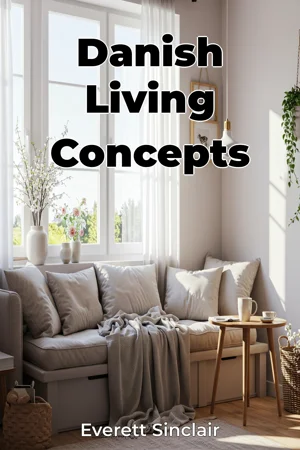
"Danish Living Concepts" explores the secrets behind Denmark's renowned happiness, diving into the cultural practices that foster well-being. The book examines core components of the Danish lifestyle, like "hygge"—more than just coziness, it's about gratitude and contentment—alongside social connectedness and functional design. These elements combine to create homes and communities that prioritize both comfort and interaction, offering valuable insights for societies grappling with isolation and urban challenges. The book progresses through three parts. It begins by introducing core concepts, then delves into the historical and cultural context shaping Danish living. Finally, it analyzes how these principles can be adapted globally. Drawing from cultural studies and design theory, the book offers a comprehensive look at how the Danish approach to home life and community design contributes to their high levels of social well-being. The study is supported with interviews, ethnographic studies, and urban planning document analysis. What sets "Danish Living Concepts" apart is its in-depth exploration of the cultural roots of Danish happiness, moving beyond superficial understandings of "hygge." It offers practical lessons for creating more livable and sustainable communities by understanding and adapting Danish principles of functional design and social connectedness.
Book Details
ISBN
9788233979881
Publisher
Publifye AS
Your Licenses
You don't own any licenses for this book
Purchase a license below to unlock this book and download the EPUB.
Purchase License
Select a tier to unlock this book
Need bulk licensing?
Contact us for enterprise agreements.