
About This Book
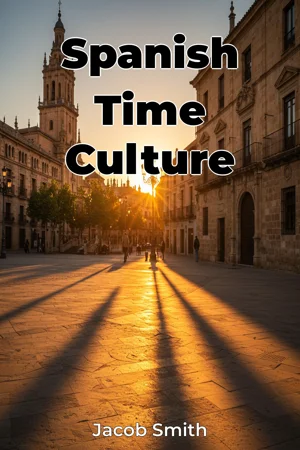
Ever wondered why Spaniards seem to live by a different clock? "Spanish Time Culture" delves into the intricate tapestry of daily scheduling and social timing practices in Spain, offering a comprehensive examination of how culture shapes the perception and utilization of time. This book is essential for anyone seeking to understand the nuances of Spanish society, the historical forces that have shaped it, and its place in the broader world. At its core, this exploration focuses on three key areas: the historical evolution of Spanish schedules, the cultural values embedded in these temporal patterns, and the social implications of Spain's distinctive approach to time. These elements are vital because they illuminate how cultural norms influence everything from business practices and personal relationships to national identity. Understanding Spanish time culture requires an appreciation of Spain's unique historical trajectory, influenced by factors such as its geographical location, its history of both imperial power and internal conflict, and its complex relationship with modernity. The book will explore these contexts to build a foundation of knowledge. The central argument of "Spanish Time Culture" is that Spanish scheduling and social timing are not merely practical arrangements but deeply ingrained expressions of cultural values, reflecting a societal emphasis on social connection, flexibility, and the prioritization of personal relationships over strict adherence to schedules. This concept is significant because it challenges conventional notions of productivity and efficiency, offering an alternative perspective on how societies organize their daily lives. The book begins by introducing the core concepts of cultural time, contrasting monochronic and polychronic cultures. It then proceeds through three major parts. First, the book examines the historical development of Spanish time culture, tracing its roots from the medieval period through the Franco era and into contemporary society. Second, it explores the contemporary manifestations of Spanish time, analyzing practices such as the late-night dinners, extended lunch breaks, and flexible work schedules that characterize daily life. Third, the book investigates the social consequences of Spanish time culture, considering its impact on business, education, and personal relationships. The analysis draws upon a range of evidence, including historical documents, sociological surveys, ethnographic studies, and interviews with Spaniards from diverse backgrounds. A unique aspect of the research is the incorporation of observational data collected in various social settings, offering firsthand insights into how time is experienced and negotiated in everyday life. "Spanish Time Culture" bridges several fields, connecting history, social science, and cultural studies, and demonstrates how cultural norms affect business practices and international relations. This interdisciplinary approach enhances the book's argument by demonstrating the pervasive influence of time culture across multiple domains. A unique perspective offered is a contrast between "Northern" and "Southern" European time cultures, challenging assumptions about universal approaches to scheduling and highlighting the cultural specificity of time management practices. The tone of the book is academic yet accessible, aiming to engage both scholars and general readers interested in Spanish culture. It is written to be informative and thought-provoking, encouraging readers to reconsider their own assumptions about time and its importance in shaping social life. This book is targeted toward students and scholars of history, sociology, anthropology, and Spanish studies, as well as business professionals and travelers seeking a deeper understanding of Spanish society. It will also appeal to anyone interested in the cultural dimensions of time and how they shape human behavior. As a work of cultural history and social science, "Spanish Time Culture" adheres to the conventions of rigorous research, balanced analysis, and clear presentation of evidence. It aims to contribute to the existing literature on time studies, offering a nuanced and insightful perspective on a relatively under-explored topic. While the book focuses primarily on mainland Spain, it also acknowledges the regional variations within the country, recognizing that time culture can differ across communities. However, it does not delve deeply into the specific time cultures of Spanish-speaking countries outside of Spain, which represents a deliberate limitation in scope. The insights offered in "Spanish Time Culture" have practical applications for anyone interacting with Spaniards, whether in a business, academic, or personal context. By understanding the cultural values embedded in Spanish time, readers can navigate social situations more effectively, build stronger relationships, and avoid misunderstandings. The book addresses ongoing debates about the impact of globalization and modernization on traditional cultural practices, examining whether Spanish time culture is eroding in the face of increasing pressures for efficiency and standardization. It also explores the potential for Spanish time culture to offer valuable lessons for other societies seeking to create more humane and sustainable ways of organizing their daily lives.
Ever wondered why Spaniards seem to live by a different clock? "Spanish Time Culture" delves into the intricate tapestry of daily scheduling and social timing practices in Spain, offering a comprehensive examination of how culture shapes the perception and utilization of time. This book is essential for anyone seeking to understand the nuances of Spanish society, the historical forces that have shaped it, and its place in the broader world. At its core, this exploration focuses on three key areas: the historical evolution of Spanish schedules, the cultural values embedded in these temporal patterns, and the social implications of Spain's distinctive approach to time. These elements are vital because they illuminate how cultural norms influence everything from business practices and personal relationships to national identity. Understanding Spanish time culture requires an appreciation of Spain's unique historical trajectory, influenced by factors such as its geographical location, its history of both imperial power and internal conflict, and its complex relationship with modernity. The book will explore these contexts to build a foundation of knowledge. The central argument of "Spanish Time Culture" is that Spanish scheduling and social timing are not merely practical arrangements but deeply ingrained expressions of cultural values, reflecting a societal emphasis on social connection, flexibility, and the prioritization of personal relationships over strict adherence to schedules. This concept is significant because it challenges conventional notions of productivity and efficiency, offering an alternative perspective on how societies organize their daily lives. The book begins by introducing the core concepts of cultural time, contrasting monochronic and polychronic cultures. It then proceeds through three major parts. First, the book examines the historical development of Spanish time culture, tracing its roots from the medieval period through the Franco era and into contemporary society. Second, it explores the contemporary manifestations of Spanish time, analyzing practices such as the late-night dinners, extended lunch breaks, and flexible work schedules that characterize daily life. Third, the book investigates the social consequences of Spanish time culture, considering its impact on business, education, and personal relationships. The analysis draws upon a range of evidence, including historical documents, sociological surveys, ethnographic studies, and interviews with Spaniards from diverse backgrounds. A unique aspect of the research is the incorporation of observational data collected in various social settings, offering firsthand insights into how time is experienced and negotiated in everyday life. "Spanish Time Culture" bridges several fields, connecting history, social science, and cultural studies, and demonstrates how cultural norms affect business practices and international relations. This interdisciplinary approach enhances the book's argument by demonstrating the pervasive influence of time culture across multiple domains. A unique perspective offered is a contrast between "Northern" and "Southern" European time cultures, challenging assumptions about universal approaches to scheduling and highlighting the cultural specificity of time management practices. The tone of the book is academic yet accessible, aiming to engage both scholars and general readers interested in Spanish culture. It is written to be informative and thought-provoking, encouraging readers to reconsider their own assumptions about time and its importance in shaping social life. This book is targeted toward students and scholars of history, sociology, anthropology, and Spanish studies, as well as business professionals and travelers seeking a deeper understanding of Spanish society. It will also appeal to anyone interested in the cultural dimensions of time and how they shape human behavior. As a work of cultural history and social science, "Spanish Time Culture" adheres to the conventions of rigorous research, balanced analysis, and clear presentation of evidence. It aims to contribute to the existing literature on time studies, offering a nuanced and insightful perspective on a relatively under-explored topic. While the book focuses primarily on mainland Spain, it also acknowledges the regional variations within the country, recognizing that time culture can differ across communities. However, it does not delve deeply into the specific time cultures of Spanish-speaking countries outside of Spain, which represents a deliberate limitation in scope. The insights offered in "Spanish Time Culture" have practical applications for anyone interacting with Spaniards, whether in a business, academic, or personal context. By understanding the cultural values embedded in Spanish time, readers can navigate social situations more effectively, build stronger relationships, and avoid misunderstandings. The book addresses ongoing debates about the impact of globalization and modernization on traditional cultural practices, examining whether Spanish time culture is eroding in the face of increasing pressures for efficiency and standardization. It also explores the potential for Spanish time culture to offer valuable lessons for other societies seeking to create more humane and sustainable ways of organizing their daily lives.
"Spanish Time Culture" explores how Spain's unique approach to time shapes its society. It examines how historical events and cultural values have influenced the nation's perception and utilization of time, revealing that Spanish scheduling is more than just practical; it's a reflection of prioritizing social connections. Intriguingly, this challenges conventional notions of productivity, offering an alternative perspective on societal organization. The book investigates the historical evolution of Spanish time culture, from the medieval period to contemporary society. It delves into modern manifestations such as late-night dinners and flexible work schedules. Furthermore, it analyzes the social consequences of this distinctive time culture on business, education, and relationships. This approach highlights the cultural values embedded in daily life, such as valuing relationships over strict schedules. The study contrasts "Northern" and "Southern" European time cultures, challenging assumptions about universal scheduling norms. Through historical documents, surveys, and interviews, the book provides a comprehensive understanding of Spanish time. Progressing across chapters, it offers valuable insights for anyone interacting with Spaniards, bridging history, social science, and cultural studies to demonstrate the pervasive influence of time culture.
Book Details
ISBN
9788233979690
Publisher
Publifye AS
Your Licenses
You don't own any licenses for this book
Purchase a license below to unlock this book and download the EPUB.
Purchase License
Select a tier to unlock this book
Need bulk licensing?
Contact us for enterprise agreements.