
About This Book
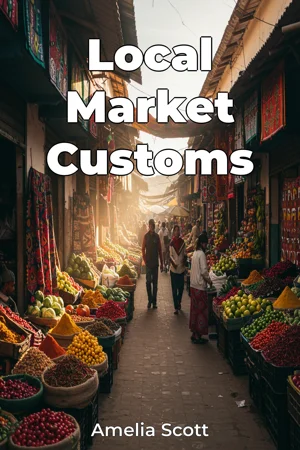
What if the key to understanding a community’s identity and resilience lies not in grand political narratives, but in the everyday transactions and traditions of its local market? "Local Market Customs" delves into the intricate relationship between traditional market practices and community life, drawing upon foundational economic and cultural studies to reveal how these unassuming spaces shape social bonds, economic stability, and cultural identity. This book is a journey into the heart of local economies. This exploration is crucial because in an era of globalization and homogenization, understanding the role of local markets becomes ever more important. These markets often act as the last bastion of cultural uniqueness and community self-determination. Therefore, this book presents a central argument: that traditional market customs are not merely economic activities, but vital social institutions that foster community cohesion, preserve cultural heritage, and provide a foundation for local economic resilience. The book unfolds in three major parts. First, it introduces the core concepts: traditional markets as multifaceted spaces, the economic principles underpinning their operations (such as bartering, local currency, and trust-based lending), and the cultural rituals and beliefs that permeate market interactions. The second section analyzes the social dimensions of markets, exploring how they function as gathering places, forums for social exchange, and sites for the enactment and reinforcement of community norms. Case studies from diverse cultural contexts illustrate how markets facilitate social interaction, transmit traditional knowledge, and contribute to community well-being. Specific attention is given to the role of women and marginalized groups in market economies. The third part addresses the economic impacts of local markets, examining their contributions to local livelihoods, food security, and sustainable development. It considers the challenges faced by these markets, including competition from global retailers, government regulations, and environmental pressures. The evidence presented is drawn from a wide range of sources, including ethnographic studies, economic surveys, historical archives, and oral histories. Methodologically, the book employs a mixed-methods approach, combining qualitative insights from anthropological fieldwork with quantitative data on market transactions and economic indicators. The book also acknowledges the interdisciplinary nature of the topic, connecting to fields such as anthropology, sociology, and development studies. For example, it draws on anthropological theories of ritual and exchange to understand the symbolic dimensions of market practices, sociological perspectives on community and social capital to analyze the social functions of markets, and development economics to assess their contributions to poverty reduction and sustainable livelihoods. A unique aspect of this book is its emphasis on the agency of local actors in shaping market institutions. It challenges top-down approaches to economic development by highlighting the importance of understanding and supporting indigenous market practices. Written in an accessible, yet academically grounded style, "Local Market Customs" is aimed at a broad audience, including students, researchers, policymakers, and anyone interested in understanding the social and economic dynamics of local communities. Planners and community developers can use the insights to better design interventions that sustain and enhance local markets. While the book examines a global range of market practices, it acknowledges the limitations of generalizing across diverse contexts. It focuses primarily on markets in developing countries and marginalized communities, recognizing that the role of markets in industrialized societies differs significantly. Ultimately, this book seeks to demonstrate that local market customs are not relics of the past, but rather valuable resources for building more resilient, equitable, and culturally vibrant communities in the 21st century. By understanding the economic and social significance of these markets, we can work to protect and promote them as essential components of community life. The book addresses debates around the impacts of globalization on local economies, offering a counterbalance to narratives that emphasize the inevitable decline of traditional markets. It suggests pathways for integrating local markets into the global economy in ways that preserve their social and cultural value, fostering sustainable community development.
What if the key to understanding a community’s identity and resilience lies not in grand political narratives, but in the everyday transactions and traditions of its local market? "Local Market Customs" delves into the intricate relationship between traditional market practices and community life, drawing upon foundational economic and cultural studies to reveal how these unassuming spaces shape social bonds, economic stability, and cultural identity. This book is a journey into the heart of local economies. This exploration is crucial because in an era of globalization and homogenization, understanding the role of local markets becomes ever more important. These markets often act as the last bastion of cultural uniqueness and community self-determination. Therefore, this book presents a central argument: that traditional market customs are not merely economic activities, but vital social institutions that foster community cohesion, preserve cultural heritage, and provide a foundation for local economic resilience. The book unfolds in three major parts. First, it introduces the core concepts: traditional markets as multifaceted spaces, the economic principles underpinning their operations (such as bartering, local currency, and trust-based lending), and the cultural rituals and beliefs that permeate market interactions. The second section analyzes the social dimensions of markets, exploring how they function as gathering places, forums for social exchange, and sites for the enactment and reinforcement of community norms. Case studies from diverse cultural contexts illustrate how markets facilitate social interaction, transmit traditional knowledge, and contribute to community well-being. Specific attention is given to the role of women and marginalized groups in market economies. The third part addresses the economic impacts of local markets, examining their contributions to local livelihoods, food security, and sustainable development. It considers the challenges faced by these markets, including competition from global retailers, government regulations, and environmental pressures. The evidence presented is drawn from a wide range of sources, including ethnographic studies, economic surveys, historical archives, and oral histories. Methodologically, the book employs a mixed-methods approach, combining qualitative insights from anthropological fieldwork with quantitative data on market transactions and economic indicators. The book also acknowledges the interdisciplinary nature of the topic, connecting to fields such as anthropology, sociology, and development studies. For example, it draws on anthropological theories of ritual and exchange to understand the symbolic dimensions of market practices, sociological perspectives on community and social capital to analyze the social functions of markets, and development economics to assess their contributions to poverty reduction and sustainable livelihoods. A unique aspect of this book is its emphasis on the agency of local actors in shaping market institutions. It challenges top-down approaches to economic development by highlighting the importance of understanding and supporting indigenous market practices. Written in an accessible, yet academically grounded style, "Local Market Customs" is aimed at a broad audience, including students, researchers, policymakers, and anyone interested in understanding the social and economic dynamics of local communities. Planners and community developers can use the insights to better design interventions that sustain and enhance local markets. While the book examines a global range of market practices, it acknowledges the limitations of generalizing across diverse contexts. It focuses primarily on markets in developing countries and marginalized communities, recognizing that the role of markets in industrialized societies differs significantly. Ultimately, this book seeks to demonstrate that local market customs are not relics of the past, but rather valuable resources for building more resilient, equitable, and culturally vibrant communities in the 21st century. By understanding the economic and social significance of these markets, we can work to protect and promote them as essential components of community life. The book addresses debates around the impacts of globalization on local economies, offering a counterbalance to narratives that emphasize the inevitable decline of traditional markets. It suggests pathways for integrating local markets into the global economy in ways that preserve their social and cultural value, fostering sustainable community development.
"Local Market Customs" explores the vital link between traditional market practices and community life, revealing how these spaces shape social bonds, economic stability, and cultural identity. In an era of globalization and homogenization, the book highlights how local markets serve as crucial bastions of community self-determination, preserving cultural heritage and fostering local economic resilience. The book argues that these markets are not merely economic hubs but also essential social institutions. Did you know that many traditional markets operate on trust-based lending and bartering systems, showcasing unique economic principles? Also, these markets often serve as vital gathering places, strengthening community cohesion and transmitting traditional knowledge. The book unfolds in three parts, beginning with core concepts such as bartering and cultural rituals, then analyzing the social dimensions of markets through case studies, and finally addressing their economic impacts on livelihoods and food security. Using a mixed-methods approach that combines ethnographic studies with economic data, the book emphasizes the agency of local actors in shaping market institutions. It challenges top-down economic approaches by supporting indigenous market practices. This perspective offers a fresh look at how local economies can thrive even amidst global pressures.
Book Details
ISBN
9788233979522
Publisher
Publifye AS
Your Licenses
You don't own any licenses for this book
Purchase a license below to unlock this book and download the EPUB.
Purchase License
Select a tier to unlock this book
Need bulk licensing?
Contact us for enterprise agreements.