
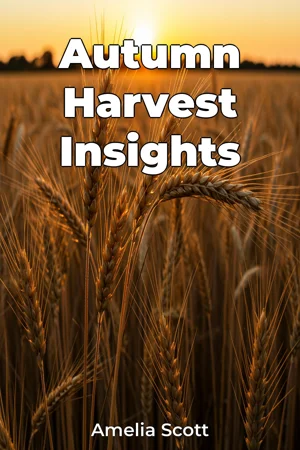
About This Book
Have you ever considered how the rhythm of the seasons, specifically harvest cycles, deeply influences not just what we eat but the economic well-being of entire communities? "Autumn Harvest Insights" delves into this vital connection, exploring the intricate relationship between seasonal agricultural production, local economic stability, and community nutrition. This book addresses a critical intersection of health, fitness, and economics, demonstrating how understanding these cycles can lead to more robust and sustainable livelihoods. We begin by establishing the fundamental concept of seasonal harvest cycles and their inherent variability. We examine specific crop yields across diverse geographical locations, drawing on data from agricultural yield reports and local economic indicators. We then connect these yields to the nutritional health of populations reliant on these harvests. It is crucial that this connection is understood, as fluctuations in crop production directly impact food availability, affordability, and ultimately, public health outcomes. Understanding pre-industrial farming practices provides historical context, emphasizing how societies managed this seasonal dependence for centuries before industrialization and global trade altered the landscape. The core argument presented is that a nuanced understanding of harvest cycles is paramount for developing resilient local economies and promoting better nutritional outcomes. This argument unfolds across several key sections. Initially, we delve into the microeconomic impact of a successful versus a failed harvest, investigating how it affects local employment, market prices, and overall business activity. We then shift to the nutritional consequences, focusing on how harvest fluctuations influence dietary diversity, nutrient intake, and vulnerability to malnutrition, particularly among vulnerable populations like children and the elderly. We examine the macroeconomic impact of regional or national harvest failures. The book's structure follows a logical progression. Part 1 introduces core concepts and establishes the historical and current context. Part 2 dissects the economic impacts, providing case studies illustrating the ripple effects of harvest variations on local business revenue, job creation, and governmental stability. In Part 3, we explore the nutrition dimensions, analyzing data that connects specific seasonal crops with community health indicators such as childhood growth rates and prevalence of nutrient deficiencies. Finally, Part 4 synthesizes the findings and explores practical strategies for mitigating negative impacts and enhancing the resilience of local economies and nutritional stability in the face of inevitable harvest fluctuations. The book's strength lies in its interdisciplinary approach. It bridges the gap between agricultural science, economics, and public health. The analysis connects directly to fields like environmental science, exploring links between climate patterns and harvest predictability, and to sociology, by examining how cultural practices and social structures mediate the impact of food scarcity. This interdisciplinary lens offers a more complete and actionable understanding of the issues. "Autumn Harvest Insights" employs a fact-based, analytical style, drawing on quantitative data from agricultural reports, nutrition surveys, and economic indicators. The analysis also incorporates qualitative data from case studies to provide a more nuanced understanding of the lived experiences of communities affected by harvest cycles. We aim for an accessible yet rigorous tone, making the information valuable for both academic researchers and practitioners working in agriculture, economics, and public health. The target audience includes students and researchers in economics, nutrition, and agricultural studies, as well as policymakers and professionals involved in food security and community development initiatives. Further, the book fills a gap in the existing literature by offering a holistic view of the interconnectedness of harvest cycles, local economies, and nutritional health. We acknowledge the limitations of generalizing findings across diverse agro-ecological zones and cultural contexts but provide a strong framework for local or region-specific research and policy development. This book addresses the ongoing debates surrounding sustainable agriculture and food security, offering data-driven insights into the impact of different farming practices and policy interventions on harvest yields and community well-being. We provide real-world examples of successful interventions and policy changes that have improved both economic stability and nutritional outcomes in regions vulnerable to harvest variability. By synthesizing diverse research and offering practical strategies, "Autumn Harvest Insights" provides a valuable resource for anyone seeking to understand and address the complex challenges at the intersection of food, economics, and health.
Have you ever considered how the rhythm of the seasons, specifically harvest cycles, deeply influences not just what we eat but the economic well-being of entire communities? "Autumn Harvest Insights" delves into this vital connection, exploring the intricate relationship between seasonal agricultural production, local economic stability, and community nutrition. This book addresses a critical intersection of health, fitness, and economics, demonstrating how understanding these cycles can lead to more robust and sustainable livelihoods. We begin by establishing the fundamental concept of seasonal harvest cycles and their inherent variability. We examine specific crop yields across diverse geographical locations, drawing on data from agricultural yield reports and local economic indicators. We then connect these yields to the nutritional health of populations reliant on these harvests. It is crucial that this connection is understood, as fluctuations in crop production directly impact food availability, affordability, and ultimately, public health outcomes. Understanding pre-industrial farming practices provides historical context, emphasizing how societies managed this seasonal dependence for centuries before industrialization and global trade altered the landscape. The core argument presented is that a nuanced understanding of harvest cycles is paramount for developing resilient local economies and promoting better nutritional outcomes. This argument unfolds across several key sections. Initially, we delve into the microeconomic impact of a successful versus a failed harvest, investigating how it affects local employment, market prices, and overall business activity. We then shift to the nutritional consequences, focusing on how harvest fluctuations influence dietary diversity, nutrient intake, and vulnerability to malnutrition, particularly among vulnerable populations like children and the elderly. We examine the macroeconomic impact of regional or national harvest failures. The book's structure follows a logical progression. Part 1 introduces core concepts and establishes the historical and current context. Part 2 dissects the economic impacts, providing case studies illustrating the ripple effects of harvest variations on local business revenue, job creation, and governmental stability. In Part 3, we explore the nutrition dimensions, analyzing data that connects specific seasonal crops with community health indicators such as childhood growth rates and prevalence of nutrient deficiencies. Finally, Part 4 synthesizes the findings and explores practical strategies for mitigating negative impacts and enhancing the resilience of local economies and nutritional stability in the face of inevitable harvest fluctuations. The book's strength lies in its interdisciplinary approach. It bridges the gap between agricultural science, economics, and public health. The analysis connects directly to fields like environmental science, exploring links between climate patterns and harvest predictability, and to sociology, by examining how cultural practices and social structures mediate the impact of food scarcity. This interdisciplinary lens offers a more complete and actionable understanding of the issues. "Autumn Harvest Insights" employs a fact-based, analytical style, drawing on quantitative data from agricultural reports, nutrition surveys, and economic indicators. The analysis also incorporates qualitative data from case studies to provide a more nuanced understanding of the lived experiences of communities affected by harvest cycles. We aim for an accessible yet rigorous tone, making the information valuable for both academic researchers and practitioners working in agriculture, economics, and public health. The target audience includes students and researchers in economics, nutrition, and agricultural studies, as well as policymakers and professionals involved in food security and community development initiatives. Further, the book fills a gap in the existing literature by offering a holistic view of the interconnectedness of harvest cycles, local economies, and nutritional health. We acknowledge the limitations of generalizing findings across diverse agro-ecological zones and cultural contexts but provide a strong framework for local or region-specific research and policy development. This book addresses the ongoing debates surrounding sustainable agriculture and food security, offering data-driven insights into the impact of different farming practices and policy interventions on harvest yields and community well-being. We provide real-world examples of successful interventions and policy changes that have improved both economic stability and nutritional outcomes in regions vulnerable to harvest variability. By synthesizing diverse research and offering practical strategies, "Autumn Harvest Insights" provides a valuable resource for anyone seeking to understand and address the complex challenges at the intersection of food, economics, and health.
"Autumn Harvest Insights" explores the crucial link between harvest cycles, local economies, and community nutrition, highlighting how seasonal agricultural production impacts economic stability and public health. The book reveals intricacies of this relationship, emphasizing that understanding agricultural yield variability is key to creating sustainable livelihoods. For instance, the book examines how fluctuations in crop production directly influence food availability and affordability, subsequently affecting public health outcomes. The book progresses logically, starting with core concepts and historical context. It then dissects economic impacts through case studies, illustrating ripple effects of harvest variations on business, jobs, and governmental stability. The analysis incorporates data from agricultural reports, nutrition surveys, and economic indicators, providing a nuanced view of how harvest cycles affect dietary diversity and nutrient intake, especially among vulnerable populations. The book uniquely bridges agricultural science, economics, and public health to provide a more actionable understanding of the issues. Finally, the book synthesizes these findings, offering practical strategies for enhancing resilience in local economies and nutritional stability against harvest fluctuations. It analyzes how both successful and failed harvests impact local employment, market prices, and business activity, while also connecting specific seasonal crops to community health indicators.
Book Details
ISBN
9788233979317
Publisher
Publifye AS
Your Licenses
You don't own any licenses for this book
Purchase a license below to unlock this book and download the EPUB.
Purchase License
Select a tier to unlock this book
Need bulk licensing?
Contact us for enterprise agreements.