
About This Book
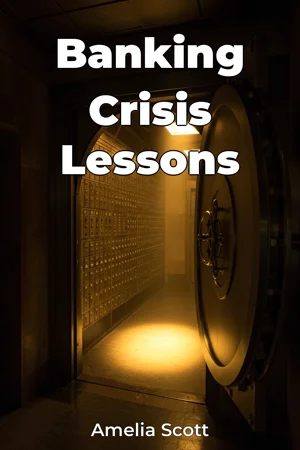
Why do banking crises continue to plague the global economy despite decades of regulatory reforms and increased financial sophistication? "Banking Crisis Lessons" delves into the recurring nature of major financial crises, focusing on the systemic risks inherent in modern banking systems and examining the effectiveness of various preventive measures. This book is essential because understanding these crises, their causes, and potential solutions is crucial for policymakers, financial professionals, and anyone seeking to navigate an increasingly volatile economic landscape. This book explores two key topics: systemic risk and crisis prevention. Systemic risk, the risk that the failure of one financial institution can trigger a cascade of failures throughout the entire system, is a central theme. The book also deeply investigates preventive measures such as regulation, supervision, and early intervention strategies designed to mitigate the likelihood and impact of these crises. The book provides a historical context, examining the evolution of banking regulation and the interconnectedness of global financial markets. A basic understanding of financial instruments, banking operations, and macroeconomic principles will be helpful for the reader, although the core concepts are explained clearly. The central argument of "Banking Crisis Lessons" is that while significant progress has been made in understanding and managing financial risk, inherent vulnerabilities within the global banking system continue to create opportunities for crises to emerge. Furthermore, the book posits that a deeper understanding of past crises, and honest evaluation of both successes and failures, is vital for developing more effective strategies for preventing future instability. The book unfolds in three parts. The first part introduces the fundamental concepts of banking crises, systemic risk, and the role of regulation. The second section analyzes select historical examples, including the Great Depression, the Savings and Loan crisis of the 1980s, and the 2008 Global Financial Crisis. These case studies dissect the specific factors that led to each crisis, evaluate the responses of policymakers, and draw out key lessons. The final section synthesizes these lessons to assess the effectiveness of current regulatory frameworks and proposes potential improvements for preventing future crises, focusing on macroprudential policies and international cooperation. The analysis presented relies on a range of evidence, including historical financial data, regulatory reports, academic studies, and case studies of specific banks and financial institutions. Where applicable, we point to limitations in the available data. The book also touches on connections to political science, exploring the political pressures that can influence regulatory decisions, and sociology, examining the role of herd behavior and groupthink in financial bubbles. Furthermore, the work connects to the field of international relations by investigating the role of international institutions in managing global financial stability. "Banking Crisis Lessons" stands out due to its comparative analysis of diverse historical crises and its focus on translating academic research into practical policy implications. The book avoids complex mathematical models where possible and instead prioritizes clear explanations and actionable insights. Written in a professional and accessible style, the book targets a broad audience, including students of economics and finance, financial professionals, policymakers, and anyone interested in understanding the dynamics of the global financial system. It offers valuable insights for those seeking to understand the risks and opportunities in today's financial world. As a work of economic history and financial analysis, the book adheres to the genre's conventions of rigorous research, clear argumentation, and evidence-based conclusions. It provides a comprehensive overview of the subject, while acknowledging that a complete analysis of every banking crisis and potential solution is beyond its scope. Ultimately, this book offers insights applicable to real-world scenarios. Policymakers can use the lessons learned to refine regulatory frameworks and improve crisis management strategies. Financial professionals can use the insights to better assess and manage risk. Anyone involved in the financial markets will be better informed and more prepared for future challenges. The book also addresses controversies such as the optimal level of regulation, the role of moral hazard in encouraging risk-taking, and the effectiveness of international cooperation in managing global financial stability.
Why do banking crises continue to plague the global economy despite decades of regulatory reforms and increased financial sophistication? "Banking Crisis Lessons" delves into the recurring nature of major financial crises, focusing on the systemic risks inherent in modern banking systems and examining the effectiveness of various preventive measures. This book is essential because understanding these crises, their causes, and potential solutions is crucial for policymakers, financial professionals, and anyone seeking to navigate an increasingly volatile economic landscape. This book explores two key topics: systemic risk and crisis prevention. Systemic risk, the risk that the failure of one financial institution can trigger a cascade of failures throughout the entire system, is a central theme. The book also deeply investigates preventive measures such as regulation, supervision, and early intervention strategies designed to mitigate the likelihood and impact of these crises. The book provides a historical context, examining the evolution of banking regulation and the interconnectedness of global financial markets. A basic understanding of financial instruments, banking operations, and macroeconomic principles will be helpful for the reader, although the core concepts are explained clearly. The central argument of "Banking Crisis Lessons" is that while significant progress has been made in understanding and managing financial risk, inherent vulnerabilities within the global banking system continue to create opportunities for crises to emerge. Furthermore, the book posits that a deeper understanding of past crises, and honest evaluation of both successes and failures, is vital for developing more effective strategies for preventing future instability. The book unfolds in three parts. The first part introduces the fundamental concepts of banking crises, systemic risk, and the role of regulation. The second section analyzes select historical examples, including the Great Depression, the Savings and Loan crisis of the 1980s, and the 2008 Global Financial Crisis. These case studies dissect the specific factors that led to each crisis, evaluate the responses of policymakers, and draw out key lessons. The final section synthesizes these lessons to assess the effectiveness of current regulatory frameworks and proposes potential improvements for preventing future crises, focusing on macroprudential policies and international cooperation. The analysis presented relies on a range of evidence, including historical financial data, regulatory reports, academic studies, and case studies of specific banks and financial institutions. Where applicable, we point to limitations in the available data. The book also touches on connections to political science, exploring the political pressures that can influence regulatory decisions, and sociology, examining the role of herd behavior and groupthink in financial bubbles. Furthermore, the work connects to the field of international relations by investigating the role of international institutions in managing global financial stability. "Banking Crisis Lessons" stands out due to its comparative analysis of diverse historical crises and its focus on translating academic research into practical policy implications. The book avoids complex mathematical models where possible and instead prioritizes clear explanations and actionable insights. Written in a professional and accessible style, the book targets a broad audience, including students of economics and finance, financial professionals, policymakers, and anyone interested in understanding the dynamics of the global financial system. It offers valuable insights for those seeking to understand the risks and opportunities in today's financial world. As a work of economic history and financial analysis, the book adheres to the genre's conventions of rigorous research, clear argumentation, and evidence-based conclusions. It provides a comprehensive overview of the subject, while acknowledging that a complete analysis of every banking crisis and potential solution is beyond its scope. Ultimately, this book offers insights applicable to real-world scenarios. Policymakers can use the lessons learned to refine regulatory frameworks and improve crisis management strategies. Financial professionals can use the insights to better assess and manage risk. Anyone involved in the financial markets will be better informed and more prepared for future challenges. The book also addresses controversies such as the optimal level of regulation, the role of moral hazard in encouraging risk-taking, and the effectiveness of international cooperation in managing global financial stability.
"Banking Crisis Lessons" explores the persistent challenge of banking crises in the global economy, despite regulatory efforts. It emphasizes the critical role of systemic risk, where the failure of one institution can trigger widespread collapse. The book examines various crisis prevention measures, such as enhanced regulation and early intervention, to mitigate these risks. Understanding that these crises is essential for policymakers, financial professionals, and anyone navigating economic volatility. The book adopts a historical perspective, analyzing past events like the Great Depression and the 2008 Global Financial Crisis to derive practical lessons. It argues that inherent vulnerabilities in the global banking system persist, creating opportunities for new crises. By synthesizing historical data, regulatory reports, and academic studies, "Banking Crisis Lessons" assesses the effectiveness of current regulatory frameworks and suggests improvements, including macroprudential policies and international cooperation. This book is valuable for translating academic research into actionable policy. The book progresses by first introducing fundamental concepts, then analyzing historical case studies, and finally synthesizing lessons to improve regulatory frameworks. It avoids complex models, prioritizing clear insights for a broad audience, including students, professionals, and policymakers interested in understanding the dynamics and risks of the global financial system.
Book Details
ISBN
9788233978730
Publisher
Publifye AS
Your Licenses
You don't own any licenses for this book
Purchase a license below to unlock this book and download the EPUB.
Purchase License
Select a tier to unlock this book
Need bulk licensing?
Contact us for enterprise agreements.