
About This Book
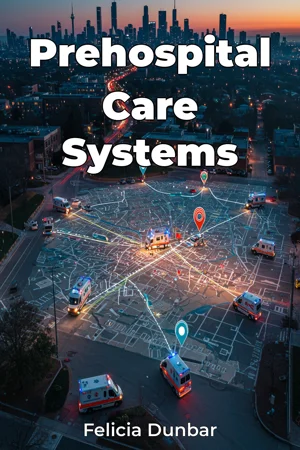
How can we optimize prehospital care systems to save more lives? This book, "Prehospital Care Systems," delves into the complexities of ambulance services and emergency response frameworks, examining their structure, function, and impact on public health outcomes. These systems are critical components of healthcare, often representing the first point of contact for individuals experiencing medical emergencies. Understanding their intricacies is paramount for healthcare professionals, policymakers, and anyone seeking to improve the effectiveness and efficiency of emergency medical services. The book's central argument is that a comprehensive, integrated approach to prehospital care, incorporating evidence-based practices and data-driven decision-making, is essential for maximizing patient survival and minimizing morbidity. We explore this argument by first defining prehospital care and its historical evolution. We then dissect the various components of modern emergency response systems, including dispatch protocols, ambulance staffing models, equipment standards, and communication networks. This foundational knowledge provides the context for subsequent analyses of system performance. A significant portion of the book is dedicated to response-time statistics. While acknowledging the limitations of response time as a singular metric, we analyze available data to identify trends, disparities, and areas for improvement. We delve into factors that influence response times, such as geographic location, population density, traffic patterns, and resource allocation strategies. This analysis is supported by research from diverse sources, including government reports, academic studies, and case studies from various regions. We investigate the relationship between response times and patient outcomes for time-sensitive conditions such as cardiac arrest, stroke, and trauma. The book is structured to provide a logical progression of knowledge. Following the introductory sections, we explore key topics such as the role of technology in prehospital care, including telemedicine and advanced communication systems; the ethical and legal considerations that govern emergency medical practice; and the impact of training and education on the competence of prehospital providers. We also examine the challenges of providing prehospital care in rural and underserved communities. The book culminates with a discussion of best practices and recommendations for improving prehospital care systems at the local, regional, and national levels. "Prehospital Care Systems" draws upon research from the fields of emergency medicine, public health, healthcare administration, and sociology. This interdisciplinary approach allows for a comprehensive understanding of the multifaceted challenges and opportunities in prehospital care. For example, public health principles inform strategies for prevention and early intervention, while healthcare administration concepts are applied to optimize resource allocation and system efficiency. This book distinguishes itself by offering a holistic perspective on prehospital care, moving beyond a purely clinical focus to encompass the broader social, economic, and policy factors that influence system performance. The tone is academic yet accessible, blending rigorous analysis with practical insights. The target audience includes paramedics, emergency medical technicians (EMTs), nurses, physicians, healthcare administrators, public health officials, and policymakers involved in emergency medical services. It will also appeal to students in related fields such as public health, nursing, and emergency management. The scope of the book is intentionally broad, covering a wide range of topics related to prehospital care systems. However, it does not delve into specific treatment protocols, which are addressed in more specialized clinical texts. The information presented in this book has real-world applications for improving patient care and optimizing resource allocation. Emergency medical service agencies can use the data and analysis to identify areas for improvement and develop strategies to enhance their performance. Policymakers can use the information to inform decisions about funding, regulation, and system design. "Prehospital Care Systems" also touches upon ongoing debates in the field, such as the optimal level of prehospital care, the appropriate use of advanced technologies, and the role of community paramedicine. By presenting different perspectives on these issues, the book encourages critical thinking and informed decision-making.
How can we optimize prehospital care systems to save more lives? This book, "Prehospital Care Systems," delves into the complexities of ambulance services and emergency response frameworks, examining their structure, function, and impact on public health outcomes. These systems are critical components of healthcare, often representing the first point of contact for individuals experiencing medical emergencies. Understanding their intricacies is paramount for healthcare professionals, policymakers, and anyone seeking to improve the effectiveness and efficiency of emergency medical services. The book's central argument is that a comprehensive, integrated approach to prehospital care, incorporating evidence-based practices and data-driven decision-making, is essential for maximizing patient survival and minimizing morbidity. We explore this argument by first defining prehospital care and its historical evolution. We then dissect the various components of modern emergency response systems, including dispatch protocols, ambulance staffing models, equipment standards, and communication networks. This foundational knowledge provides the context for subsequent analyses of system performance. A significant portion of the book is dedicated to response-time statistics. While acknowledging the limitations of response time as a singular metric, we analyze available data to identify trends, disparities, and areas for improvement. We delve into factors that influence response times, such as geographic location, population density, traffic patterns, and resource allocation strategies. This analysis is supported by research from diverse sources, including government reports, academic studies, and case studies from various regions. We investigate the relationship between response times and patient outcomes for time-sensitive conditions such as cardiac arrest, stroke, and trauma. The book is structured to provide a logical progression of knowledge. Following the introductory sections, we explore key topics such as the role of technology in prehospital care, including telemedicine and advanced communication systems; the ethical and legal considerations that govern emergency medical practice; and the impact of training and education on the competence of prehospital providers. We also examine the challenges of providing prehospital care in rural and underserved communities. The book culminates with a discussion of best practices and recommendations for improving prehospital care systems at the local, regional, and national levels. "Prehospital Care Systems" draws upon research from the fields of emergency medicine, public health, healthcare administration, and sociology. This interdisciplinary approach allows for a comprehensive understanding of the multifaceted challenges and opportunities in prehospital care. For example, public health principles inform strategies for prevention and early intervention, while healthcare administration concepts are applied to optimize resource allocation and system efficiency. This book distinguishes itself by offering a holistic perspective on prehospital care, moving beyond a purely clinical focus to encompass the broader social, economic, and policy factors that influence system performance. The tone is academic yet accessible, blending rigorous analysis with practical insights. The target audience includes paramedics, emergency medical technicians (EMTs), nurses, physicians, healthcare administrators, public health officials, and policymakers involved in emergency medical services. It will also appeal to students in related fields such as public health, nursing, and emergency management. The scope of the book is intentionally broad, covering a wide range of topics related to prehospital care systems. However, it does not delve into specific treatment protocols, which are addressed in more specialized clinical texts. The information presented in this book has real-world applications for improving patient care and optimizing resource allocation. Emergency medical service agencies can use the data and analysis to identify areas for improvement and develop strategies to enhance their performance. Policymakers can use the information to inform decisions about funding, regulation, and system design. "Prehospital Care Systems" also touches upon ongoing debates in the field, such as the optimal level of prehospital care, the appropriate use of advanced technologies, and the role of community paramedicine. By presenting different perspectives on these issues, the book encourages critical thinking and informed decision-making.
"Prehospital Care Systems" offers a comprehensive look at emergency medical services, examining how ambulance services and emergency response frameworks impact public health. It emphasizes that an integrated, evidence-based approach is crucial for improving patient outcomes in medical emergencies. Interestingly, the book analyzes response-time statistics, acknowledging their limitations while exploring factors like geography and population density that influence them. This analysis extends to examining the correlation between response times and patient outcomes for conditions like cardiac arrest and stroke. The book progresses logically, starting with the historical evolution of prehospital care and dissecting modern emergency response systems. It then explores the role of technology, ethical and legal considerations, and the challenges of rural prehospital care. By drawing upon research from emergency medicine, public health, and healthcare administration, the book provides a holistic understanding of the multifaceted challenges and opportunities within prehospital care systems. This book uniquely blends rigorous analysis with practical insights, making it valuable for paramedics, EMTs, healthcare administrators, and policymakers. It moves beyond a clinical focus to consider the broader social and economic factors influencing emergency medical services, ultimately providing best practices and recommendations for improving prehospital care at various levels.
Book Details
ISBN
9788233978549
Publisher
Publifye AS
Your Licenses
You don't own any licenses for this book
Purchase a license below to unlock this book and download the EPUB.
Purchase License
Select a tier to unlock this book
Need bulk licensing?
Contact us for enterprise agreements.