
About This Book
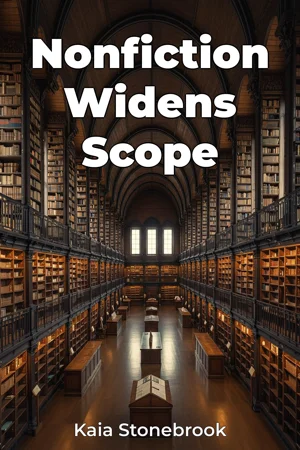
Have you ever considered the sheer breadth of human knowledge captured within the pages of nonfiction? This book, "Nonfiction Widens Scope," serves as an exploration of how nonfiction transcends traditional disciplinary boundaries, attracting readers from all walks of life with its diverse subject matter. We delve into how history and science, two cornerstones of human understanding, exemplify this expansive reach. These fields, while distinct, are frequently interconnected, shaping our present and informing our future. Why are history and science so crucial, and why does nonfiction serve as such a vital conduit for their dissemination? History provides the context for our present, offering lessons learned and patterns observed across generations. Science, conversely, offers a framework for understanding the natural world, driving innovation and progress. Nonfiction, in its myriad forms, makes these complex topics accessible to a broad audience. To fully appreciate the scope of nonfiction, one must acknowledge the historical development of these genres. From ancient chronicles to groundbreaking scientific treatises, the written word has always played a pivotal role in documenting and disseminating knowledge. While no specific prerequisite knowledge is absolutely necessary for this book, some familiarity with basic historical and scientific concepts will enhance the reading experience. The central argument of "Nonfiction Widens Scope" is that nonfiction, particularly in the realms of history and science, acts as a crucial bridge between specialized knowledge and public understanding. This is vital because an informed citizenry is essential for a healthy democracy and for making sound decisions about the future. The book's structure begins with an introduction to the diverse landscape of nonfiction, highlighting its capacity to encompass a wide array of subjects. It then pivots to an in-depth examination of historical narratives, exploring how nonfiction authors reconstruct past events, analyze primary sources, and present compelling accounts of bygone eras. A significant portion of the book is dedicated to the realm of scientific nonfiction, examining how authors translate complex scientific concepts, report on cutting-edge research, and engage readers in the wonders of the natural world. Finally, the book culminates in a discussion of the practical implications of nonfiction, emphasizing its role in education, public policy, and individual empowerment. Throughout "Nonfiction Widens Scope," we draw upon a variety of evidence, including excerpts from influential nonfiction works, analyses of publishing trends, and case studies of successful nonfiction authors. We will also examine data from library circulation statistics and book sales to illustrate the popularity and impact of nonfiction across different demographics. The connections between history and science extend beyond their shared reliance on evidence and analysis. History often provides the social and political context for scientific discoveries, while science frequently offers new tools and methods for historical research. Furthermore, both fields intersect with philosophy, particularly in questions of epistemology and ethics. These interdisciplinary connections enrich the book's argument by demonstrating the interconnectedness of knowledge. This book adopts a clear, accessible writing style, aiming to make complex ideas understandable to a broad audience. While grounded in scholarly research, the tone is conversational and engaging, avoiding jargon and technical language whenever possible. The intended readership includes students, educators, librarians, writers, and anyone with an interest in history, science, or the power of nonfiction. "Nonfiction Widens Scope" acknowledges the limitations of focusing solely on history and science. While these fields are representative of the breadth of nonfiction, they do not encompass its entirety. Other genres, such as biography, memoir, and self-help, also play significant roles in shaping public understanding and enriching individual lives. This book aims to provide a framework for understanding the broader landscape of nonfiction, not an exhaustive survey of every subgenre. The information presented in this book has real-world applications for readers. It can inform their choices as consumers of information, helping them to critically evaluate sources and distinguish between credible and unreliable accounts. It can also inspire them to explore new areas of knowledge, to engage in civic discourse, and to become lifelong learners. By exploring the diverse landscape of nonfiction, "Nonfiction Widens Scope" aims to illuminate the power of knowledge and its capacity to shape a more informed and engaged citizenry.
Have you ever considered the sheer breadth of human knowledge captured within the pages of nonfiction? This book, "Nonfiction Widens Scope," serves as an exploration of how nonfiction transcends traditional disciplinary boundaries, attracting readers from all walks of life with its diverse subject matter. We delve into how history and science, two cornerstones of human understanding, exemplify this expansive reach. These fields, while distinct, are frequently interconnected, shaping our present and informing our future. Why are history and science so crucial, and why does nonfiction serve as such a vital conduit for their dissemination? History provides the context for our present, offering lessons learned and patterns observed across generations. Science, conversely, offers a framework for understanding the natural world, driving innovation and progress. Nonfiction, in its myriad forms, makes these complex topics accessible to a broad audience. To fully appreciate the scope of nonfiction, one must acknowledge the historical development of these genres. From ancient chronicles to groundbreaking scientific treatises, the written word has always played a pivotal role in documenting and disseminating knowledge. While no specific prerequisite knowledge is absolutely necessary for this book, some familiarity with basic historical and scientific concepts will enhance the reading experience. The central argument of "Nonfiction Widens Scope" is that nonfiction, particularly in the realms of history and science, acts as a crucial bridge between specialized knowledge and public understanding. This is vital because an informed citizenry is essential for a healthy democracy and for making sound decisions about the future. The book's structure begins with an introduction to the diverse landscape of nonfiction, highlighting its capacity to encompass a wide array of subjects. It then pivots to an in-depth examination of historical narratives, exploring how nonfiction authors reconstruct past events, analyze primary sources, and present compelling accounts of bygone eras. A significant portion of the book is dedicated to the realm of scientific nonfiction, examining how authors translate complex scientific concepts, report on cutting-edge research, and engage readers in the wonders of the natural world. Finally, the book culminates in a discussion of the practical implications of nonfiction, emphasizing its role in education, public policy, and individual empowerment. Throughout "Nonfiction Widens Scope," we draw upon a variety of evidence, including excerpts from influential nonfiction works, analyses of publishing trends, and case studies of successful nonfiction authors. We will also examine data from library circulation statistics and book sales to illustrate the popularity and impact of nonfiction across different demographics. The connections between history and science extend beyond their shared reliance on evidence and analysis. History often provides the social and political context for scientific discoveries, while science frequently offers new tools and methods for historical research. Furthermore, both fields intersect with philosophy, particularly in questions of epistemology and ethics. These interdisciplinary connections enrich the book's argument by demonstrating the interconnectedness of knowledge. This book adopts a clear, accessible writing style, aiming to make complex ideas understandable to a broad audience. While grounded in scholarly research, the tone is conversational and engaging, avoiding jargon and technical language whenever possible. The intended readership includes students, educators, librarians, writers, and anyone with an interest in history, science, or the power of nonfiction. "Nonfiction Widens Scope" acknowledges the limitations of focusing solely on history and science. While these fields are representative of the breadth of nonfiction, they do not encompass its entirety. Other genres, such as biography, memoir, and self-help, also play significant roles in shaping public understanding and enriching individual lives. This book aims to provide a framework for understanding the broader landscape of nonfiction, not an exhaustive survey of every subgenre. The information presented in this book has real-world applications for readers. It can inform their choices as consumers of information, helping them to critically evaluate sources and distinguish between credible and unreliable accounts. It can also inspire them to explore new areas of knowledge, to engage in civic discourse, and to become lifelong learners. By exploring the diverse landscape of nonfiction, "Nonfiction Widens Scope" aims to illuminate the power of knowledge and its capacity to shape a more informed and engaged citizenry.
"Nonfiction Widens Scope" explores how nonfiction literature acts as a vital bridge connecting specialized knowledge with public understanding, particularly within the realms of science and history. The book emphasizes the crucial role of nonfiction in disseminating knowledge and fostering an informed citizenry, essential for a healthy democracy. It highlights how historical narratives provide context and lessons from the past, while scientific concepts offer frameworks for understanding the natural world. The book progresses by first introducing the diverse landscape of nonfiction, then delving into historical narratives and scientific nonfiction. Notably, the interdisciplinary connections between history and science are explored, demonstrating their shared reliance on evidence and analysis. For instance, history provides the social context for scientific discoveries, while science offers new tools for historical research. This approach enriches the book's argument by showcasing the interconnectedness of knowledge. The book adopts an accessible writing style, making complex ideas understandable to a broad audience through examples and analogies. It underscores the real-world applications of nonfiction, from informing consumer choices to inspiring lifelong learning. It serves as a valuable resource for students, educators, and anyone interested in understanding the power of nonfiction in shaping an informed and engaged citizenry.
Book Details
ISBN
9788233977597
Publisher
Publifye AS
Your Licenses
You don't own any licenses for this book
Purchase a license below to unlock this book and download the EPUB.
Purchase License
Select a tier to unlock this book
Need bulk licensing?
Contact us for enterprise agreements.