
About This Book
In the realm of wilderness survival, fire represents far more than just warmth and light; it is a fundamental tool for safety, signaling, and psychological well-being. "Emergency Fire Making" offers a comprehensive exploration of methods to create fire using minimal tools, drawing upon documented wilderness survival techniques to empower readers with life-saving skills. This book focuses on three key topics: friction-based fire starting, utilizing natural tinders and kindling, and constructing effective fire lays for various environmental conditions. Understanding these elements is crucial because, in a survival situation, access to conventional tools like matches or lighters is not guaranteed. Proficiency in these techniques can be the difference between enduring hardship and thriving. Historically, humans have relied on fire for survival, with indigenous cultures developing sophisticated methods tailored to their specific environments. This book synthesizes these traditional techniques with modern scientific understanding of combustion and material properties. While no prior knowledge is strictly required, a basic understanding of outdoor environments and safety precautions will enhance the reader's learning experience. The central argument of "Emergency Fire Making" is that the ability to create fire with minimal resources is an attainable skill that significantly enhances self-reliance and resilience in emergency situations. This skill is not merely a historical curiosity but a vital component of modern preparedness. The book begins by introducing the fundamental principles of fire starting, explaining the fire triangle and the importance of oxygen, heat, and fuel. It then progresses systematically through various friction-based methods, such as the bow drill, hand drill, and fire plow, providing detailed instructions and visual aids for each. A significant portion of the book is dedicated to identifying and preparing suitable natural tinders and kindling, covering a wide range of materials found in diverse environments. The final sections focus on fire lay construction, teaching readers how to build fires that are efficient, safe, and appropriate for different weather conditions. It culminates in a comprehensive guide to troubleshooting common fire-starting challenges and adapting techniques to specific scenarios. The information presented is supported by extensive research into documented survival accounts, ethnographic studies of indigenous fire-making practices, and experimental testing of various techniques. Original photographs and illustrations demonstrate each step clearly. "Emergency Fire Making" connects to several other fields, including botany (identifying suitable tinder), physics (understanding combustion), and anthropology (studying traditional survival practices). These interdisciplinary connections enrich the book's argument by providing a holistic understanding of fire making. This book presents a unique approach by emphasizing the practical application of time-tested methods in a modern context. Rather than focusing on purely theoretical knowledge, it offers hands-on instructions and real-world examples. The tone is informative and accessible, aiming to empower readers with practical skills rather than overwhelm them with technical jargon. The target audience includes outdoor enthusiasts, survivalists, campers, hikers, and anyone interested in developing self-reliance skills. This book is valuable to them because it provides the knowledge and skills necessary to create fire in emergency situations, potentially saving lives. As a "Crafts & Hobbies" book, "Emergency Fire Making" provides step-by-step instructions and practical guidance, enabling readers to master a valuable skill. Its "Adventure" genre appeal lies in its focus on self-reliance and preparedness for challenging outdoor situations. The scope of the book is limited to fire-making techniques that rely on minimal tools and natural resources. It does not cover advanced fire-starting technologies or the use of specialized equipment. The information in "Emergency Fire Making" can be applied in a variety of real-world situations, from wilderness survival to emergency preparedness to simply enjoying a more self-sufficient outdoor experience. While the book touches on various techniques, it acknowledges that the most effective method often depends on the specific environment and available materials, highlighting the importance of adaptability and experimentation.
In the realm of wilderness survival, fire represents far more than just warmth and light; it is a fundamental tool for safety, signaling, and psychological well-being. "Emergency Fire Making" offers a comprehensive exploration of methods to create fire using minimal tools, drawing upon documented wilderness survival techniques to empower readers with life-saving skills. This book focuses on three key topics: friction-based fire starting, utilizing natural tinders and kindling, and constructing effective fire lays for various environmental conditions. Understanding these elements is crucial because, in a survival situation, access to conventional tools like matches or lighters is not guaranteed. Proficiency in these techniques can be the difference between enduring hardship and thriving. Historically, humans have relied on fire for survival, with indigenous cultures developing sophisticated methods tailored to their specific environments. This book synthesizes these traditional techniques with modern scientific understanding of combustion and material properties. While no prior knowledge is strictly required, a basic understanding of outdoor environments and safety precautions will enhance the reader's learning experience. The central argument of "Emergency Fire Making" is that the ability to create fire with minimal resources is an attainable skill that significantly enhances self-reliance and resilience in emergency situations. This skill is not merely a historical curiosity but a vital component of modern preparedness. The book begins by introducing the fundamental principles of fire starting, explaining the fire triangle and the importance of oxygen, heat, and fuel. It then progresses systematically through various friction-based methods, such as the bow drill, hand drill, and fire plow, providing detailed instructions and visual aids for each. A significant portion of the book is dedicated to identifying and preparing suitable natural tinders and kindling, covering a wide range of materials found in diverse environments. The final sections focus on fire lay construction, teaching readers how to build fires that are efficient, safe, and appropriate for different weather conditions. It culminates in a comprehensive guide to troubleshooting common fire-starting challenges and adapting techniques to specific scenarios. The information presented is supported by extensive research into documented survival accounts, ethnographic studies of indigenous fire-making practices, and experimental testing of various techniques. Original photographs and illustrations demonstrate each step clearly. "Emergency Fire Making" connects to several other fields, including botany (identifying suitable tinder), physics (understanding combustion), and anthropology (studying traditional survival practices). These interdisciplinary connections enrich the book's argument by providing a holistic understanding of fire making. This book presents a unique approach by emphasizing the practical application of time-tested methods in a modern context. Rather than focusing on purely theoretical knowledge, it offers hands-on instructions and real-world examples. The tone is informative and accessible, aiming to empower readers with practical skills rather than overwhelm them with technical jargon. The target audience includes outdoor enthusiasts, survivalists, campers, hikers, and anyone interested in developing self-reliance skills. This book is valuable to them because it provides the knowledge and skills necessary to create fire in emergency situations, potentially saving lives. As a "Crafts & Hobbies" book, "Emergency Fire Making" provides step-by-step instructions and practical guidance, enabling readers to master a valuable skill. Its "Adventure" genre appeal lies in its focus on self-reliance and preparedness for challenging outdoor situations. The scope of the book is limited to fire-making techniques that rely on minimal tools and natural resources. It does not cover advanced fire-starting technologies or the use of specialized equipment. The information in "Emergency Fire Making" can be applied in a variety of real-world situations, from wilderness survival to emergency preparedness to simply enjoying a more self-sufficient outdoor experience. While the book touches on various techniques, it acknowledges that the most effective method often depends on the specific environment and available materials, highlighting the importance of adaptability and experimentation.
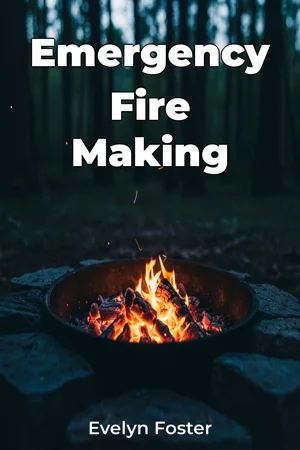
"Emergency Fire Making" teaches essential wilderness survival skills, focusing on creating fire with minimal tools. The book details the crucial role of fire for warmth, signaling, and psychological comfort in emergency situations. Readers will discover how indigenous cultures developed unique fire-making methods and learn about the fire triangle, emphasizing the need for oxygen, heat, and fuel. This guide progresses logically, first exploring friction-based techniques like the bow drill and hand drill, supported by clear visuals. It then delves into identifying and preparing natural tinders and kindling from diverse environments. Finally, it presents fire lay construction, teaching how to build efficient and safe fires suited to different weather conditions. By mastering these techniques, readers gain self-reliance and preparedness, transforming what might be a daunting survival scenario into a manageable challenge.
Book Details
ISBN
9788233976651
Publisher
Publifye AS
Your Licenses
You don't own any licenses for this book
Purchase a license below to unlock this book and download the EPUB.
Purchase License
Select a tier to unlock this book
Need bulk licensing?
Contact us for enterprise agreements.