
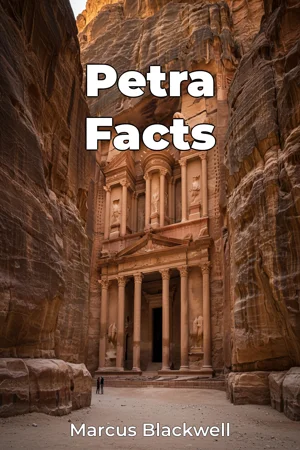
About This Book
Have you ever wondered how an entire metropolis could vanish from the map for centuries, only to be rediscovered as a breathtaking testament to human ingenuity? "Petra Facts" unveils the captivating story of Petra, the lost city carved into the sandstone cliffs of Jordan, revealing the secrets behind its architectural marvels and its mysterious disappearance from historical record. This book explores the intricate history, awe-inspiring architecture, and complex social structure of the Nabataean civilization that created Petra. We will dissect three primary facets of Petra's existence: the geological and environmental factors that shaped its location and construction, the unique blend of architectural styles reflecting the Nabataeans' diverse cultural interactions, and the economic and political strategies that allowed the city to flourish and ultimately decline. Understanding these topics is crucial to appreciating Petra not merely as a beautiful ruin, but as a complex urban center shaped by specific historical forces and environmental conditions. To fully grasp Petra's significance, it is important to understand the historical context of the region. The Nabataeans, originally nomadic traders, skillfully navigated the political landscape of the ancient Near East, interacting with empires like the Romans and the Greeks. This book assumes a basic familiarity with the geography of the Middle East and a general understanding of ancient trading routes, which can be easily acquired. The central argument of "Petra Facts" posits that Petra's enduring appeal lies not only in its aesthetic grandeur but also in its representation of human adaptability and cultural exchange. It demonstrates how the Nabataeans synthesized various cultural influences into a unique architectural and engineering paradigm, creating a city that was both a functional trading hub and a powerful symbol of their identity. The book is structured to provide a comprehensive understanding of Petra. It begins with an introduction to the Nabataean civilization and the geographical context of Petra. It then delves into the city's architectural wonders, analyzing the iconic Treasury (Al-Khazneh), the Monastery (Ad Deir), and the Siq, the narrow gorge that serves as the main entrance. Each structure is examined in terms of its design, function, and cultural significance. The book further explores Petra as a center of trade, examining the city's water management systems and its role in facilitating the exchange of goods between the East and West. Finally, the book addresses the factors that led to Petra's decline and eventual rediscovery in the 19th century, culminating in a discussion of its modern-day significance as a UNESCO World Heritage site and a symbol of Jordan's rich cultural heritage. "Petra Facts" draws upon a variety of sources, including archaeological reports, historical texts, and geological surveys. It incorporates recent discoveries and interpretations to provide an up-to-date and nuanced understanding of Petra. Unique data sets, such as 3D models of the city and analyses of Nabataean pottery, are utilized to support the arguments presented. The study of Petra inherently connects to multiple disciplines. Archaeology provides the physical evidence for understanding Nabataean life. Architectural history allows for the analysis of Petra's unique building styles, demonstrating confluence of Hellenistic and Near Eastern forms. Finally, economic history sheds light on Petra's role in regional and global trade networks, with a particular focus on commodities like frankincense and myrrh. These interdisciplinary connections enrich the book's argument by placing Petra within a broader historical and cultural context. This book offers a balanced and objective perspective on Petra, moving beyond romanticized portrayals to present a fact-based analysis of the city's history, architecture, and social structure. The tone and writing style are accessible and engaging, making complex information understandable for a wide audience. The book's approach is factual, avoiding conjecture and sensationalism. The target audience includes history enthusiasts, architecture buffs, travelers planning a visit to Petra, and students studying Middle Eastern history or archaeology. This book offers valuable insights into a remarkable civilization and a unique archaeological site. As a work of non-fiction, "Petra Facts" adheres to the principles of accuracy, objectivity, and evidence-based analysis. It avoids fictionalization or speculation, focusing instead on presenting verifiable information. The scope is focused on Petra itself and the Nabataean civilization, with limited discussion of broader historical events beyond their direct relevance to the city. The information in "Petra Facts" can be applied in various practical ways. It provides a deeper understanding of cultural heritage preservation and the challenges of managing archaeological sites. It also offers insights into sustainable urban planning and the importance of water management in arid environments. While the main narrative focuses on established facts, the book also acknowledges ongoing debates surrounding aspects of Nabataean culture and Petra's history. These include discussions about the precise dating of certain structures and interpretations of Nabataean religious practices providing a comprehensive view of the subject.
Have you ever wondered how an entire metropolis could vanish from the map for centuries, only to be rediscovered as a breathtaking testament to human ingenuity? "Petra Facts" unveils the captivating story of Petra, the lost city carved into the sandstone cliffs of Jordan, revealing the secrets behind its architectural marvels and its mysterious disappearance from historical record. This book explores the intricate history, awe-inspiring architecture, and complex social structure of the Nabataean civilization that created Petra. We will dissect three primary facets of Petra's existence: the geological and environmental factors that shaped its location and construction, the unique blend of architectural styles reflecting the Nabataeans' diverse cultural interactions, and the economic and political strategies that allowed the city to flourish and ultimately decline. Understanding these topics is crucial to appreciating Petra not merely as a beautiful ruin, but as a complex urban center shaped by specific historical forces and environmental conditions. To fully grasp Petra's significance, it is important to understand the historical context of the region. The Nabataeans, originally nomadic traders, skillfully navigated the political landscape of the ancient Near East, interacting with empires like the Romans and the Greeks. This book assumes a basic familiarity with the geography of the Middle East and a general understanding of ancient trading routes, which can be easily acquired. The central argument of "Petra Facts" posits that Petra's enduring appeal lies not only in its aesthetic grandeur but also in its representation of human adaptability and cultural exchange. It demonstrates how the Nabataeans synthesized various cultural influences into a unique architectural and engineering paradigm, creating a city that was both a functional trading hub and a powerful symbol of their identity. The book is structured to provide a comprehensive understanding of Petra. It begins with an introduction to the Nabataean civilization and the geographical context of Petra. It then delves into the city's architectural wonders, analyzing the iconic Treasury (Al-Khazneh), the Monastery (Ad Deir), and the Siq, the narrow gorge that serves as the main entrance. Each structure is examined in terms of its design, function, and cultural significance. The book further explores Petra as a center of trade, examining the city's water management systems and its role in facilitating the exchange of goods between the East and West. Finally, the book addresses the factors that led to Petra's decline and eventual rediscovery in the 19th century, culminating in a discussion of its modern-day significance as a UNESCO World Heritage site and a symbol of Jordan's rich cultural heritage. "Petra Facts" draws upon a variety of sources, including archaeological reports, historical texts, and geological surveys. It incorporates recent discoveries and interpretations to provide an up-to-date and nuanced understanding of Petra. Unique data sets, such as 3D models of the city and analyses of Nabataean pottery, are utilized to support the arguments presented. The study of Petra inherently connects to multiple disciplines. Archaeology provides the physical evidence for understanding Nabataean life. Architectural history allows for the analysis of Petra's unique building styles, demonstrating confluence of Hellenistic and Near Eastern forms. Finally, economic history sheds light on Petra's role in regional and global trade networks, with a particular focus on commodities like frankincense and myrrh. These interdisciplinary connections enrich the book's argument by placing Petra within a broader historical and cultural context. This book offers a balanced and objective perspective on Petra, moving beyond romanticized portrayals to present a fact-based analysis of the city's history, architecture, and social structure. The tone and writing style are accessible and engaging, making complex information understandable for a wide audience. The book's approach is factual, avoiding conjecture and sensationalism. The target audience includes history enthusiasts, architecture buffs, travelers planning a visit to Petra, and students studying Middle Eastern history or archaeology. This book offers valuable insights into a remarkable civilization and a unique archaeological site. As a work of non-fiction, "Petra Facts" adheres to the principles of accuracy, objectivity, and evidence-based analysis. It avoids fictionalization or speculation, focusing instead on presenting verifiable information. The scope is focused on Petra itself and the Nabataean civilization, with limited discussion of broader historical events beyond their direct relevance to the city. The information in "Petra Facts" can be applied in various practical ways. It provides a deeper understanding of cultural heritage preservation and the challenges of managing archaeological sites. It also offers insights into sustainable urban planning and the importance of water management in arid environments. While the main narrative focuses on established facts, the book also acknowledges ongoing debates surrounding aspects of Nabataean culture and Petra's history. These include discussions about the precise dating of certain structures and interpretations of Nabataean religious practices providing a comprehensive view of the subject.
"Petra Facts" explores the fascinating story of Petra, the ancient city carved into the Jordanian desert by the Nabataean civilization. This book delves into the unique architecture and complex history of this "lost city", examining how the Nabataeans, originally nomadic traders, skillfully navigated the ancient world's political landscape. It highlights Petra's role as a crucial trading hub and showcases the ingenious water management systems that allowed the city to thrive in an arid environment. The book uncovers how the Nabataeans blended various cultural influences, from the Greeks to the Romans, into a unique architectural style. This resulted in iconic structures like Al-Khazneh (The Treasury) and Ad Deir (The Monastery). Beginning with the Nabataean civilization and Petra's geography, the book progresses through Petra's architectural wonders, its role as a trade center, and the factors contributing to its decline, concluding with its rediscovery and modern significance as a UNESCO World Heritage Site. Drawing upon archaeological reports, historical texts, and geological surveys, "Petra Facts" offers a comprehensive and balanced perspective on Petra. It emphasizes human adaptability and cultural exchange. Through detailed analysis and an accessible writing style, it provides valuable insights for history enthusiasts, architecture buffs, and anyone interested in unraveling the mysteries of this remarkable civilization.
Book Details
ISBN
9788233976088
Publisher
Publifye AS
Your Licenses
You don't own any licenses for this book
Purchase a license below to unlock this book and download the EPUB.
Purchase License
Select a tier to unlock this book
Need bulk licensing?
Contact us for enterprise agreements.