
About This Book
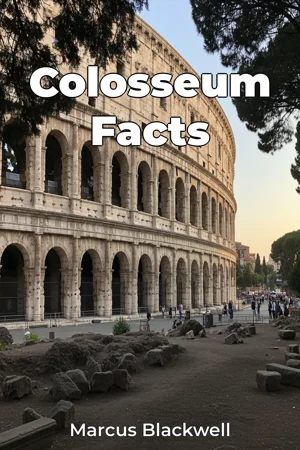
Have you ever wondered how a structure built nearly two thousand years ago continues to captivate and inspire awe in modern society? "Colosseum Facts" delves into the multifaceted history, architectural sophistication, and enduring legacy of Rome's iconic amphitheater. This book explores the Colosseum not merely as a historical artifact, but as a testament to Roman engineering, society, and enduring cultural influence. At its core, this book examines three crucial elements: the Colosseum's construction and architectural design, the spectacles and social dynamics of the gladiatorial combats and public games held within its walls, and its subsequent transformation from a venue of entertainment to a monument of historical and architectural significance. Understanding these aspects provides a comprehensive view of the Colosseum’s place in history and its ongoing relevance. To fully appreciate the monument, we provide essential historical context, detailing the political climate of the Flavian dynasty under which it was built, and the social structures that supported its operation. We explore the Roman fascination with spectacle, the role of gladiators in society, and the engineering feats that enabled the construction of such a massive structure. Prior knowledge of basic Roman history will be beneficial but is not required, as the necessary background is provided. The central argument of "Colosseum Facts" is that the Colosseum stands as a powerful symbol of Roman ingenuity, social complexity, and adaptive reuse throughout history. Its architectural design, the brutal games it hosted, and its later adaptations reflect the changing values and priorities of Western civilization. This book is structured to guide the reader through a sequential exploration of the Colosseum and starts by introducing the initial planning and architectural elements. The book develops its arguments through three major sections. First, we dissect the Colosseum's architectural marvel, examining its innovative use of concrete, its complex system of arches and vaults, and the logistical challenges overcome during its construction. Second, the book analyzes the gladiatorial contests and public games staged within its arena, exploring the social hierarchy, the role of gladiators, and the broader cultural significance of these spectacles. Third, we trace the Colosseum's transformation over the centuries, from its decline following the fall of the Roman Empire to its adaptation for various purposes, including housing, workshops, and religious functions, culminating in its modern status as a major tourist attraction and historical site. The evidence presented throughout this book is drawn from a variety of primary sources, including ancient Roman texts, archaeological findings, and architectural analyses. We also incorporate recent scholarship and present new interpretations of existing data. This book connects to other fields such as sociology through an analysis of social stratification as seen in the seating arrangements during the games, art history and architecture through a discussion of design influences and engineering innovations, and political science through an examination of how spectacles were used for political purposes. These interdisciplinary connections enrich our understanding of the Colosseum and its impact. "Colosseum Facts" offers a clear and fact-based account, avoiding sensationalism and speculation. The writing style is accessible to those with a general interest in history and architecture, while maintaining scholarly rigor. This book provides essential insight for history enthusiasts, architecture students, and anyone intrigued by the legacy of the Roman Empire. The scope of this book is deliberately focused on the Colosseum but also touches on related amphitheaters throughout the Roman empire for the sake of comparison. Readers can apply the insights gained from this book to better understand the relationship between architecture, society, and power, as well as the enduring legacy of the Roman Empire in modern culture. While there is general agreement on the Colosseum's basic history, debates continue regarding the precise number of gladiatorial combats, the specific types of animals used in the shows, and the exact methods of construction. This book addresses these controversies by presenting the different viewpoints alongside the evidence for each.
Have you ever wondered how a structure built nearly two thousand years ago continues to captivate and inspire awe in modern society? "Colosseum Facts" delves into the multifaceted history, architectural sophistication, and enduring legacy of Rome's iconic amphitheater. This book explores the Colosseum not merely as a historical artifact, but as a testament to Roman engineering, society, and enduring cultural influence. At its core, this book examines three crucial elements: the Colosseum's construction and architectural design, the spectacles and social dynamics of the gladiatorial combats and public games held within its walls, and its subsequent transformation from a venue of entertainment to a monument of historical and architectural significance. Understanding these aspects provides a comprehensive view of the Colosseum’s place in history and its ongoing relevance. To fully appreciate the monument, we provide essential historical context, detailing the political climate of the Flavian dynasty under which it was built, and the social structures that supported its operation. We explore the Roman fascination with spectacle, the role of gladiators in society, and the engineering feats that enabled the construction of such a massive structure. Prior knowledge of basic Roman history will be beneficial but is not required, as the necessary background is provided. The central argument of "Colosseum Facts" is that the Colosseum stands as a powerful symbol of Roman ingenuity, social complexity, and adaptive reuse throughout history. Its architectural design, the brutal games it hosted, and its later adaptations reflect the changing values and priorities of Western civilization. This book is structured to guide the reader through a sequential exploration of the Colosseum and starts by introducing the initial planning and architectural elements. The book develops its arguments through three major sections. First, we dissect the Colosseum's architectural marvel, examining its innovative use of concrete, its complex system of arches and vaults, and the logistical challenges overcome during its construction. Second, the book analyzes the gladiatorial contests and public games staged within its arena, exploring the social hierarchy, the role of gladiators, and the broader cultural significance of these spectacles. Third, we trace the Colosseum's transformation over the centuries, from its decline following the fall of the Roman Empire to its adaptation for various purposes, including housing, workshops, and religious functions, culminating in its modern status as a major tourist attraction and historical site. The evidence presented throughout this book is drawn from a variety of primary sources, including ancient Roman texts, archaeological findings, and architectural analyses. We also incorporate recent scholarship and present new interpretations of existing data. This book connects to other fields such as sociology through an analysis of social stratification as seen in the seating arrangements during the games, art history and architecture through a discussion of design influences and engineering innovations, and political science through an examination of how spectacles were used for political purposes. These interdisciplinary connections enrich our understanding of the Colosseum and its impact. "Colosseum Facts" offers a clear and fact-based account, avoiding sensationalism and speculation. The writing style is accessible to those with a general interest in history and architecture, while maintaining scholarly rigor. This book provides essential insight for history enthusiasts, architecture students, and anyone intrigued by the legacy of the Roman Empire. The scope of this book is deliberately focused on the Colosseum but also touches on related amphitheaters throughout the Roman empire for the sake of comparison. Readers can apply the insights gained from this book to better understand the relationship between architecture, society, and power, as well as the enduring legacy of the Roman Empire in modern culture. While there is general agreement on the Colosseum's basic history, debates continue regarding the precise number of gladiatorial combats, the specific types of animals used in the shows, and the exact methods of construction. This book addresses these controversies by presenting the different viewpoints alongside the evidence for each.
"Colosseum Facts" explores Rome's iconic amphitheater, detailing its construction, the spectacles it hosted, and its enduring influence. The book highlights the Colosseum as more than just a historical site; it's a testament to Roman engineering and social dynamics. Intriguingly, the Colosseum's design incorporated innovative uses of concrete and a complex system of arches and vaults, while the seating arrangements reflected the rigid social hierarchy of the time. The book examines the Colosseum's role in Roman society, from gladiatorial contests to public games, and its subsequent transformation through the ages. The book progresses through three major sections, beginning with an examination of the Colosseum's architectural design and innovative engineering. It then analyzes the gladiatorial contests and public games staged within the arena, exploring the social hierarchy and cultural significance of these spectacles. Finally, it traces the Colosseum's transformation over centuries, including its decline and adaptation for various purposes, culminating in its modern status as a major tourist attraction. The book's approach is fact-based, offering essential insight for those interested in Roman history and architecture.
Book Details
ISBN
9788233975975
Publisher
Publifye AS
Your Licenses
You don't own any licenses for this book
Purchase a license below to unlock this book and download the EPUB.
Purchase License
Select a tier to unlock this book
Need bulk licensing?
Contact us for enterprise agreements.