
About This Book
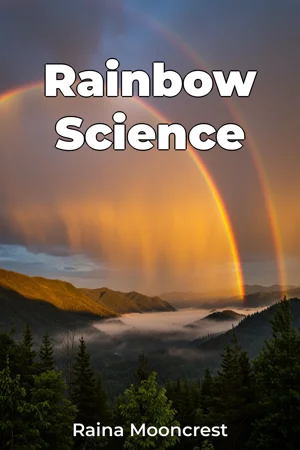
Have you ever stopped to truly consider the science behind the fleeting beauty of a rainbow? This book, "Rainbow Science," delves into the physics that governs the formation, appearance, and diverse variations of these captivating atmospheric phenomena. We will explore the fundamental principles of light, water, and atmospheric conditions that conspire to create rainbows. Understanding these principles not only enriches our appreciation for the natural world but also provides a tangible example of physics in action. "Rainbow Science" offers a comprehensive exploration of several crucial aspects of rainbow formation. Firstly, we will examine the refraction and reflection of light within water droplets, which are the cornerstone of rainbow creation. Secondly, we will address the geometric optics that dictate why rainbows consistently appear as arcs, and how the observer’s position plays a critical role. Finally, we will investigate the rarer and more unusual types of rainbows, such as supernumerary rainbows, twinned rainbows, and fog bows, each representing unique atmospheric conditions and optical phenomena. Within these pages, we present a thorough analysis of the science underpinning these aerial wonders, beginning with Sir Isaac Newton's groundbreaking work on optics and the prism, which laid the foundation for our understanding. We build upon this historical context, introducing essential concepts such as wavelengths, angles of refraction, and atmospheric conditions, assuming only a basic understanding of science on the part of the reader. The central argument of "Rainbow Science" is that every rainbow, regardless of its appearance or rarity, is a direct outcome of predictable and explainable physical laws. By demonstrating the consistent application of these laws across a spectrum of rainbow types, this book aims to empower readers with a deeper appreciation for the elegance and order of the universe. The book is structured to systematically unpack the complexities of rainbow formation. We begin by introducing the fundamental principles of light and optics, and then progress to examining the conditions necessary for rainbow formation, including droplet size, sun angle, and observer positioning. The latter half of the book is dedicated to exploring different rainbow variations, each with its own corresponding chapter elucidating the specific atmospheric and optical conditions that give rise to its unique appearance. We conclude with a discussion on potential real-world applications of this knowledge, such as in atmospheric research and meteorological forecasting. The evidence and research presented in "Rainbow Science" are derived from a synthesis of established scientific literature, meteorological data, and recent advancements in atmospheric physics. The book draws from experimental findings, theoretical models, and observational studies, and supports its arguments with clear diagrams, illustrations, and photographs of various rainbow phenomena. The study of rainbows connects to diverse fields such as meteorology, atmospheric science, and even art and philosophy, as rainbows have historically been sources of inspiration and wonder. Specifically, the optical principles behind rainbows have implications in the design of lenses and optical instruments, showcasing the practical applications of understanding light refraction and reflection. "Rainbow Science" distinguishes itself by providing a holistic and accessible explanation of rainbow physics, suitable for a broad audience ranging from science enthusiasts to students and educators. The book offers a balance between technical accuracy and engaging presentation, employing simple language and avoiding jargon, allowing readers to delve deep without advanced preparation. Written in a clear and engaging style, "Rainbow Science" aims to make complex scientific concepts understandable and relatable. It is targeted toward anyone with an interest in science or the natural world, be they amateur photographers, weather enthusiasts, or students seeking to augment their understanding of physics. "Rainbow Science" is carefully scoped to focus specifically on the scientific principles behind rainbow formation, staying away from cultural interpretations or mythological representations, and instead, concentrating on factual explanations, and quantitative descriptions of these mesmerizing displays of light. We address some controversies such as why certain rainbow types are more prevelant in certain geographical regions, and how changes in climate may effect the prevelance of rainbows globally. By focusing on the physics, we give the reader a deeper appreciation for the natural world.
Have you ever stopped to truly consider the science behind the fleeting beauty of a rainbow? This book, "Rainbow Science," delves into the physics that governs the formation, appearance, and diverse variations of these captivating atmospheric phenomena. We will explore the fundamental principles of light, water, and atmospheric conditions that conspire to create rainbows. Understanding these principles not only enriches our appreciation for the natural world but also provides a tangible example of physics in action. "Rainbow Science" offers a comprehensive exploration of several crucial aspects of rainbow formation. Firstly, we will examine the refraction and reflection of light within water droplets, which are the cornerstone of rainbow creation. Secondly, we will address the geometric optics that dictate why rainbows consistently appear as arcs, and how the observer’s position plays a critical role. Finally, we will investigate the rarer and more unusual types of rainbows, such as supernumerary rainbows, twinned rainbows, and fog bows, each representing unique atmospheric conditions and optical phenomena. Within these pages, we present a thorough analysis of the science underpinning these aerial wonders, beginning with Sir Isaac Newton's groundbreaking work on optics and the prism, which laid the foundation for our understanding. We build upon this historical context, introducing essential concepts such as wavelengths, angles of refraction, and atmospheric conditions, assuming only a basic understanding of science on the part of the reader. The central argument of "Rainbow Science" is that every rainbow, regardless of its appearance or rarity, is a direct outcome of predictable and explainable physical laws. By demonstrating the consistent application of these laws across a spectrum of rainbow types, this book aims to empower readers with a deeper appreciation for the elegance and order of the universe. The book is structured to systematically unpack the complexities of rainbow formation. We begin by introducing the fundamental principles of light and optics, and then progress to examining the conditions necessary for rainbow formation, including droplet size, sun angle, and observer positioning. The latter half of the book is dedicated to exploring different rainbow variations, each with its own corresponding chapter elucidating the specific atmospheric and optical conditions that give rise to its unique appearance. We conclude with a discussion on potential real-world applications of this knowledge, such as in atmospheric research and meteorological forecasting. The evidence and research presented in "Rainbow Science" are derived from a synthesis of established scientific literature, meteorological data, and recent advancements in atmospheric physics. The book draws from experimental findings, theoretical models, and observational studies, and supports its arguments with clear diagrams, illustrations, and photographs of various rainbow phenomena. The study of rainbows connects to diverse fields such as meteorology, atmospheric science, and even art and philosophy, as rainbows have historically been sources of inspiration and wonder. Specifically, the optical principles behind rainbows have implications in the design of lenses and optical instruments, showcasing the practical applications of understanding light refraction and reflection. "Rainbow Science" distinguishes itself by providing a holistic and accessible explanation of rainbow physics, suitable for a broad audience ranging from science enthusiasts to students and educators. The book offers a balance between technical accuracy and engaging presentation, employing simple language and avoiding jargon, allowing readers to delve deep without advanced preparation. Written in a clear and engaging style, "Rainbow Science" aims to make complex scientific concepts understandable and relatable. It is targeted toward anyone with an interest in science or the natural world, be they amateur photographers, weather enthusiasts, or students seeking to augment their understanding of physics. "Rainbow Science" is carefully scoped to focus specifically on the scientific principles behind rainbow formation, staying away from cultural interpretations or mythological representations, and instead, concentrating on factual explanations, and quantitative descriptions of these mesmerizing displays of light. We address some controversies such as why certain rainbow types are more prevelant in certain geographical regions, and how changes in climate may effect the prevelance of rainbows globally. By focusing on the physics, we give the reader a deeper appreciation for the natural world.
Rainbows, those fleeting arcs of color, are more than just pretty sights; they're physics in action. "Rainbow Science" explores the atmospheric phenomena behind these optical wonders, revealing how light interacts with water droplets to create the vibrant displays we observe. The book unpacks the science, starting with the basics of light refraction and reflection, explaining why rainbows consistently appear as arcs and how our viewing position matters. The book progresses systematically, building from fundamental principles to the specific conditions needed for rainbow formation, such as droplet size and sun angle. Later chapters delve into rarer types like supernumerary rainbows and fog bows, each a result of unique atmospheric conditions. Sir Isaac Newton's work on optics laid the groundwork, and the book builds on this to explore wavelengths and angles of refraction, assuming only a basic science background. What makes "Rainbow Science" unique is its accessible approach. Avoiding jargon, it explains complex concepts in plain language, suitable for anyone from science enthusiasts to students. It showcases how understanding rainbows connects to broader fields like meteorology and even the design of optical instruments. The book emphasizes that every rainbow, no matter how rare, is a predictable outcome of physical laws, offering a deeper appreciation for the elegance of science.
Book Details
ISBN
9788233975364
Publisher
Publifye AS
Your Licenses
You don't own any licenses for this book
Purchase a license below to unlock this book and download the EPUB.
Purchase License
Select a tier to unlock this book
Need bulk licensing?
Contact us for enterprise agreements.