
About This Book
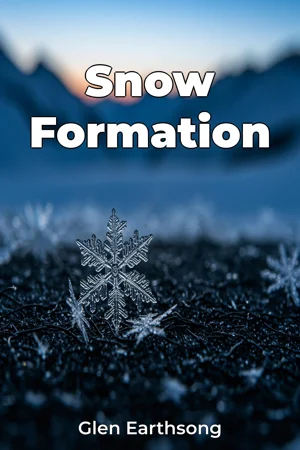
Have you ever stopped to consider the silent complexity of a single snowflake? “Snow Formation” delves into the intricate world of these frozen marvels, exploring their genesis in the atmosphere, the science behind their unique and varied patterns, and their crucial role in the Earth’s water cycle. This book is not just an exposition of scientific facts; it is an investigation into a captivating natural phenomenon that profoundly impacts our planet. We will begin by examining the fundamental atmospheric conditions necessary for snowflake formation, highlighting the role of water vapor, temperature, and microscopic particles in the air. Understanding these initial conditions is key to grasping why snowflakes form in the first place and why they are predominantly found in specific regions and climates. This section will provide essential context and build on basic scientific principles applicable to atmospheric sciences, setting the stage for a more detailed analysis. The central argument of "Snow Formation" is that the seemingly simple snowflake is a complex expression of environmental conditions and physical laws. This viewpoint is important because it illustrates the profound interconnectedness of atmospheric science, thermodynamics, and environmental processes. The book is structured to first introduce the basic concepts, then develop these ideas through explanations of crystal growth and atmospheric dynamics, culminating in a discussion of snowflakes' broader environmental impact. The book will present evidence gathered from atmospheric research, including observational data from meteorological studies and laboratory experiments simulating snowflake formation. Unique datasets from high-altitude observation stations and sophisticated weather models will be used to support the arguments. This book connects to several interdisciplinary fields, including meteorology, climate science, and environmental engineering. Meteorology provides the foundational understanding of atmospheric processes; climate science contextualizes the role of snow in global climate patterns, including albedo effects and temperature regulation. Environmental engineering benefits from understanding snow formation relating to water resource management. A unique aspect of “Snow Formation” is its detailed examination of the microphysics of ice crystal growth, combining theoretical models with real-world observations to offer a comprehensive picture of how snowflakes develop their complex structures. This will be delivered using a clear and accessible style, avoiding overly technical jargon while maintaining scientific accuracy. Intended for a broad audience, including students, educators, and anyone with an interest in nature and earth sciences, “Snow Formation” offers valuable insights into a fascinating natural phenomenon. High school students studying environmental science, geography students, and weather enthusiasts, will find this book valuable. As a work of nature and earth sciences geography, "Snow Formation" adheres to the conventions of scientific accuracy, clear explanation, and comprehensive coverage. The scope of the book is limited to the formation, structure, and environmental role of snowflakes, with no discussion of other forms of precipitation or broader climate modeling. The real-world applications of understanding snowflake formation are numerous. It informs weather forecasting, climate modeling, and water resource management, particularly in regions dependent on snowmelt for their water supply. Moreover, the book touches on ongoing debates within the scientific community regarding climate change impacts on snowfall patterns and snowpack dynamics. By exploring the hidden world within each snowflake, "Snow Formation" aims to deepen readers’ appreciation for the complexity and beauty of the natural world and to underscore the importance of understanding our planet's intricate systems.
Have you ever stopped to consider the silent complexity of a single snowflake? “Snow Formation” delves into the intricate world of these frozen marvels, exploring their genesis in the atmosphere, the science behind their unique and varied patterns, and their crucial role in the Earth’s water cycle. This book is not just an exposition of scientific facts; it is an investigation into a captivating natural phenomenon that profoundly impacts our planet. We will begin by examining the fundamental atmospheric conditions necessary for snowflake formation, highlighting the role of water vapor, temperature, and microscopic particles in the air. Understanding these initial conditions is key to grasping why snowflakes form in the first place and why they are predominantly found in specific regions and climates. This section will provide essential context and build on basic scientific principles applicable to atmospheric sciences, setting the stage for a more detailed analysis. The central argument of "Snow Formation" is that the seemingly simple snowflake is a complex expression of environmental conditions and physical laws. This viewpoint is important because it illustrates the profound interconnectedness of atmospheric science, thermodynamics, and environmental processes. The book is structured to first introduce the basic concepts, then develop these ideas through explanations of crystal growth and atmospheric dynamics, culminating in a discussion of snowflakes' broader environmental impact. The book will present evidence gathered from atmospheric research, including observational data from meteorological studies and laboratory experiments simulating snowflake formation. Unique datasets from high-altitude observation stations and sophisticated weather models will be used to support the arguments. This book connects to several interdisciplinary fields, including meteorology, climate science, and environmental engineering. Meteorology provides the foundational understanding of atmospheric processes; climate science contextualizes the role of snow in global climate patterns, including albedo effects and temperature regulation. Environmental engineering benefits from understanding snow formation relating to water resource management. A unique aspect of “Snow Formation” is its detailed examination of the microphysics of ice crystal growth, combining theoretical models with real-world observations to offer a comprehensive picture of how snowflakes develop their complex structures. This will be delivered using a clear and accessible style, avoiding overly technical jargon while maintaining scientific accuracy. Intended for a broad audience, including students, educators, and anyone with an interest in nature and earth sciences, “Snow Formation” offers valuable insights into a fascinating natural phenomenon. High school students studying environmental science, geography students, and weather enthusiasts, will find this book valuable. As a work of nature and earth sciences geography, "Snow Formation" adheres to the conventions of scientific accuracy, clear explanation, and comprehensive coverage. The scope of the book is limited to the formation, structure, and environmental role of snowflakes, with no discussion of other forms of precipitation or broader climate modeling. The real-world applications of understanding snowflake formation are numerous. It informs weather forecasting, climate modeling, and water resource management, particularly in regions dependent on snowmelt for their water supply. Moreover, the book touches on ongoing debates within the scientific community regarding climate change impacts on snowfall patterns and snowpack dynamics. By exploring the hidden world within each snowflake, "Snow Formation" aims to deepen readers’ appreciation for the complexity and beauty of the natural world and to underscore the importance of understanding our planet's intricate systems.
"Snow Formation" explores the fascinating science behind snowflakes, delving into their creation in the atmosphere and their essential role in Earth's water cycle. The book reveals how water vapor, temperature, and microscopic particles combine to form these unique ice crystals. Interestingly, the book highlights that the intricate patterns of snowflakes are not random but are a direct reflection of the atmospheric conditions during their formation. The book uniquely examines the microphysics of ice crystal growth, blending theoretical models with real-world observations. It emphasizes how understanding snowflake formation is crucial for meteorology, climate science, and environmental engineering, particularly in weather forecasting and water resource management. The text begins by introducing basic concepts, progressing through crystal growth and atmospheric dynamics, and concluding with a discussion of snowflakes' broader environmental impact.
Book Details
ISBN
9788233975234
Publisher
Publifye AS
Your Licenses
You don't own any licenses for this book
Purchase a license below to unlock this book and download the EPUB.
Purchase License
Select a tier to unlock this book
Need bulk licensing?
Contact us for enterprise agreements.