
About This Book
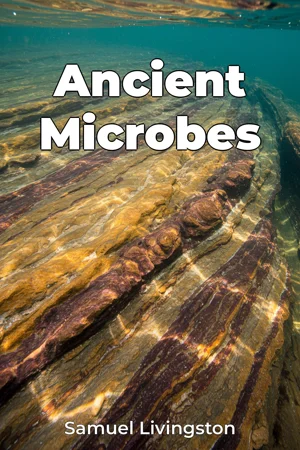
What if the story of life on Earth began not with grand creatures, but with organisms so small they were invisible to the naked eye? "Ancient Microbes" unveils the pivotal role of fossilized microorganisms—the true pioneers of our planet—in shaping the world we inhabit today. This book explores how these first life forms, often overlooked in traditional narratives of evolution, fundamentally altered Earth's geology, atmosphere, and ultimately paved the way for complex life. We delve into the earth sciences, microbial biology, and life sciences to illuminate the ancient origins of microbial life. The book's central argument posits that microbial life is not merely a precursor to complex organisms, but a persistent and active force driving planetary change over billions of years. Understanding the origin and evolution of these ancient microbes is crucial for grasping the full scope of life's history and its ongoing impact on Earth. "Ancient Microbes" is structured to provide a comprehensive understanding of this often-underappreciated field. We begin by establishing the geological and chemical context in which early life emerged, detailing the conditions on early Earth and the environments where microbial fossils are found. Next, the book addresses the techniques used to identify and study these ancient microbes including advanced microscopy, spectroscopy, and geochemical analysis which allow researchers to discern the biological origin of microscopic fossils and to reconstruct their metabolic processes. A significant portion of the book is dedicated to examining several key sites around the world where exceptionally well-preserved microbial fossils have been discovered, from the banded iron formations of Western Australia to the ancient cherts of South Africa. We explore what these fossilized communities tell us about the evolution of photosynthesis, nitrogen fixation, and other fundamental biological processes. The culmination of the book explores the implications of microbial evolution for understanding the potential for life beyond Earth as well as the application of geo-biological processes in environmental remediation. The evidence presented relies on a combination of geological data, phylogenetic analyses, and experimental microbiology. Isotopic signatures, biomarker compounds, and the morphology of microfossils themselves provide multiple lines of evidence supporting the existence and activities of ancient microbes. This book exists at the intersection of several disciplines. It connects earth sciences and biology, providing a geological context for understanding evolution, and links to astrobiology, informing the search for life on other planets. Additionally, it touches on environmental science, as ancient microbial processes have modern-day applications in bioremediation and sustainable energy. "Ancient Microbes" offers a unique perspective by emphasizing the active role of microbes in shaping Earth’s environment. It challenges the traditional view of microbes as passive recipients of environmental change and instead portrays them as powerful agents of planetary transformation. The writing style is accessible to a broad audience, while maintaining scientific rigor. Complex concepts are explained clearly, and technical jargon is minimized to ensure that readers from diverse backgrounds can engage with the material. The primary target audience includes undergraduate and graduate students in biology, geology, and environmental science, as well as researchers and professionals in these fields. It will also appeal to anyone with a general interest in the origins of life, the evolution of Earth, and the intersection of science and nature. In keeping with the conventions of science non-fiction, "Ancient Microbes" prioritizes accuracy, clarity, and evidence-based arguments. While the book covers a vast timescale, from the Archean Eon to the present, its scope is limited to the direct evidence for microbial life and its environmental impact. It does not delve into the details of later evolutionary events involving multicellular organisms. The investigation into ancient microbes has practical implications for understanding modern environmental challenges. By studying how microbes have adapted to changing conditions in the past, we can gain insights into how they might respond to current and future environmental changes, such as climate change and pollution. Finally, the book also touches upon some of the ongoing debates in the field, such as the interpretation of ambiguous microfossil structures and the challenges of distinguishing between biogenic and abiogenic features in ancient rocks. "Ancient Microbes" invites readers to embark on a journey through deep time, revealing the hidden world of ancient microorganisms and their enduring influence on our planet.
What if the story of life on Earth began not with grand creatures, but with organisms so small they were invisible to the naked eye? "Ancient Microbes" unveils the pivotal role of fossilized microorganisms—the true pioneers of our planet—in shaping the world we inhabit today. This book explores how these first life forms, often overlooked in traditional narratives of evolution, fundamentally altered Earth's geology, atmosphere, and ultimately paved the way for complex life. We delve into the earth sciences, microbial biology, and life sciences to illuminate the ancient origins of microbial life. The book's central argument posits that microbial life is not merely a precursor to complex organisms, but a persistent and active force driving planetary change over billions of years. Understanding the origin and evolution of these ancient microbes is crucial for grasping the full scope of life's history and its ongoing impact on Earth. "Ancient Microbes" is structured to provide a comprehensive understanding of this often-underappreciated field. We begin by establishing the geological and chemical context in which early life emerged, detailing the conditions on early Earth and the environments where microbial fossils are found. Next, the book addresses the techniques used to identify and study these ancient microbes including advanced microscopy, spectroscopy, and geochemical analysis which allow researchers to discern the biological origin of microscopic fossils and to reconstruct their metabolic processes. A significant portion of the book is dedicated to examining several key sites around the world where exceptionally well-preserved microbial fossils have been discovered, from the banded iron formations of Western Australia to the ancient cherts of South Africa. We explore what these fossilized communities tell us about the evolution of photosynthesis, nitrogen fixation, and other fundamental biological processes. The culmination of the book explores the implications of microbial evolution for understanding the potential for life beyond Earth as well as the application of geo-biological processes in environmental remediation. The evidence presented relies on a combination of geological data, phylogenetic analyses, and experimental microbiology. Isotopic signatures, biomarker compounds, and the morphology of microfossils themselves provide multiple lines of evidence supporting the existence and activities of ancient microbes. This book exists at the intersection of several disciplines. It connects earth sciences and biology, providing a geological context for understanding evolution, and links to astrobiology, informing the search for life on other planets. Additionally, it touches on environmental science, as ancient microbial processes have modern-day applications in bioremediation and sustainable energy. "Ancient Microbes" offers a unique perspective by emphasizing the active role of microbes in shaping Earth’s environment. It challenges the traditional view of microbes as passive recipients of environmental change and instead portrays them as powerful agents of planetary transformation. The writing style is accessible to a broad audience, while maintaining scientific rigor. Complex concepts are explained clearly, and technical jargon is minimized to ensure that readers from diverse backgrounds can engage with the material. The primary target audience includes undergraduate and graduate students in biology, geology, and environmental science, as well as researchers and professionals in these fields. It will also appeal to anyone with a general interest in the origins of life, the evolution of Earth, and the intersection of science and nature. In keeping with the conventions of science non-fiction, "Ancient Microbes" prioritizes accuracy, clarity, and evidence-based arguments. While the book covers a vast timescale, from the Archean Eon to the present, its scope is limited to the direct evidence for microbial life and its environmental impact. It does not delve into the details of later evolutionary events involving multicellular organisms. The investigation into ancient microbes has practical implications for understanding modern environmental challenges. By studying how microbes have adapted to changing conditions in the past, we can gain insights into how they might respond to current and future environmental changes, such as climate change and pollution. Finally, the book also touches upon some of the ongoing debates in the field, such as the interpretation of ambiguous microfossil structures and the challenges of distinguishing between biogenic and abiogenic features in ancient rocks. "Ancient Microbes" invites readers to embark on a journey through deep time, revealing the hidden world of ancient microorganisms and their enduring influence on our planet.
"Ancient Microbes" reveals how microscopic life has shaped Earth for billions of years, challenging the traditional view of evolution. It highlights that these ancient microbes, often overlooked, weren't just passive bystanders but active agents that fundamentally altered our planet's geology and atmosphere. The book delves into how microbial life continuously drives planetary change, emphasizing the importance of understanding their origins for a complete grasp of life's history. The investigation methods used to study these ancient life forms include advanced microscopy and geochemical analysis, which help researchers determine the biological origin of microfossils. Examining key sites like the banded iron formations and ancient cherts provides insights into the evolution of processes like photosynthesis. The book progresses by first establishing the geological context of early Earth, then detailing the techniques used to study ancient microbes and finally explores the implications of microbial evolution. This book uniquely emphasizes the active role of microbes in shaping Earth's environment, presenting them as powerful agents of planetary transformation. By connecting earth sciences, biology, and astrobiology, "Ancient Microbes" demonstrates how insights from studying ancient microbes can inform our understanding of modern environmental challenges and the search for life beyond Earth.
Book Details
ISBN
9788233975128
Publisher
Publifye AS
Your Licenses
You don't own any licenses for this book
Purchase a license below to unlock this book and download the EPUB.
Purchase License
Select a tier to unlock this book
Need bulk licensing?
Contact us for enterprise agreements.