
About This Book
What if the very air we breathe is a bustling highway for microbial life, influencing everything from our health to the Earth's climate? "Microbes in Air" delves into this unseen world, revealing the fascinating journey of airborne microorganisms, their role in spreading infections, and their surprising impact on global climate patterns. This book offers a comprehensive exploration of aerobiology, bridging the gap between microbiology, environmental science, and public health. The book's central argument is that airborne microbes are not merely passive travelers in the atmosphere but active agents shaping ecosystems and human health. Understanding their behavior is crucial for predicting disease outbreaks, managing environmental changes, and developing effective mitigation strategies. This understanding is made ever more pressing as human activities continue to alter atmospheric conditions and microbial ecosystems. "Microbes in Air" begins by establishing the context of aerobiology, tracing its historical development and highlighting its growing significance in the face of emerging infectious diseases and climate change. We explore the fundamental properties of airborne microorganisms, examining their diversity, survival mechanisms, and dispersal strategies. The book systematically investigates the sources and pathways of these microbes, looking at how they become airborne from soil, water, and human activities. The core of the book is structured around three major themes: the transport and survival of microbes in the atmosphere, their impact on human and animal health, and their role in climate processes. The first section examines the physical and biological factors influencing microbial dispersal, including wind patterns, temperature gradients, and humidity levels. The second section covers the role of airborne microbes in spreading respiratory infections, focusing on specific pathogens and the mechanisms of transmission. This section also addresses the implications for public health, including strategies for prevention and control. The third section investigates the less-explored connection between airborne microbes and climate change, looking at how these organisms influence cloud formation, precipitation patterns, and carbon cycling. The book draws upon a wide range of scientific evidence, including field studies, laboratory experiments, and computational models. We present data from atmospheric monitoring programs, epidemiological investigations, and climate simulations, supported by detailed case studies and illustrative examples. Particular attention is given to recent advances in molecular techniques for identifying and characterizing airborne microbes. "Microbes in Air" connects to several other disciplines, including meteorology (studying atmospheric conditions), ecology (examining microbial interactions), and medicine (addressing infectious diseases). These interdisciplinary connections enrich the book's analysis and provide a holistic understanding of airborne microbial processes.. The approach taken in "Microbes in Air" is to present complex scientific information in an accessible and engaging manner, suitable for a broad audience. The book avoids overly technical jargon and provides clear explanations of key concepts, making it valuable for students, researchers, and anyone interested in the intersection of microbiology, environmental science, and public health. The target audience for "Microbes in Air" includes undergraduate and graduate students in biology, environmental science, and public health; researchers in aerobiology and related fields; and professionals working in environmental management and disease control. The book will also appeal to anyone with a general interest in the unseen world of microorganisms and their impact on our lives. The book's scope is broad, covering a wide range of topics related to airborne microbes. However, it does not delve into the specific details of every microbial species or disease. Instead, it focuses on providing a comprehensive overview of general principles and key examples. The information presented in this book has numerous real-world applications, including improving air quality monitoring, developing more effective infection control strategies, and predicting the effects of climate change on microbial ecosystems. It also provides a framework for assessing the risks associated with emerging airborne pathogens. The field of aerobiology is not without its controversies, particularly regarding the role of airborne microbes in long-range transport and the effectiveness of various mitigation strategies. "Microbes in Air" addresses these debates by presenting different perspectives and critically evaluating the available evidence. The book culminates by synthesizing the various lines of evidence and highlighting the key implications of the findings. It offers a forward-looking perspective on the future of aerobiology and the challenges and opportunities that lie ahead.
What if the very air we breathe is a bustling highway for microbial life, influencing everything from our health to the Earth's climate? "Microbes in Air" delves into this unseen world, revealing the fascinating journey of airborne microorganisms, their role in spreading infections, and their surprising impact on global climate patterns. This book offers a comprehensive exploration of aerobiology, bridging the gap between microbiology, environmental science, and public health. The book's central argument is that airborne microbes are not merely passive travelers in the atmosphere but active agents shaping ecosystems and human health. Understanding their behavior is crucial for predicting disease outbreaks, managing environmental changes, and developing effective mitigation strategies. This understanding is made ever more pressing as human activities continue to alter atmospheric conditions and microbial ecosystems. "Microbes in Air" begins by establishing the context of aerobiology, tracing its historical development and highlighting its growing significance in the face of emerging infectious diseases and climate change. We explore the fundamental properties of airborne microorganisms, examining their diversity, survival mechanisms, and dispersal strategies. The book systematically investigates the sources and pathways of these microbes, looking at how they become airborne from soil, water, and human activities. The core of the book is structured around three major themes: the transport and survival of microbes in the atmosphere, their impact on human and animal health, and their role in climate processes. The first section examines the physical and biological factors influencing microbial dispersal, including wind patterns, temperature gradients, and humidity levels. The second section covers the role of airborne microbes in spreading respiratory infections, focusing on specific pathogens and the mechanisms of transmission. This section also addresses the implications for public health, including strategies for prevention and control. The third section investigates the less-explored connection between airborne microbes and climate change, looking at how these organisms influence cloud formation, precipitation patterns, and carbon cycling. The book draws upon a wide range of scientific evidence, including field studies, laboratory experiments, and computational models. We present data from atmospheric monitoring programs, epidemiological investigations, and climate simulations, supported by detailed case studies and illustrative examples. Particular attention is given to recent advances in molecular techniques for identifying and characterizing airborne microbes. "Microbes in Air" connects to several other disciplines, including meteorology (studying atmospheric conditions), ecology (examining microbial interactions), and medicine (addressing infectious diseases). These interdisciplinary connections enrich the book's analysis and provide a holistic understanding of airborne microbial processes.. The approach taken in "Microbes in Air" is to present complex scientific information in an accessible and engaging manner, suitable for a broad audience. The book avoids overly technical jargon and provides clear explanations of key concepts, making it valuable for students, researchers, and anyone interested in the intersection of microbiology, environmental science, and public health. The target audience for "Microbes in Air" includes undergraduate and graduate students in biology, environmental science, and public health; researchers in aerobiology and related fields; and professionals working in environmental management and disease control. The book will also appeal to anyone with a general interest in the unseen world of microorganisms and their impact on our lives. The book's scope is broad, covering a wide range of topics related to airborne microbes. However, it does not delve into the specific details of every microbial species or disease. Instead, it focuses on providing a comprehensive overview of general principles and key examples. The information presented in this book has numerous real-world applications, including improving air quality monitoring, developing more effective infection control strategies, and predicting the effects of climate change on microbial ecosystems. It also provides a framework for assessing the risks associated with emerging airborne pathogens. The field of aerobiology is not without its controversies, particularly regarding the role of airborne microbes in long-range transport and the effectiveness of various mitigation strategies. "Microbes in Air" addresses these debates by presenting different perspectives and critically evaluating the available evidence. The book culminates by synthesizing the various lines of evidence and highlighting the key implications of the findings. It offers a forward-looking perspective on the future of aerobiology and the challenges and opportunities that lie ahead.
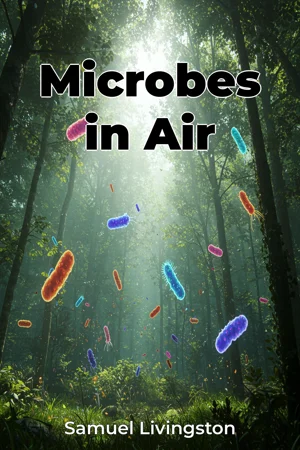
"Microbes in Air" unveils the hidden world of airborne microorganisms, exploring their profound influence on our health and the environment. This book delves into aerobiology, revealing how these tiny life forms are not just passively floating in the atmosphere but actively shaping ecosystems. For example, airborne microbes play a significant role in spreading respiratory infections, impacting public health strategies. The book examines the journey of these microbes, from their sources to their eventual impact, emphasizing the importance of understanding their behavior for managing environmental changes and predicting disease outbreaks. It explores how factors like wind patterns and humidity influence microbial dispersal, and it connects these processes to climate change, particularly how microbes can influence cloud formation. "Microbes in Air" presents complex scientific information in an accessible manner, making it valuable for a wide audience. The book progresses logically, first establishing the context of aerobiology, then systematically investigating the transport, survival, and impact of airborne microbes. It highlights the connections between aerobiology and other disciplines, like meteorology and ecology, offering a holistic understanding of these unseen processes.
Book Details
ISBN
9788233974978
Publisher
Publifye AS
Your Licenses
You don't own any licenses for this book
Purchase a license below to unlock this book and download the EPUB.
Purchase License
Select a tier to unlock this book
Need bulk licensing?
Contact us for enterprise agreements.