
About This Book
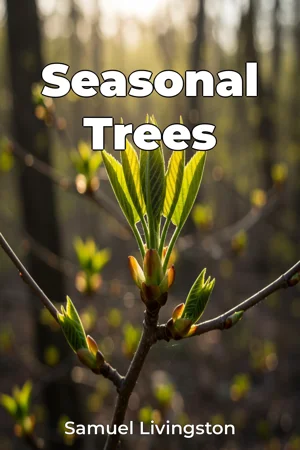
Have you ever paused to consider the intricate transformations trees undergo throughout the year, and what these changes reveal about the fundamental processes of life? "Seasonal Trees" delves into the fascinating world of tree biology, exploring the cyclical journey from the vibrant renewal of spring to the stark dormancy of winter. This book illuminates how trees respond to environmental cues, adapt to changing conditions, and contribute to the larger ecological tapestry. This exploration centers around three core themes: the physiological mechanisms driving seasonal changes, the ecological interactions shaped by these changes, and the evolutionary adaptations that enable trees to thrive in diverse climates. Understanding these themes provides insight into the resilience of forests and the impact of climate change on these vital ecosystems. Historically, our understanding of tree physiology has evolved from simple observations of seasonal events to complex biochemical analyses. Socially, the changing seasons, marked by the transformations of trees, have influenced cultural traditions and artistic expression for centuries. Scientifically, trees serve as models for studying plant adaptation and ecological dynamics. The central argument of "Seasonal Trees" underscores that a tree's annual cycle is not merely a passive response to environmental stimuli, but an actively regulated process involving complex hormonal signals, metabolic adjustments, and genetic controls. By understanding this intricate interplay, we can better predict how trees will respond to future environmental challenges. The book is structured to guide the reader through a comprehensive exploration of these topics. It begins by introducing the fundamental concepts of tree physiology, including photosynthesis, respiration, and nutrient transport. The subsequent chapters delve into the specific changes trees undergo in each season: a) The awakening of spring, marked by bud break and leaf emergence. b) The period of growth and reproduction during summer. c) The preparation for dormancy in autumn, characterized by leaf senescence and abscission. d) The strategies for surviving the harsh conditions of winter. The book culminates by discussing the implications of climate change on tree phenology and distribution, exploring potential adaptations, and offering management strategies for preserving forest health. The evidence presented draws upon diverse sources, including long-term ecological studies, controlled experiments in laboratory settings, and cutting-edge genomic analyses. Unique data sets from arboretums and forest monitoring programs are integrated to provide a comprehensive view of tree responses across different geographical regions and climate zones. "Seasonal Trees" connects to several other fields of study. Firstly, it links to climatology by examining how changing temperature and precipitation patterns affect tree growth and survival. Secondly, it intersects with ecology by exploring the interactions between trees and other organisms, such as insects, fungi, and herbivores. Thirdly, it relates to genetics by investigating the genes that control seasonal responses and adaptive traits. These interdisciplinary connections enrich the book's arguments and broaden its appeal. The book offers an accessible yet scientifically rigorous discussion of tree biology, avoiding jargon and complex mathematical models. This approach makes the information understandable for a wide audience, from students and nature enthusiasts to researchers and policymakers. The target audience includes undergraduate and graduate students in biology, forestry, and environmental science, as well as anyone with a general interest in nature and botany. This book would be valuable to them because it provides a comprehensive overview of tree physiology and ecology, integrating current research with practical applications. As a work of non-fiction in the life sciences, "Seasonal Trees" adheres to the standards of scientific accuracy and objectivity. It presents evidence-based arguments, cites credible sources, and avoids anecdotal claims or unsupported generalizations. The scope of the book is intentionally limited to the temperate and boreal regions of the world, where seasonal changes are most pronounced. While examples from tropical and subtropical regions are included where relevant, the primary focus remains on trees adapted to seasonal climates. The information in "Seasonal Trees" can be applied practically in various ways. Forest managers can use this knowledge to develop sustainable harvesting practices that minimize the impact on tree health and ecosystem function. Homeowners can use it to select tree species that are well-suited to their local climate and to provide proper care throughout the year. Educators can use it to teach students about plant biology and the importance of forests. While there is broad agreement on the fundamental principles of tree physiology, ongoing debates exist regarding the relative importance of different environmental factors in controlling seasonal responses, as well as the potential for trees to adapt to rapid climate change. These controversies are explored in the context of the scientific evidence, offering different perspectives on these complex issues.
Have you ever paused to consider the intricate transformations trees undergo throughout the year, and what these changes reveal about the fundamental processes of life? "Seasonal Trees" delves into the fascinating world of tree biology, exploring the cyclical journey from the vibrant renewal of spring to the stark dormancy of winter. This book illuminates how trees respond to environmental cues, adapt to changing conditions, and contribute to the larger ecological tapestry. This exploration centers around three core themes: the physiological mechanisms driving seasonal changes, the ecological interactions shaped by these changes, and the evolutionary adaptations that enable trees to thrive in diverse climates. Understanding these themes provides insight into the resilience of forests and the impact of climate change on these vital ecosystems. Historically, our understanding of tree physiology has evolved from simple observations of seasonal events to complex biochemical analyses. Socially, the changing seasons, marked by the transformations of trees, have influenced cultural traditions and artistic expression for centuries. Scientifically, trees serve as models for studying plant adaptation and ecological dynamics. The central argument of "Seasonal Trees" underscores that a tree's annual cycle is not merely a passive response to environmental stimuli, but an actively regulated process involving complex hormonal signals, metabolic adjustments, and genetic controls. By understanding this intricate interplay, we can better predict how trees will respond to future environmental challenges. The book is structured to guide the reader through a comprehensive exploration of these topics. It begins by introducing the fundamental concepts of tree physiology, including photosynthesis, respiration, and nutrient transport. The subsequent chapters delve into the specific changes trees undergo in each season: a) The awakening of spring, marked by bud break and leaf emergence. b) The period of growth and reproduction during summer. c) The preparation for dormancy in autumn, characterized by leaf senescence and abscission. d) The strategies for surviving the harsh conditions of winter. The book culminates by discussing the implications of climate change on tree phenology and distribution, exploring potential adaptations, and offering management strategies for preserving forest health. The evidence presented draws upon diverse sources, including long-term ecological studies, controlled experiments in laboratory settings, and cutting-edge genomic analyses. Unique data sets from arboretums and forest monitoring programs are integrated to provide a comprehensive view of tree responses across different geographical regions and climate zones. "Seasonal Trees" connects to several other fields of study. Firstly, it links to climatology by examining how changing temperature and precipitation patterns affect tree growth and survival. Secondly, it intersects with ecology by exploring the interactions between trees and other organisms, such as insects, fungi, and herbivores. Thirdly, it relates to genetics by investigating the genes that control seasonal responses and adaptive traits. These interdisciplinary connections enrich the book's arguments and broaden its appeal. The book offers an accessible yet scientifically rigorous discussion of tree biology, avoiding jargon and complex mathematical models. This approach makes the information understandable for a wide audience, from students and nature enthusiasts to researchers and policymakers. The target audience includes undergraduate and graduate students in biology, forestry, and environmental science, as well as anyone with a general interest in nature and botany. This book would be valuable to them because it provides a comprehensive overview of tree physiology and ecology, integrating current research with practical applications. As a work of non-fiction in the life sciences, "Seasonal Trees" adheres to the standards of scientific accuracy and objectivity. It presents evidence-based arguments, cites credible sources, and avoids anecdotal claims or unsupported generalizations. The scope of the book is intentionally limited to the temperate and boreal regions of the world, where seasonal changes are most pronounced. While examples from tropical and subtropical regions are included where relevant, the primary focus remains on trees adapted to seasonal climates. The information in "Seasonal Trees" can be applied practically in various ways. Forest managers can use this knowledge to develop sustainable harvesting practices that minimize the impact on tree health and ecosystem function. Homeowners can use it to select tree species that are well-suited to their local climate and to provide proper care throughout the year. Educators can use it to teach students about plant biology and the importance of forests. While there is broad agreement on the fundamental principles of tree physiology, ongoing debates exist regarding the relative importance of different environmental factors in controlling seasonal responses, as well as the potential for trees to adapt to rapid climate change. These controversies are explored in the context of the scientific evidence, offering different perspectives on these complex issues.
"Seasonal Trees" explores the hidden world of tree biology, revealing the amazing ways trees adapt to changing seasons. From the burst of new life in spring to the quiet dormancy of winter, trees undergo remarkable transformations. Did you know that a tree's annual cycle isn't just a passive reaction to the environment? It's a complex process involving hormonal signals and metabolic adjustments. The book illuminates how these seasonal changes shape ecological interactions and influence the resilience of forests. The book progresses from foundational concepts like photosynthesis and respiration to detailed discussions of each season: spring awakening, summer growth, autumn preparation for dormancy, and winter survival. The book highlights the impact of climate change on tree phenology, offering insights into potential adaptations and forest management strategies. By integrating long-term ecological studies, experiments, and genomic analyses, "Seasonal Trees" provides a comprehensive understanding of tree responses across diverse regions and climate zones.
Book Details
ISBN
9788233974657
Publisher
Publifye AS
Your Licenses
You don't own any licenses for this book
Purchase a license below to unlock this book and download the EPUB.
Purchase License
Select a tier to unlock this book
Need bulk licensing?
Contact us for enterprise agreements.