
About This Book
Have you ever wondered how life persists in regions where the sun blazes relentlessly and water is a scarce commodity? "Desert Trees" unveils the secrets of arboreal survival in the planet's most arid landscapes, exploring the fascinating adaptations that enable specific tree species to not only endure but thrive in extreme heat and drought. This book delves into the critical role of water storage mechanisms in these trees, revealing how they have evolved to capture, conserve, and utilize this precious resource with remarkable efficiency. This book primarily addresses two major themes: the unique adaptations that allow trees to survive extreme heat, and the diverse methods these trees use to store water. Understanding these topics is crucial in an era facing increasing desertification and climate change. The insights provided offer valuable knowledge for conservation efforts, sustainable land management, and even inspire innovative engineering solutions. The current ecological crisis necessitates a deeper understanding of how plant life adapts to harsh environments. Over centuries, desert trees have developed sophisticated mechanisms for survival, offering a blueprint for resilience in the face of environmental stress. Readers should have a basic understanding of plant biology, including photosynthesis and water transport processes, although these concepts will be reviewed within the book. The central argument of "Desert Trees" is that the survival strategies of these plants represent a vital source of knowledge for addressing global challenges related to water scarcity and climate change. By closely examining the physiological and structural adaptations of desert trees, we can gain insights into developing more sustainable approaches to agriculture, forestry, and urban planning in arid and semi-arid regions. The book is structured to first introduce the major desert biomes of the world and the specific environmental challenges they present to plant life. Following this initial overview, the argument develops in three major parts. Firstly, it looks into the heat-resistant adaptations of desert trees, including leaf morphology, bark characteristics, and physiological processes that prevent overheating and reduce water loss. Secondly, the core concept of water storage is explored, categorizing different storage methods such as succulent tissues, deep root systems, and specialized stem structures. Trees like the Baobab and Saguaro Cactus (though technically a succulent) are examined to illustrate these points. Thirdly, the book analyzes the interplay between desert trees and their surrounding ecosystems, focusing on their role in maintaining soil stability, providing habitat for wildlife, and influencing local climate patterns. It culminates by discussing practical applications of this knowledge, such as selecting appropriate tree species for urban greening in arid cities and developing drought-resistant crops. The evidence presented throughout the book draws from a range of scientific disciplines, including plant physiology, ecology, and botany. It includes detailed anatomical studies of desert tree tissues, analyses of water use efficiency, and ecological surveys of desert ecosystems. Furthermore, the book references and incorporates findings from recent studies using advanced techniques such as isotope hydrology to trace water movement within trees and remote sensing to assess vegetation health in arid landscapes. "Desert Trees" connects to other fields such as climatology (understanding the impacts of climate change on desert ecosystems), materials science (inspiring the design of drought-resistant materials), and urban planning (developing sustainable urban landscapes in arid regions). These interdisciplinary connections reinforce the book's central argument by demonstrating the broad relevance of desert tree adaptations to various societal challenges. A unique aspect of this book is its emphasis on translating scientific knowledge into practical solutions. It not only explores the intricacies of desert tree biology but also provides actionable recommendations for applying this knowledge in real-world contexts, such as conservation and sustainable development. The book employs an accessible, informative, and engaging writing style, making complex scientific concepts understandable to a broad audience. The book is targeted towards students, researchers, environmental professionals, and anyone interested in learning about the natural world and sustainable living. It offers valuable insights for those seeking to understand how organisms adapt to extreme environments and how this knowledge can be used to address global environmental challenges. As a work of non-fiction within the genres of Nature, Biology, and Science Life Sciences, the book adheres to the standard conventions of this genre, including accurate scientific information, clear explanations, and proper citation of sources. The scope of "Desert Trees" is limited to the adaptations of trees in hot desert environments, excluding cold desert regions. While the book focuses primarily on trees, it occasionally references other desert plants to provide context and comparisons. The information presented in "Desert Trees" can be directly applied to various real-world challenges, most notably developing strategies for mitigating the impacts of desertification and promoting sustainable land management practices in arid and semi-arid regions. This book also addresses the ongoing debates surrounding the most effective methods for restoring degraded desert ecosystems and the role of native tree species in these efforts. It offers a balanced perspective on these controversies, presenting evidence-based arguments to inform decision-making.
Have you ever wondered how life persists in regions where the sun blazes relentlessly and water is a scarce commodity? "Desert Trees" unveils the secrets of arboreal survival in the planet's most arid landscapes, exploring the fascinating adaptations that enable specific tree species to not only endure but thrive in extreme heat and drought. This book delves into the critical role of water storage mechanisms in these trees, revealing how they have evolved to capture, conserve, and utilize this precious resource with remarkable efficiency. This book primarily addresses two major themes: the unique adaptations that allow trees to survive extreme heat, and the diverse methods these trees use to store water. Understanding these topics is crucial in an era facing increasing desertification and climate change. The insights provided offer valuable knowledge for conservation efforts, sustainable land management, and even inspire innovative engineering solutions. The current ecological crisis necessitates a deeper understanding of how plant life adapts to harsh environments. Over centuries, desert trees have developed sophisticated mechanisms for survival, offering a blueprint for resilience in the face of environmental stress. Readers should have a basic understanding of plant biology, including photosynthesis and water transport processes, although these concepts will be reviewed within the book. The central argument of "Desert Trees" is that the survival strategies of these plants represent a vital source of knowledge for addressing global challenges related to water scarcity and climate change. By closely examining the physiological and structural adaptations of desert trees, we can gain insights into developing more sustainable approaches to agriculture, forestry, and urban planning in arid and semi-arid regions. The book is structured to first introduce the major desert biomes of the world and the specific environmental challenges they present to plant life. Following this initial overview, the argument develops in three major parts. Firstly, it looks into the heat-resistant adaptations of desert trees, including leaf morphology, bark characteristics, and physiological processes that prevent overheating and reduce water loss. Secondly, the core concept of water storage is explored, categorizing different storage methods such as succulent tissues, deep root systems, and specialized stem structures. Trees like the Baobab and Saguaro Cactus (though technically a succulent) are examined to illustrate these points. Thirdly, the book analyzes the interplay between desert trees and their surrounding ecosystems, focusing on their role in maintaining soil stability, providing habitat for wildlife, and influencing local climate patterns. It culminates by discussing practical applications of this knowledge, such as selecting appropriate tree species for urban greening in arid cities and developing drought-resistant crops. The evidence presented throughout the book draws from a range of scientific disciplines, including plant physiology, ecology, and botany. It includes detailed anatomical studies of desert tree tissues, analyses of water use efficiency, and ecological surveys of desert ecosystems. Furthermore, the book references and incorporates findings from recent studies using advanced techniques such as isotope hydrology to trace water movement within trees and remote sensing to assess vegetation health in arid landscapes. "Desert Trees" connects to other fields such as climatology (understanding the impacts of climate change on desert ecosystems), materials science (inspiring the design of drought-resistant materials), and urban planning (developing sustainable urban landscapes in arid regions). These interdisciplinary connections reinforce the book's central argument by demonstrating the broad relevance of desert tree adaptations to various societal challenges. A unique aspect of this book is its emphasis on translating scientific knowledge into practical solutions. It not only explores the intricacies of desert tree biology but also provides actionable recommendations for applying this knowledge in real-world contexts, such as conservation and sustainable development. The book employs an accessible, informative, and engaging writing style, making complex scientific concepts understandable to a broad audience. The book is targeted towards students, researchers, environmental professionals, and anyone interested in learning about the natural world and sustainable living. It offers valuable insights for those seeking to understand how organisms adapt to extreme environments and how this knowledge can be used to address global environmental challenges. As a work of non-fiction within the genres of Nature, Biology, and Science Life Sciences, the book adheres to the standard conventions of this genre, including accurate scientific information, clear explanations, and proper citation of sources. The scope of "Desert Trees" is limited to the adaptations of trees in hot desert environments, excluding cold desert regions. While the book focuses primarily on trees, it occasionally references other desert plants to provide context and comparisons. The information presented in "Desert Trees" can be directly applied to various real-world challenges, most notably developing strategies for mitigating the impacts of desertification and promoting sustainable land management practices in arid and semi-arid regions. This book also addresses the ongoing debates surrounding the most effective methods for restoring degraded desert ecosystems and the role of native tree species in these efforts. It offers a balanced perspective on these controversies, presenting evidence-based arguments to inform decision-making.
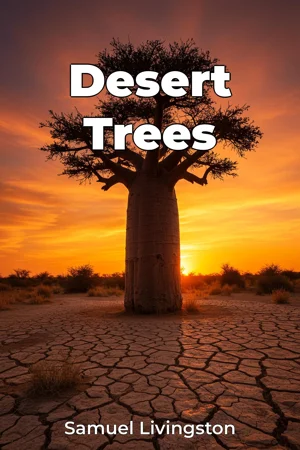
"Desert Trees" explores the remarkable adaptations of trees thriving in arid climates, revealing nature's strategies for survival in extreme environments. The book investigates how these trees have evolved sophisticated mechanisms for water storage and developed unique heat resistance, crucial for enduring relentless sun and scarce water. It highlights how desert trees contribute to their ecosystems by maintaining soil stability and providing habitats, showcasing their critical ecological roles. This book delves into the plant physiology and botany of trees like the Baobab, examining their leaf morphology, bark, and deep root systems that prevent overheating and reduce water loss. You'll discover how these adaptations offer blueprints for resilience, applicable to sustainable land management and combating desertification. The book progresses systematically, beginning with an introduction to desert biomes, then exploring heat-resistant adaptations, water storage methods, and the interplay between trees and their ecosystems. Targeted for students, researchers, and anyone interested in science life sciences, "Desert Trees" translates scientific knowledge into practical solutions. By understanding these natural adaptations to environmental stress, we can develop innovative approaches to agriculture, forestry, and urban planning, making it a valuable resource for addressing global challenges related to water scarcity and climate change.
Book Details
ISBN
9788233974435
Publisher
Publifye AS
Your Licenses
You don't own any licenses for this book
Purchase a license below to unlock this book and download the EPUB.
Purchase License
Select a tier to unlock this book
Need bulk licensing?
Contact us for enterprise agreements.