
About This Book
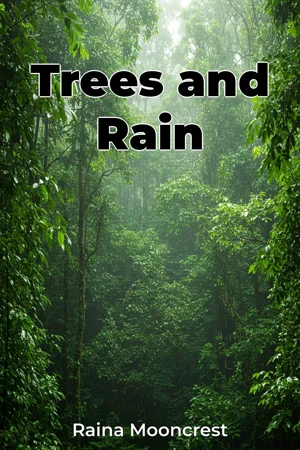
Can understanding the intricate relationship between trees and rainfall offer a key to combating drought and stabilizing our planet's increasingly volatile climate? "Trees and Rain" delves into the profound influence of forests on precipitation patterns, drought mitigation, and the maintenance of regional climates, revealing the science behind this critical ecological connection. The book explores the complex interplay between forests, the water cycle, and atmospheric processes, demonstrating how forests are not merely passive recipients of rainfall but active participants in its generation and distribution. This book addresses three core themes: the biophysical mechanisms by which forests influence rainfall, the role of forests in preventing and alleviating drought conditions, and the broader implications of forest cover for regional climate stability. These topics are crucial as deforestation continues to threaten global water cycles, exacerbating water scarcity and impacting agricultural productivity, biodiversity, and human livelihoods. "Trees and Rain" provides essential scientific, geographical, and historical context, drawing upon established research in hydrology, meteorology, and ecology. It assumes a general understanding of basic ecological principles but avoids technical jargon to remain accessible to a broad audience. The book's central argument posits that maintaining and restoring forest ecosystems is vital for ensuring regional and global water security. This argument is important because it reframes the discussion on forest conservation, emphasizing the direct, tangible benefits of forests for water resource management and climate resilience. The book is structured to provide a comprehensive understanding of the subject matter. It begins with an introduction to the water cycle and the role of forests within that cycle, including the processes of evapotranspiration, cloud formation, and precipitation. Subsequent sections delve into specific mechanisms by which forests influence rainfall, such as orographic precipitation enhancement, the release of biogenic volatile organic compounds that act as cloud condensation nuclei, and the impact of forest cover on soil moisture retention. The book then examines case studies from various regions around the world, demonstrating the effects of deforestation on rainfall patterns and drought severity. The culmination synthesizes the evidence to present a compelling argument for the importance of forest conservation and restoration, followed by a discussion of practical strategies for sustainable forest management and policy interventions aimed at protecting and enhancing the water-regulating functions of forests. The evidence presented is drawn from diverse sources, including peer-reviewed scientific literature, long-term hydrological monitoring data, remote sensing imagery, and climate modeling studies. It presents unique data from field experiments conducted in diverse forest ecosystems, providing empirical support for the book's central claims. The book also considers interdisciplinary connections to fields such as agricultural science, economics, and political science. Exploring the impact of forest cover on agricultural yields highlights the economic value of forest ecosystem services. Further exploring the political and economic aspects of deforestation and reforestation policies demonstrates the need for integrated approaches to land management. "Trees and Rain" offers a distinctive perspective by integrating micro-scale biophysical processes with macro-scale climate patterns, providing a holistic view of the forest-water relationship. This approach moves beyond simplistic correlations to elucidate the underlying mechanisms that drive the observed phenomena. The writing style is factual and evidence based, while remaining accessible and engaging for a non-specialist audience. It avoids sensationalism, opting instead for a clear and concise presentation of the scientific evidence. The target audience includes environmental scientists, policymakers, conservationists, and anyone interested in understanding the role of forests in maintaining water resources and mitigating climate change. It is also suitable for students in environmental science, geography, and related fields. As a work of non-fiction within the genres of nature, earth sciences, and geography, "Trees and Rain" adheres to the conventions of rigorous scientific accuracy, transparency in methodology, and clear communication of complex concepts. The scope encompasses a global perspective on the forest-water relationship, with examples drawn from diverse forest ecosystems around the world. However, it does not delve into the specific details of forest management practices in particular regions, focusing instead on the broader principles and mechanisms. The information presented in "Trees and Rain" can be applied to inform forest management decisions, land-use planning, and climate change adaptation strategies. It provides a scientific basis for prioritizing forest conservation and restoration efforts to enhance water security and build climate resilience. While the scientific consensus supports the important role of forests in the water cycle, ongoing debates exist regarding the precise magnitude of forest influence under different environmental conditions. "Trees and Rain" addresses these debates, presenting a balanced assessment of the current state of knowledge and identifying areas for future research.
Can understanding the intricate relationship between trees and rainfall offer a key to combating drought and stabilizing our planet's increasingly volatile climate? "Trees and Rain" delves into the profound influence of forests on precipitation patterns, drought mitigation, and the maintenance of regional climates, revealing the science behind this critical ecological connection. The book explores the complex interplay between forests, the water cycle, and atmospheric processes, demonstrating how forests are not merely passive recipients of rainfall but active participants in its generation and distribution. This book addresses three core themes: the biophysical mechanisms by which forests influence rainfall, the role of forests in preventing and alleviating drought conditions, and the broader implications of forest cover for regional climate stability. These topics are crucial as deforestation continues to threaten global water cycles, exacerbating water scarcity and impacting agricultural productivity, biodiversity, and human livelihoods. "Trees and Rain" provides essential scientific, geographical, and historical context, drawing upon established research in hydrology, meteorology, and ecology. It assumes a general understanding of basic ecological principles but avoids technical jargon to remain accessible to a broad audience. The book's central argument posits that maintaining and restoring forest ecosystems is vital for ensuring regional and global water security. This argument is important because it reframes the discussion on forest conservation, emphasizing the direct, tangible benefits of forests for water resource management and climate resilience. The book is structured to provide a comprehensive understanding of the subject matter. It begins with an introduction to the water cycle and the role of forests within that cycle, including the processes of evapotranspiration, cloud formation, and precipitation. Subsequent sections delve into specific mechanisms by which forests influence rainfall, such as orographic precipitation enhancement, the release of biogenic volatile organic compounds that act as cloud condensation nuclei, and the impact of forest cover on soil moisture retention. The book then examines case studies from various regions around the world, demonstrating the effects of deforestation on rainfall patterns and drought severity. The culmination synthesizes the evidence to present a compelling argument for the importance of forest conservation and restoration, followed by a discussion of practical strategies for sustainable forest management and policy interventions aimed at protecting and enhancing the water-regulating functions of forests. The evidence presented is drawn from diverse sources, including peer-reviewed scientific literature, long-term hydrological monitoring data, remote sensing imagery, and climate modeling studies. It presents unique data from field experiments conducted in diverse forest ecosystems, providing empirical support for the book's central claims. The book also considers interdisciplinary connections to fields such as agricultural science, economics, and political science. Exploring the impact of forest cover on agricultural yields highlights the economic value of forest ecosystem services. Further exploring the political and economic aspects of deforestation and reforestation policies demonstrates the need for integrated approaches to land management. "Trees and Rain" offers a distinctive perspective by integrating micro-scale biophysical processes with macro-scale climate patterns, providing a holistic view of the forest-water relationship. This approach moves beyond simplistic correlations to elucidate the underlying mechanisms that drive the observed phenomena. The writing style is factual and evidence based, while remaining accessible and engaging for a non-specialist audience. It avoids sensationalism, opting instead for a clear and concise presentation of the scientific evidence. The target audience includes environmental scientists, policymakers, conservationists, and anyone interested in understanding the role of forests in maintaining water resources and mitigating climate change. It is also suitable for students in environmental science, geography, and related fields. As a work of non-fiction within the genres of nature, earth sciences, and geography, "Trees and Rain" adheres to the conventions of rigorous scientific accuracy, transparency in methodology, and clear communication of complex concepts. The scope encompasses a global perspective on the forest-water relationship, with examples drawn from diverse forest ecosystems around the world. However, it does not delve into the specific details of forest management practices in particular regions, focusing instead on the broader principles and mechanisms. The information presented in "Trees and Rain" can be applied to inform forest management decisions, land-use planning, and climate change adaptation strategies. It provides a scientific basis for prioritizing forest conservation and restoration efforts to enhance water security and build climate resilience. While the scientific consensus supports the important role of forests in the water cycle, ongoing debates exist regarding the precise magnitude of forest influence under different environmental conditions. "Trees and Rain" addresses these debates, presenting a balanced assessment of the current state of knowledge and identifying areas for future research.
"Trees and Rain" explores the vital link between forests and rainfall, revealing how forests actively participate in generating and distributing precipitation, rather than merely receiving it. This book examines the biophysical mechanisms behind this relationship, including how forests influence cloud formation through evapotranspiration and the release of biogenic volatile organic compounds. It argues that maintaining and restoring forest ecosystems is crucial for regional and global water security. The book delves into the role of forests in mitigating drought and stabilizing regional climates, addressing concerns about deforestation and water scarcity. Did you know that forests can enhance orographic precipitation, increasing rainfall in mountainous regions? Or that forest cover significantly impacts soil moisture retention? "Trees and Rain" uses scientific research and case studies to illustrate the effects of deforestation on rainfall patterns around the globe. The book progresses from introducing the water cycle and forest's role to examining specific mechanisms and real-world impacts. It concludes by advocating for sustainable forest management and policy interventions. By integrating micro-scale processes with macro-scale climate patterns, "Trees and Rain" offers a comprehensive view, making it a valuable resource for environmental scientists, policymakers, and anyone interested in forest conservation and climate resilience.
Book Details
ISBN
9788233974398
Publisher
Publifye AS
Your Licenses
You don't own any licenses for this book
Purchase a license below to unlock this book and download the EPUB.
Purchase License
Select a tier to unlock this book
Need bulk licensing?
Contact us for enterprise agreements.