
About This Book
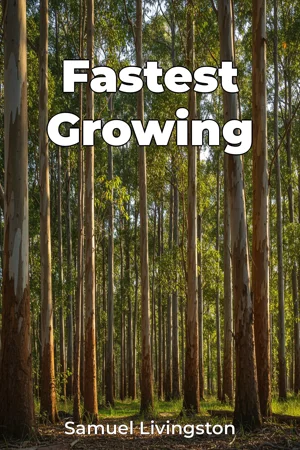
Can trees grow fast enough to combat deforestation and meet the increasing global demand for timber? This book, 'Fastest Growing', explores the world of rapidly growing trees and their pivotal role in reforestation efforts and timber production. We delve into the biological mechanisms that enable certain species to achieve remarkable growth rates, examining their significance in sustainable forestry and ecological restoration. The core topics revolve around three fundamental areas: the biology of rapid tree growth, the practical applications in reforestation and timber cultivation, and the environmental impact of utilizing these species. These topics are vitally important because of the urgent need for sustainable solutions to deforestation, climate change, and the increasing global demand for wood products. Understanding how to cultivate and manage fast-growing trees effectively is crucial for balancing economic needs with environmental stewardship. Historically, forestry has often relied on slower-growing, native species, with longer harvest cycles. However, the escalating rate of deforestation and the pressure on existing forests necessitate exploring alternative approaches. This book provides a scientific context for understanding the potential of fast-growing trees to address these challenges, assuming the reader has a basic understanding of plant biology and ecological principles. The central argument is that the strategic cultivation of carefully selected, fast-growing tree species, coupled with responsible forest management practices, represents a viable and essential strategy for mitigating deforestation, sequestering carbon, and meeting global timber demands sustainably. This argument is critical because it challenges conventional forestry practices and highlights the potential of innovative approaches to achieve a more sustainable future. The book is structured to offer a comprehensive understanding of the subject. It begins by introducing the concept of rapid tree growth, exploring the biological and environmental factors that contribute to it. The second section delves into specific examples of fast-growing trees around the world, detailing their characteristics, growth rates, and ecological requirements. The third section focuses on the practical applications, including optimal cultivation techniques, sustainable harvesting methods, and the economic viability of utilizing these trees in timber production. Finally, we explore the environmental implications, examining the potential benefits and risks associated with large-scale cultivation of fast-growing species. The evidence presented is drawn from a variety of sources, including peer-reviewed scientific literature, field studies, and data collected from commercial forestry operations. We analyze growth rates, carbon sequestration potential, soil impacts, and biodiversity effects, using quantitative data and comparative analyses to support the arguments presented. This book connects to several interdisciplinary fields. Ecology provides the framework for understanding the environmental impacts of fast-growing trees. Economics informs the analysis of the financial viability of reforestation projects. Genetics plays a role in explaining how selective breeding and genetic engineering can further enhance growth rates and disease resistance. These connections provide a more holistic understanding of the challenges and opportunities associated with fast-growing trees. 'Fastest Growing' offers a comprehensive assessment while avoiding unsubstantiated claims. The tone is factual and informative, aimed at educating and empowering readers with the knowledge needed to make informed decisions about sustainable forestry practices. The target audience includes forestry professionals, environmental scientists, policymakers, students in related fields, and anyone interested in sustainable solutions to environmental challenges. This book provides valuable insights into a promising approach to sustainable forestry and ecological restoration. As a work of non-fiction, this book adheres to standards of accuracy, objectivity, and transparency. The book acknowledges the inherent limitations in generalizing about species performance across varied environmental conditions and emphasizes the need for site-specific assessments. The knowledge presented has numerous real-world applications, from informing reforestation strategies to guiding investment decisions in sustainable timber production. Understanding the potential and limitations of these trees allows for more effective resource management and conservation efforts. Furthermore, 'Fastest Growing' addresses controversies surrounding the use of non-native species and the potential impacts on biodiversity. It examines the ongoing debate about the trade-offs between maximizing timber production and preserving native ecosystems, providing a balanced perspective on the complexities of sustainable forestry.
Can trees grow fast enough to combat deforestation and meet the increasing global demand for timber? This book, 'Fastest Growing', explores the world of rapidly growing trees and their pivotal role in reforestation efforts and timber production. We delve into the biological mechanisms that enable certain species to achieve remarkable growth rates, examining their significance in sustainable forestry and ecological restoration. The core topics revolve around three fundamental areas: the biology of rapid tree growth, the practical applications in reforestation and timber cultivation, and the environmental impact of utilizing these species. These topics are vitally important because of the urgent need for sustainable solutions to deforestation, climate change, and the increasing global demand for wood products. Understanding how to cultivate and manage fast-growing trees effectively is crucial for balancing economic needs with environmental stewardship. Historically, forestry has often relied on slower-growing, native species, with longer harvest cycles. However, the escalating rate of deforestation and the pressure on existing forests necessitate exploring alternative approaches. This book provides a scientific context for understanding the potential of fast-growing trees to address these challenges, assuming the reader has a basic understanding of plant biology and ecological principles. The central argument is that the strategic cultivation of carefully selected, fast-growing tree species, coupled with responsible forest management practices, represents a viable and essential strategy for mitigating deforestation, sequestering carbon, and meeting global timber demands sustainably. This argument is critical because it challenges conventional forestry practices and highlights the potential of innovative approaches to achieve a more sustainable future. The book is structured to offer a comprehensive understanding of the subject. It begins by introducing the concept of rapid tree growth, exploring the biological and environmental factors that contribute to it. The second section delves into specific examples of fast-growing trees around the world, detailing their characteristics, growth rates, and ecological requirements. The third section focuses on the practical applications, including optimal cultivation techniques, sustainable harvesting methods, and the economic viability of utilizing these trees in timber production. Finally, we explore the environmental implications, examining the potential benefits and risks associated with large-scale cultivation of fast-growing species. The evidence presented is drawn from a variety of sources, including peer-reviewed scientific literature, field studies, and data collected from commercial forestry operations. We analyze growth rates, carbon sequestration potential, soil impacts, and biodiversity effects, using quantitative data and comparative analyses to support the arguments presented. This book connects to several interdisciplinary fields. Ecology provides the framework for understanding the environmental impacts of fast-growing trees. Economics informs the analysis of the financial viability of reforestation projects. Genetics plays a role in explaining how selective breeding and genetic engineering can further enhance growth rates and disease resistance. These connections provide a more holistic understanding of the challenges and opportunities associated with fast-growing trees. 'Fastest Growing' offers a comprehensive assessment while avoiding unsubstantiated claims. The tone is factual and informative, aimed at educating and empowering readers with the knowledge needed to make informed decisions about sustainable forestry practices. The target audience includes forestry professionals, environmental scientists, policymakers, students in related fields, and anyone interested in sustainable solutions to environmental challenges. This book provides valuable insights into a promising approach to sustainable forestry and ecological restoration. As a work of non-fiction, this book adheres to standards of accuracy, objectivity, and transparency. The book acknowledges the inherent limitations in generalizing about species performance across varied environmental conditions and emphasizes the need for site-specific assessments. The knowledge presented has numerous real-world applications, from informing reforestation strategies to guiding investment decisions in sustainable timber production. Understanding the potential and limitations of these trees allows for more effective resource management and conservation efforts. Furthermore, 'Fastest Growing' addresses controversies surrounding the use of non-native species and the potential impacts on biodiversity. It examines the ongoing debate about the trade-offs between maximizing timber production and preserving native ecosystems, providing a balanced perspective on the complexities of sustainable forestry.
"Fastest Growing" explores the burgeoning field of rapidly growing trees and their potential to revolutionize reforestation and timber production. It delves into the biological underpinnings that enable certain tree species to achieve extraordinary growth rates, offering insights into sustainable forestry and ecological restoration. Did you know that some fast-growing trees can sequester carbon at a significantly higher rate than slower-growing species, making them valuable tools in combating climate change? The study of these species involves a multidisciplinary approach, connecting ecology, economics, and genetics to inform sustainable solutions. This book examines the practical applications of these trees, from cultivation techniques and sustainable harvesting methods to the economic viability of timber production. It addresses potential environmental impacts, including effects on soil and biodiversity, while navigating controversies surrounding non-native species and the trade-offs between timber production and ecosystem preservation. The book progresses systematically, beginning with an introduction to rapid tree growth, followed by specific examples, practical applications, and a final exploration of environmental implications, providing a balanced perspective on the complexities of sustainable forestry.
Book Details
ISBN
9788233974305
Publisher
Publifye AS
Your Licenses
You don't own any licenses for this book
Purchase a license below to unlock this book and download the EPUB.
Purchase License
Select a tier to unlock this book
Need bulk licensing?
Contact us for enterprise agreements.