
About This Book
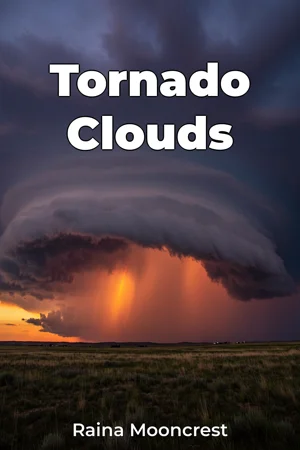
Have you ever wondered what transforms an ordinary thunderstorm into a violently rotating vortex capable of immense destruction? "Tornado Clouds" unravels the complex processes behind tornado formation, focusing on supercell thunderstorms and providing critical insights into recognizing warning signs that could save lives. This book bridges the gap between scientific understanding and practical knowledge, empowering readers to become informed observers of the natural world and take appropriate safety measures. The primary focus of "Tornado Clouds" is threefold: understanding the atmospheric conditions conducive to supercell development, exploring the mechanisms within supercells that lead to tornadogenesis, and identifying visual cues that indicate an imminent tornado. These topics are of paramount importance due to the increasing frequency and intensity of severe weather events globally, making knowledge of tornado formation and prediction crucial for public safety and preparedness. It is essential to understand these weather dynamics as populations expand into historically tornado-prone regions, enhancing the potential for human impact. The book begins by establishing a foundation in atmospheric science, explaining basic meteorological principles such as temperature gradients, air pressure, and wind shear. It then delves into the life cycle of a thunderstorm, differentiating between ordinary storms, multicell storms, and the more dangerous supercell thunderstorms. This lays the groundwork for understanding how unique atmospheric conditions, such as a capping inversion and strong vertical wind shear, contribute to supercell formation. "Tornado Clouds" argues that a comprehensive understanding of supercell dynamics and visual indicators drastically improves tornado awareness and safety. The book’s structure follows a logical progression, starting with an introduction to basic meteorology before building to the complex interplay of forces within a supercell. The initial chapters define key meteorological concepts and outline the general formation of thunderstorms. Subsequent chapters focus on supercell thunderstorms, examining their unique characteristics such as rotating updrafts (mesocyclones), wall clouds, and flanking lines. A dedicated section explores the various stages of tornadogenesis, from the initial formation of a mesocyclone to the development of a visible tornado funnel. The book culminates with a practical guide to identifying tornado warning signs, understanding the role of radar and storm spotters, and implementing personal safety plans. To support its arguments, "Tornado Clouds" draws upon a diverse range of evidence, including radar imagery, observational data from storm chasers, and case studies of significant tornado events. It incorporates analyses from peer-reviewed scientific journals, government reports from agencies like the National Weather Service, and high-resolution photographs and videos of supercells and tornadoes. The book employs a visual approach, using diagrams and illustrations to clarify complex meteorological processes. "Tornado Clouds" connects to several related fields, including climatology, geography, and risk management. By examining the geographical distribution of tornadoes and their relationship to climate patterns, the book offers insights into long-term trends and potential future changes. Its focus on risk assessment ties it to fields concerned with disaster preparedness and mitigation strategies. Furthermore, the book enhances its arguments by discussing the societal impacts of tornadoes, linking it to studies in social sciences related to community resilience and vulnerability. This book distinguishes itself through its accessible yet scientifically rigorous approach. It avoids complex mathematical equations and jargon, preferring clear explanations and illustrative examples. The book maintains a formal tone, presenting information in a direct and authoritative manner, suitable for readers seeking factual knowledge. The target audience includes weather enthusiasts, amateur storm spotters, students studying meteorology or related fields, and anyone living in tornado-prone regions who wants to understand the science behind these destructive phenomena. This book provides valuable information to all those seeking to better understand severe weather and improve their safety. As a work of non-fiction, specifically in the realm of nature and earth sciences, "Tornado Clouds" relies on empirical evidence and established scientific principles. It avoids speculative or sensationalized accounts, adhering to the conventions of scientific writing, including clear definitions, logical reasoning, and accurate data representation. While providing an in-depth examination of tornado formation within supercells, the book does not delve into other types of tornadoes (e.g., landspouts, waterspouts) that form through different mechanisms. The scope is intentionally limited to supercell tornadoes to allow for a more thorough and focused analysis. The knowledge presented in "Tornado Clouds" can be applied in numerous real-world scenarios. It empowers individuals to make informed decisions during severe weather events, assists storm spotters in accurately identifying and reporting potential tornadoes, and provides a valuable resource for educators seeking to teach about severe weather. While the core principles of tornado formation are well-established, there are ongoing debates within the meteorological community regarding the finer points of tornadogenesis and the predictability of tornadoes. The book acknowledges these debates, presenting different perspectives on unresolved questions and highlighting areas for future research.
Have you ever wondered what transforms an ordinary thunderstorm into a violently rotating vortex capable of immense destruction? "Tornado Clouds" unravels the complex processes behind tornado formation, focusing on supercell thunderstorms and providing critical insights into recognizing warning signs that could save lives. This book bridges the gap between scientific understanding and practical knowledge, empowering readers to become informed observers of the natural world and take appropriate safety measures. The primary focus of "Tornado Clouds" is threefold: understanding the atmospheric conditions conducive to supercell development, exploring the mechanisms within supercells that lead to tornadogenesis, and identifying visual cues that indicate an imminent tornado. These topics are of paramount importance due to the increasing frequency and intensity of severe weather events globally, making knowledge of tornado formation and prediction crucial for public safety and preparedness. It is essential to understand these weather dynamics as populations expand into historically tornado-prone regions, enhancing the potential for human impact. The book begins by establishing a foundation in atmospheric science, explaining basic meteorological principles such as temperature gradients, air pressure, and wind shear. It then delves into the life cycle of a thunderstorm, differentiating between ordinary storms, multicell storms, and the more dangerous supercell thunderstorms. This lays the groundwork for understanding how unique atmospheric conditions, such as a capping inversion and strong vertical wind shear, contribute to supercell formation. "Tornado Clouds" argues that a comprehensive understanding of supercell dynamics and visual indicators drastically improves tornado awareness and safety. The book’s structure follows a logical progression, starting with an introduction to basic meteorology before building to the complex interplay of forces within a supercell. The initial chapters define key meteorological concepts and outline the general formation of thunderstorms. Subsequent chapters focus on supercell thunderstorms, examining their unique characteristics such as rotating updrafts (mesocyclones), wall clouds, and flanking lines. A dedicated section explores the various stages of tornadogenesis, from the initial formation of a mesocyclone to the development of a visible tornado funnel. The book culminates with a practical guide to identifying tornado warning signs, understanding the role of radar and storm spotters, and implementing personal safety plans. To support its arguments, "Tornado Clouds" draws upon a diverse range of evidence, including radar imagery, observational data from storm chasers, and case studies of significant tornado events. It incorporates analyses from peer-reviewed scientific journals, government reports from agencies like the National Weather Service, and high-resolution photographs and videos of supercells and tornadoes. The book employs a visual approach, using diagrams and illustrations to clarify complex meteorological processes. "Tornado Clouds" connects to several related fields, including climatology, geography, and risk management. By examining the geographical distribution of tornadoes and their relationship to climate patterns, the book offers insights into long-term trends and potential future changes. Its focus on risk assessment ties it to fields concerned with disaster preparedness and mitigation strategies. Furthermore, the book enhances its arguments by discussing the societal impacts of tornadoes, linking it to studies in social sciences related to community resilience and vulnerability. This book distinguishes itself through its accessible yet scientifically rigorous approach. It avoids complex mathematical equations and jargon, preferring clear explanations and illustrative examples. The book maintains a formal tone, presenting information in a direct and authoritative manner, suitable for readers seeking factual knowledge. The target audience includes weather enthusiasts, amateur storm spotters, students studying meteorology or related fields, and anyone living in tornado-prone regions who wants to understand the science behind these destructive phenomena. This book provides valuable information to all those seeking to better understand severe weather and improve their safety. As a work of non-fiction, specifically in the realm of nature and earth sciences, "Tornado Clouds" relies on empirical evidence and established scientific principles. It avoids speculative or sensationalized accounts, adhering to the conventions of scientific writing, including clear definitions, logical reasoning, and accurate data representation. While providing an in-depth examination of tornado formation within supercells, the book does not delve into other types of tornadoes (e.g., landspouts, waterspouts) that form through different mechanisms. The scope is intentionally limited to supercell tornadoes to allow for a more thorough and focused analysis. The knowledge presented in "Tornado Clouds" can be applied in numerous real-world scenarios. It empowers individuals to make informed decisions during severe weather events, assists storm spotters in accurately identifying and reporting potential tornadoes, and provides a valuable resource for educators seeking to teach about severe weather. While the core principles of tornado formation are well-established, there are ongoing debates within the meteorological community regarding the finer points of tornadogenesis and the predictability of tornadoes. The book acknowledges these debates, presenting different perspectives on unresolved questions and highlighting areas for future research.
"Tornado Clouds" explores the science behind one of nature's most destructive phenomena: tornadoes. Focusing on supercell thunderstorms, the book explains how these powerful storms form and what makes them capable of spawning tornadoes. Readers will discover the crucial role of mesocyclones, rotating updrafts within supercells, and how wind shear contributes to their development. Understanding these weather dynamics is increasingly important as populations grow in tornado-prone areas. The book progresses logically, starting with basic atmospheric science and building to complex supercell dynamics. Using radar imagery, storm chaser observations, and case studies, "Tornado Clouds" offers a visual and accessible explanation of tornado formation. It also highlights tornado warning signs, empowering readers to become informed observers and take necessary safety precautions. This book is valuable for weather enthusiasts, storm spotters, and anyone living in areas affected by severe weather.
Book Details
ISBN
9788233974275
Publisher
Publifye AS
Your Licenses
You don't own any licenses for this book
Purchase a license below to unlock this book and download the EPUB.
Purchase License
Select a tier to unlock this book
Need bulk licensing?
Contact us for enterprise agreements.