
About This Book
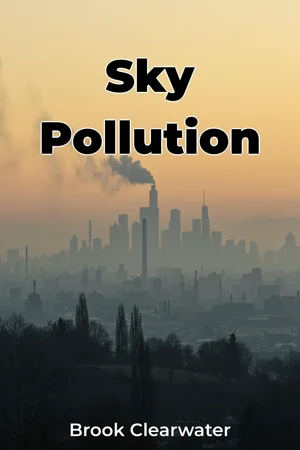
Have you ever paused to consider why the sky appears blue, or how city skylines often fade into a hazy gray? "Sky Pollution" delves into the profound and often overlooked ways in which atmospheric pollutants alter the very essence of our skies, impacting their color, visibility, and the overall quality of the air we breathe. The book examines, from an environmental and geographical standpoint, how human activities have fundamentally changed our relationship with the atmosphere. This exploration is critical because the degradation of our skies serves as a visual indicator of broader environmental problems. Reduced visibility due to smog affects transportation, public health suffers from the inhalation of particulate matter, and ecosystems are altered by the deposition of atmospheric pollutants. Understanding these impacts is essential for informed decision-making and effective environmental stewardship. The study of sky pollution requires a grasp of atmospheric science, chemistry, and geography. These elements will be introduced so that the reader will have a foundational understanding of how pollutants are generated, how they disperse, and how they interact with sunlight and weather patterns. The book argues that sky pollution is not merely an aesthetic issue but a tangible threat to both environmental and human well-being, demanding urgent attention and comprehensive solutions. "Sky Pollution" is structured to provide a comprehensive understanding of the subject. Firstly, the book introduces the basic science of atmospheric optics and pollutant chemistry, explaining how different pollutants affect the scattering and absorption of light. Secondly, the book develops detailed case studies of specific sources of sky pollution such as industrial emissions, vehicle exhaust, and agricultural practices, providing data-driven assessments of their impact. A large section concerns the geographical distribution of sky pollution, highlighting regions most affected and the transboundary nature of atmospheric pollutants. The evidence presented relies heavily on atmospheric monitoring data, satellite imagery analysis, and peer-reviewed research from environmental science and public health. Specific methodologies will include the use of air quality indices, spectrophotometry, and mathematical models to simulate pollutant transport and dispersion. The book also connects to other fields, such as urban planning and public policy. By linking sky pollution to urban sprawl and transportation policies, the book underscores the need for integrated solutions. The implications for public health are assessed through epidemiological studies, demonstrating the links between air quality and respiratory illnesses. What sets “Sky Pollution” apart is its integrated approach, combining scientific analysis with policy recommendations and geographical data. The book is written for a broad audience, including students, policymakers, environmental advocates, and anyone concerned about the quality of the air they breathe. The tone is professional and detailed, yet the text is designed to be accessible to those without a science background. The intended readership includes undergraduate students in environmental science and geography, policymakers involved in air quality regulation, and informed citizens seeking to understand the environmental challenges facing our planet. The book's value lies in its ability to translate complex scientific information into actionable insights, empowering readers to advocate for change and make informed choices. As a book in the environmental and earth sciences geography genres, "Sky Pollution" aims to deliver factual analysis, data-driven evidence, and a clear articulation of the key issues. The scope of the book is global, but with a particular focus on regions with high levels of air pollution like major industrial and urban centers. While the book touches on potential technological solutions, its primary focus is on understanding the problem and its fundamental causes. The information presented can be applied to urban planning, transportation policy, and strategies for reducing industrial emissions. Individuals can use the knowledge gained to make informed choices about their consumption patterns, transportation options, and advocacy efforts. While the scientific consensus on the negative effects of air pollution is strong, debates persist regarding the most effective strategies for mitigation and regulation. "Sky Pollution" addresses these debates by presenting a range of perspectives.
Have you ever paused to consider why the sky appears blue, or how city skylines often fade into a hazy gray? "Sky Pollution" delves into the profound and often overlooked ways in which atmospheric pollutants alter the very essence of our skies, impacting their color, visibility, and the overall quality of the air we breathe. The book examines, from an environmental and geographical standpoint, how human activities have fundamentally changed our relationship with the atmosphere. This exploration is critical because the degradation of our skies serves as a visual indicator of broader environmental problems. Reduced visibility due to smog affects transportation, public health suffers from the inhalation of particulate matter, and ecosystems are altered by the deposition of atmospheric pollutants. Understanding these impacts is essential for informed decision-making and effective environmental stewardship. The study of sky pollution requires a grasp of atmospheric science, chemistry, and geography. These elements will be introduced so that the reader will have a foundational understanding of how pollutants are generated, how they disperse, and how they interact with sunlight and weather patterns. The book argues that sky pollution is not merely an aesthetic issue but a tangible threat to both environmental and human well-being, demanding urgent attention and comprehensive solutions. "Sky Pollution" is structured to provide a comprehensive understanding of the subject. Firstly, the book introduces the basic science of atmospheric optics and pollutant chemistry, explaining how different pollutants affect the scattering and absorption of light. Secondly, the book develops detailed case studies of specific sources of sky pollution such as industrial emissions, vehicle exhaust, and agricultural practices, providing data-driven assessments of their impact. A large section concerns the geographical distribution of sky pollution, highlighting regions most affected and the transboundary nature of atmospheric pollutants. The evidence presented relies heavily on atmospheric monitoring data, satellite imagery analysis, and peer-reviewed research from environmental science and public health. Specific methodologies will include the use of air quality indices, spectrophotometry, and mathematical models to simulate pollutant transport and dispersion. The book also connects to other fields, such as urban planning and public policy. By linking sky pollution to urban sprawl and transportation policies, the book underscores the need for integrated solutions. The implications for public health are assessed through epidemiological studies, demonstrating the links between air quality and respiratory illnesses. What sets “Sky Pollution” apart is its integrated approach, combining scientific analysis with policy recommendations and geographical data. The book is written for a broad audience, including students, policymakers, environmental advocates, and anyone concerned about the quality of the air they breathe. The tone is professional and detailed, yet the text is designed to be accessible to those without a science background. The intended readership includes undergraduate students in environmental science and geography, policymakers involved in air quality regulation, and informed citizens seeking to understand the environmental challenges facing our planet. The book's value lies in its ability to translate complex scientific information into actionable insights, empowering readers to advocate for change and make informed choices. As a book in the environmental and earth sciences geography genres, "Sky Pollution" aims to deliver factual analysis, data-driven evidence, and a clear articulation of the key issues. The scope of the book is global, but with a particular focus on regions with high levels of air pollution like major industrial and urban centers. While the book touches on potential technological solutions, its primary focus is on understanding the problem and its fundamental causes. The information presented can be applied to urban planning, transportation policy, and strategies for reducing industrial emissions. Individuals can use the knowledge gained to make informed choices about their consumption patterns, transportation options, and advocacy efforts. While the scientific consensus on the negative effects of air pollution is strong, debates persist regarding the most effective strategies for mitigation and regulation. "Sky Pollution" addresses these debates by presenting a range of perspectives.
"Sky Pollution" examines how atmospheric pollutants from sources like industrial emissions and vehicle exhaust alter our skies, impacting their color, visibility, and air quality. It highlights how reduced visibility affects transportation and how air pollution contributes to respiratory illnesses, emphasizing the need for environmental stewardship. The book uniquely combines atmospheric science, chemistry, and geography to explain the generation, dispersion, and interaction of pollutants, revealing the tangible threat to both environmental and human well-being. The book progresses from basic atmospheric optics and pollutant chemistry to detailed case studies of pollution sources and their geographical distribution. Using data-driven assessments, satellite imagery analysis, and air quality indices, it showcases the transboundary nature of atmospheric pollutants. By linking sky pollution to urban planning and public policy, "Sky Pollution" underscores the necessity for integrated solutions, making complex scientific information accessible to a broad audience concerned about environmental and earth sciences.
Book Details
ISBN
9788233974251
Publisher
Publifye AS
Your Licenses
You don't own any licenses for this book
Purchase a license below to unlock this book and download the EPUB.
Purchase License
Select a tier to unlock this book
Need bulk licensing?
Contact us for enterprise agreements.