
About This Book
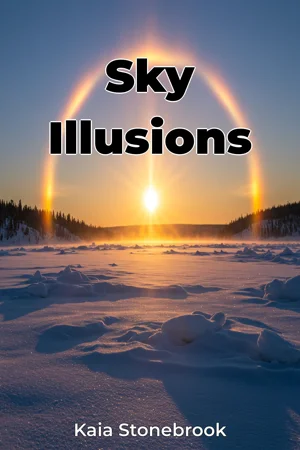
Have you ever looked up at the sky and seen something that seemed impossible, a shimmering halo around the sun or a phantom lake hovering above the horizon? These aren’t tricks of the light; they are real, observable phenomena born from the intricate interplay of light and atmospheric conditions. In "Sky Illusions," we will delve into the science behind these captivating optical effects, exploring halos, sun dogs, mirages, and several other atmospheric phenomena that transform the sky into a canvas of illusion. These topics are not merely interesting curiosities; understanding them provides insights into our atmosphere’s composition, temperature gradients, and the behavior of light itself. Recognizing these phenomena also enhances our appreciation of the natural world and allows us to interpret weather patterns and atmospheric conditions more effectively. This book examines the historical context of sky illusions, tracing back to ancient observations and interpretations, often steeped in mythology and folklore. We build upon the fundamental physics of light refraction, reflection, and diffraction, explaining how these principles manifest in the atmosphere. While basic knowledge of physics is beneficial, all concepts are explained clearly and accessibly. The central argument of "Sky Illusions" is that understanding the science behind optical atmospheric events illuminates fundamental principles of physics, meteorology, and geography, fostering a deeper comprehension of our environment. This understanding moves beyond simple observation to informed interpretation, enabling a more nuanced appreciation of the natural world and its processes. We begin by introducing the basic properties of light and the atmospheric elements that influence its path. The book proceeds in three major sections. The first details halos and related phenomena, explaining how ice crystals in the upper atmosphere refract sunlight to create rings, arcs, and bright spots. The second section explores mirages, both inferior (appearing below the object) and superior (appearing above the object), demonstrating how temperature gradients near the Earth’s surface bend light to create these deceptive images. The third section investigates other intriguing illusions, such as glories, coronas, and iridescence, detailing their formation mechanisms and the conditions under which they typically occur. The argument culminates by demonstrating how observing these illusions can provide valuable information about atmospheric conditions and the weather. The practical implications include aiding in weather forecasting, understanding the effects of pollution on atmospheric optics, and simply enhancing one's ability to interpret the visual world. The evidence presented is drawn from extensive research in atmospheric physics, meteorology, and optical studies. We utilize observational data, including photographs and meteorological records, as well as computer simulations to illustrate the complex interactions of light and atmospheric elements. Unique data sources include high-altitude balloon measurements of atmospheric temperature and humidity, which help to model the formation of mirages. "Sky Illusions" connects to several other fields. Firstly, its exploration of light and optics directly relates to physics. Secondly, its investigation of atmospheric conditions is deeply intertwined with meteorology. Thirdly, understanding the geographic distribution of certain illusions, such as mirages in deserts or halos in polar regions, relates to geography. These interdisciplinary connections enrich the core argument by highlighting the diverse factors that contribute to the creation and observation of sky illusions. This book adopts a unique approach by combining scientific explanations with practical observation techniques. It provides readers with the tools to not only understand the underlying principles but also to identify and interpret these phenomena in their own environments. The writing style is accessible and engaging, aiming to make complex scientific concepts understandable and enjoyable for a broad audience. The target audience includes amateur astronomers, weather enthusiasts, students of physics and geography, and anyone with a general interest in the natural world. This book would be valuable to them because it offers a comprehensive and accessible explanation of captivating natural phenomena, fostering a deeper understanding of our environment and the science that governs it. As a work of non-fiction within the science and earth sciences/geography genres, "Sky Illusions" adheres to the conventions of accuracy, clarity, and evidence-based reasoning. It presents information in a structured and logical manner, supported by scientific data and research. The scope of "Sky Illusions" is intentionally limited to optical phenomena occurring primarily in the troposphere and lower stratosphere. It does not delve into more complex topics such as upper atmospheric phenomena or advanced optical theory. This limitation allows for a focused and in-depth exploration of the selected illusions. The information presented in "Sky Illusions" has real-world applications, such as aiding in weather forecasting by understanding the atmospheric conditions that produce certain illusions. It also enhances observational skills, enabling readers to interpret the visual world more effectively. While the basic principles of atmospheric optics are well-established, there are ongoing debates regarding the precise details of cloud microphysics and the formation of certain rare optical phenomena. This book touches upon these debates where relevant, presenting different perspectives and highlighting areas of ongoing research.
Have you ever looked up at the sky and seen something that seemed impossible, a shimmering halo around the sun or a phantom lake hovering above the horizon? These aren’t tricks of the light; they are real, observable phenomena born from the intricate interplay of light and atmospheric conditions. In "Sky Illusions," we will delve into the science behind these captivating optical effects, exploring halos, sun dogs, mirages, and several other atmospheric phenomena that transform the sky into a canvas of illusion. These topics are not merely interesting curiosities; understanding them provides insights into our atmosphere’s composition, temperature gradients, and the behavior of light itself. Recognizing these phenomena also enhances our appreciation of the natural world and allows us to interpret weather patterns and atmospheric conditions more effectively. This book examines the historical context of sky illusions, tracing back to ancient observations and interpretations, often steeped in mythology and folklore. We build upon the fundamental physics of light refraction, reflection, and diffraction, explaining how these principles manifest in the atmosphere. While basic knowledge of physics is beneficial, all concepts are explained clearly and accessibly. The central argument of "Sky Illusions" is that understanding the science behind optical atmospheric events illuminates fundamental principles of physics, meteorology, and geography, fostering a deeper comprehension of our environment. This understanding moves beyond simple observation to informed interpretation, enabling a more nuanced appreciation of the natural world and its processes. We begin by introducing the basic properties of light and the atmospheric elements that influence its path. The book proceeds in three major sections. The first details halos and related phenomena, explaining how ice crystals in the upper atmosphere refract sunlight to create rings, arcs, and bright spots. The second section explores mirages, both inferior (appearing below the object) and superior (appearing above the object), demonstrating how temperature gradients near the Earth’s surface bend light to create these deceptive images. The third section investigates other intriguing illusions, such as glories, coronas, and iridescence, detailing their formation mechanisms and the conditions under which they typically occur. The argument culminates by demonstrating how observing these illusions can provide valuable information about atmospheric conditions and the weather. The practical implications include aiding in weather forecasting, understanding the effects of pollution on atmospheric optics, and simply enhancing one's ability to interpret the visual world. The evidence presented is drawn from extensive research in atmospheric physics, meteorology, and optical studies. We utilize observational data, including photographs and meteorological records, as well as computer simulations to illustrate the complex interactions of light and atmospheric elements. Unique data sources include high-altitude balloon measurements of atmospheric temperature and humidity, which help to model the formation of mirages. "Sky Illusions" connects to several other fields. Firstly, its exploration of light and optics directly relates to physics. Secondly, its investigation of atmospheric conditions is deeply intertwined with meteorology. Thirdly, understanding the geographic distribution of certain illusions, such as mirages in deserts or halos in polar regions, relates to geography. These interdisciplinary connections enrich the core argument by highlighting the diverse factors that contribute to the creation and observation of sky illusions. This book adopts a unique approach by combining scientific explanations with practical observation techniques. It provides readers with the tools to not only understand the underlying principles but also to identify and interpret these phenomena in their own environments. The writing style is accessible and engaging, aiming to make complex scientific concepts understandable and enjoyable for a broad audience. The target audience includes amateur astronomers, weather enthusiasts, students of physics and geography, and anyone with a general interest in the natural world. This book would be valuable to them because it offers a comprehensive and accessible explanation of captivating natural phenomena, fostering a deeper understanding of our environment and the science that governs it. As a work of non-fiction within the science and earth sciences/geography genres, "Sky Illusions" adheres to the conventions of accuracy, clarity, and evidence-based reasoning. It presents information in a structured and logical manner, supported by scientific data and research. The scope of "Sky Illusions" is intentionally limited to optical phenomena occurring primarily in the troposphere and lower stratosphere. It does not delve into more complex topics such as upper atmospheric phenomena or advanced optical theory. This limitation allows for a focused and in-depth exploration of the selected illusions. The information presented in "Sky Illusions" has real-world applications, such as aiding in weather forecasting by understanding the atmospheric conditions that produce certain illusions. It also enhances observational skills, enabling readers to interpret the visual world more effectively. While the basic principles of atmospheric optics are well-established, there are ongoing debates regarding the precise details of cloud microphysics and the formation of certain rare optical phenomena. This book touches upon these debates where relevant, presenting different perspectives and highlighting areas of ongoing research.
"Sky Illusions" explores the captivating world of atmospheric optics, revealing the science behind phenomena like shimmering halos and mirages. These aren't mere tricks of light but real occurrences influenced by atmospheric conditions. The book delves into how ice crystals create halos and sun dogs through light refraction, and how temperature gradients cause mirages, bending light to create illusions of water or displaced objects. Understanding these sky illusions offers insights into weather patterns and the atmosphere's composition. The book begins with the basic properties of light and atmospheric elements, then progresses through halos, mirages, and other intriguing illusions like glories and coronas. It connects these phenomena to physics, meteorology, and geography, demonstrating how observing these illusions can provide valuable information about atmospheric conditions. This approach allows readers to not only understand the science but also to identify and interpret these phenomena, enhancing their appreciation of the natural world. "Sky Illusions" uniquely combines scientific explanations with practical observation, making complex concepts accessible. The book's value lies in its ability to transform casual sky observation into informed interpretation, aiding in weather forecasting and deepening our understanding of the environment.
Book Details
ISBN
9788233974152
Publisher
Publifye AS
Your Licenses
You don't own any licenses for this book
Purchase a license below to unlock this book and download the EPUB.
Purchase License
Select a tier to unlock this book
Need bulk licensing?
Contact us for enterprise agreements.