
About This Book
Have you ever paused to consider why the sky blazes with vibrant hues at sunrise and sunset, or why storm clouds often appear a menacing gray? "Cloud Colors" delves into the intricate science behind these atmospheric spectacles, exploring the physical processes that transform clouds into dynamic canvases of color. This book is an exploration of light, atmospheric conditions, and the fascinating interplay that results in the varied and beautiful cloudscapes we observe. Understanding these phenomena not only enriches our appreciation of the natural world but also provides insights into weather patterns and atmospheric science. "Cloud Colors" primarily focuses on two core concepts: light scattering and absorption within the atmosphere, and the influence of water droplets and ice crystals on the visual appearance of clouds. The book examines how different wavelengths of light interact with these particles, leading to the diverse palette of colors we perceive. Understanding these principles is key to interpreting cloud formations as indicators of current and future weather conditions. To fully appreciate the science of cloud colors, a basic understanding of light and the electromagnetic spectrum is helpful, though all concepts will be explained. The book begins with a brief overview of the history of atmospheric observation and the development of scientific theories explaining cloud formation and behavior. The central argument of "Cloud Colors" is that the color of a cloud is not merely aesthetic but a direct indicator of its composition, altitude, and the atmospheric conditions surrounding it. By understanding the underlying principles of light interaction and cloud physics, observers can gain valuable insights into weather prediction and atmospheric processes. The book is structured into three main sections. The first section introduces the fundamental principles of light scattering, absorption, and reflection, with a focus on how these processes operate within the atmosphere. Terminology will be clearly defined, and illustrative examples will be provided to ensure comprehension. The second section examines the specific conditions that lead to different cloud colors. Chapters will address sunrise and sunset coloration, the grayness of storm clouds, and the vibrant colors sometimes seen in iridescent clouds. Each case study will include detailed explanations of the relevant atmospheric conditions and the physical processes at play. The third and final section explores the applications of cloud color interpretation in fields such as meteorology and climate science. It will also delve into the role of cloud observation in art and culture. "Cloud Colors" presents a range of evidence to support its arguments, drawing on scientific literature, observational data, and photographic examples. The book utilizes diagrams and illustrations to visually explain complex processes, along with real-world examples of cloud formations and their associated weather conditions. This book intersects with several other fields, including meteorology, physics, and art. Meteorological science provides the basis for understanding weather systems and cloud formation. Physics explains the behavior of light and its interaction with matter. Art provides inspiration for appreciating the aesthetic aspects of clouds and their colors. These interdisciplinary connections enrich the reader's understanding of the subject matter. "Cloud Colors" distinguishes itself by offering a comprehensive and accessible explanation of the science behind cloud coloration. It blends rigorous scientific analysis with engaging explanations, making it suitable for both amateur weather enthusiasts and more advanced readers. The book adopts a conversational yet informative tone, breaking down complex concepts into easily digestible information. The book is aimed at weather enthusiasts, amateur photographers, students of earth science, and anyone with a general interest in the natural world. It offers a unique perspective on a common phenomenon, providing readers with the knowledge to interpret and appreciate the colors of the sky. As a work of non-fiction within the Earth Sciences genre, "Cloud Colors" adheres to principles of accuracy, objectivity, and clear communication. It presents information in a systematic and evidence-based manner. The book focuses specifically on the science of cloud colors, excluding other broader discussions of atmospheric science. The knowledge gained from "Cloud Colors" can be applied in several practical ways. Observers can use cloud colors to make informed predictions about upcoming weather, enhancing their preparedness for changing atmospheric conditions. While the book touches on prevailing scientific theories, it acknowledges that there are constantly evolving debates for more precise climate models and the role clouds play within them. "Cloud Colors" provides a foundation for understanding these discussions.
Have you ever paused to consider why the sky blazes with vibrant hues at sunrise and sunset, or why storm clouds often appear a menacing gray? "Cloud Colors" delves into the intricate science behind these atmospheric spectacles, exploring the physical processes that transform clouds into dynamic canvases of color. This book is an exploration of light, atmospheric conditions, and the fascinating interplay that results in the varied and beautiful cloudscapes we observe. Understanding these phenomena not only enriches our appreciation of the natural world but also provides insights into weather patterns and atmospheric science. "Cloud Colors" primarily focuses on two core concepts: light scattering and absorption within the atmosphere, and the influence of water droplets and ice crystals on the visual appearance of clouds. The book examines how different wavelengths of light interact with these particles, leading to the diverse palette of colors we perceive. Understanding these principles is key to interpreting cloud formations as indicators of current and future weather conditions. To fully appreciate the science of cloud colors, a basic understanding of light and the electromagnetic spectrum is helpful, though all concepts will be explained. The book begins with a brief overview of the history of atmospheric observation and the development of scientific theories explaining cloud formation and behavior. The central argument of "Cloud Colors" is that the color of a cloud is not merely aesthetic but a direct indicator of its composition, altitude, and the atmospheric conditions surrounding it. By understanding the underlying principles of light interaction and cloud physics, observers can gain valuable insights into weather prediction and atmospheric processes. The book is structured into three main sections. The first section introduces the fundamental principles of light scattering, absorption, and reflection, with a focus on how these processes operate within the atmosphere. Terminology will be clearly defined, and illustrative examples will be provided to ensure comprehension. The second section examines the specific conditions that lead to different cloud colors. Chapters will address sunrise and sunset coloration, the grayness of storm clouds, and the vibrant colors sometimes seen in iridescent clouds. Each case study will include detailed explanations of the relevant atmospheric conditions and the physical processes at play. The third and final section explores the applications of cloud color interpretation in fields such as meteorology and climate science. It will also delve into the role of cloud observation in art and culture. "Cloud Colors" presents a range of evidence to support its arguments, drawing on scientific literature, observational data, and photographic examples. The book utilizes diagrams and illustrations to visually explain complex processes, along with real-world examples of cloud formations and their associated weather conditions. This book intersects with several other fields, including meteorology, physics, and art. Meteorological science provides the basis for understanding weather systems and cloud formation. Physics explains the behavior of light and its interaction with matter. Art provides inspiration for appreciating the aesthetic aspects of clouds and their colors. These interdisciplinary connections enrich the reader's understanding of the subject matter. "Cloud Colors" distinguishes itself by offering a comprehensive and accessible explanation of the science behind cloud coloration. It blends rigorous scientific analysis with engaging explanations, making it suitable for both amateur weather enthusiasts and more advanced readers. The book adopts a conversational yet informative tone, breaking down complex concepts into easily digestible information. The book is aimed at weather enthusiasts, amateur photographers, students of earth science, and anyone with a general interest in the natural world. It offers a unique perspective on a common phenomenon, providing readers with the knowledge to interpret and appreciate the colors of the sky. As a work of non-fiction within the Earth Sciences genre, "Cloud Colors" adheres to principles of accuracy, objectivity, and clear communication. It presents information in a systematic and evidence-based manner. The book focuses specifically on the science of cloud colors, excluding other broader discussions of atmospheric science. The knowledge gained from "Cloud Colors" can be applied in several practical ways. Observers can use cloud colors to make informed predictions about upcoming weather, enhancing their preparedness for changing atmospheric conditions. While the book touches on prevailing scientific theories, it acknowledges that there are constantly evolving debates for more precise climate models and the role clouds play within them. "Cloud Colors" provides a foundation for understanding these discussions.
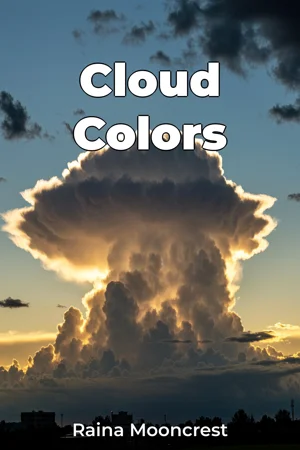
"Cloud Colors" explores the captivating science behind the colors we see in clouds, revealing how atmospheric conditions and light interaction create stunning visual displays. The book delves into the core principles of light scattering and absorption, explaining how water droplets and ice crystals influence the colors we perceive. For example, the vibrant hues at sunrise and sunset are a result of light scattering, while the menacing gray of storm clouds indicates specific atmospheric conditions. This exploration of atmospheric science progresses systematically, starting with the history of cloud observation and fundamental principles of light. It then examines specific conditions leading to different cloud colors, such as those seen in iridescent clouds, using real-world examples and detailed explanations. The book uniquely combines rigorous scientific analysis with accessible language, making complex concepts understandable for a broad audience. Ultimately, "Cloud Colors" demonstrates that a cloud's color is not merely aesthetic but a direct indicator of its composition, altitude, and surrounding atmospheric conditions. By understanding these principles, readers can gain valuable insights into weather patterns, enriching their appreciation of the natural world. The book concludes by exploring the applications of cloud color interpretation in meteorology, climate science, art, and culture.
Book Details
ISBN
9788233974077
Publisher
Publifye AS
Your Licenses
You don't own any licenses for this book
Purchase a license below to unlock this book and download the EPUB.
Purchase License
Select a tier to unlock this book
Need bulk licensing?
Contact us for enterprise agreements.