
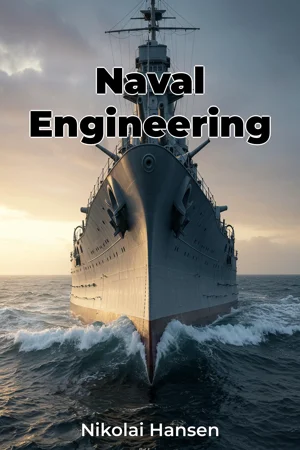
About This Book
How has the intricate dance between naval architecture and evolving military strategy shaped the course of maritime history and technological advancement? This book, "Naval Engineering," delves into the fundamental principles that govern ship design, stability, and propulsion, exploring how these elements have been refined and revolutionized across centuries of naval warfare and peacetime innovation. These core concepts are not merely theoretical; they represent the foundation upon which naval power, maritime trade, and oceanic exploration are built, making their understanding crucial for anyone involved in or studying these domains. The book provides a comprehensive examination of naval engineering principles, framed within the historical context of their development and application. It considers the social and military pressures that have driven innovation in naval technology, from the age of sail to the nuclear era. While a basic understanding of physics and mechanics will be beneficial, the text is structured to progressively introduce complex concepts, ensuring accessibility for a broad audience. The central argument of "Naval Engineering" is that the evolution of naval technology is inextricably linked to the strategic and tactical demands of naval warfare, as well as the concurrent advancements in civilian maritime practices. This connection underscores the critical role of naval engineering not only in military history but also in the broader context of technological progress. The book is structured in three major parts. First, it introduces the fundamental concepts of naval architecture, including hull design, hydrostatics, and hydrodynamics. This section examines the principles that govern a ship's stability, buoyancy, and resistance to motion, drawing upon technical papers and established maritime standards. Second, it explores various propulsion systems, from sail and steam to diesel and nuclear power. Each system is analyzed in terms of its efficiency, performance, and impact on ship design. Lastly, the text examines the integration of these systems within the broader context of naval operations, covering topics such as damage control, survivability, and the influence of technology on naval strategy. The arguments presented are supported by a wealth of technical data, historical records, and case studies. The book draws upon archival materials from naval museums, historical societies, and engineering institutions, providing unique insights into the design and construction of naval vessels throughout history. Furthermore, it references relevant maritime standards and regulatory frameworks, ensuring a practical and up-to-date perspective on engineering practices. "Naval Engineering" connects strongly to several interdisciplinary fields including Military History, Mechanical Engineering, and broader Historical considerations of Military advancement. Its content provides a practical guide for maritime professionals, naval historians, mechanical engineers, and students interested in the intersection of technology and military strategy. The book's approach stands out is its dual focus on both the theoretical underpinnings of naval engineering and the practical application of these principles in real-world scenarios. The tone and style of the book is fact-based, analytical, and accessible. Complex concepts are explained clearly and concisely, with an emphasis on visual aids such as diagrams, illustrations, and photographs to enhance understanding. The book is targeted at naval officers, maritime professionals, engineering students, military historians, and anyone with a deep interest in naval technology and maritime history. The book offers a comprehensive survey of naval engineering principles, with a particular emphasis on the historical context of their development and application. While it does not delve into the intricacies of specific ship designs or combat tactics, it provides a solid foundation for understanding the technological underpinnings of naval power. The information within this book can be directly applied to the study and analysis of naval history, the design and operation of maritime vessels, and the development of future naval technologies. While the core principles of naval engineering remain constant, their application is subject to ongoing debate and refinement. This book acknowledges these controversies, presenting different perspectives on key issues such as the optimal hull design for different types of vessels, the relative merits of various propulsion systems, and the trade-offs between performance, cost, and survivability.
How has the intricate dance between naval architecture and evolving military strategy shaped the course of maritime history and technological advancement? This book, "Naval Engineering," delves into the fundamental principles that govern ship design, stability, and propulsion, exploring how these elements have been refined and revolutionized across centuries of naval warfare and peacetime innovation. These core concepts are not merely theoretical; they represent the foundation upon which naval power, maritime trade, and oceanic exploration are built, making their understanding crucial for anyone involved in or studying these domains. The book provides a comprehensive examination of naval engineering principles, framed within the historical context of their development and application. It considers the social and military pressures that have driven innovation in naval technology, from the age of sail to the nuclear era. While a basic understanding of physics and mechanics will be beneficial, the text is structured to progressively introduce complex concepts, ensuring accessibility for a broad audience. The central argument of "Naval Engineering" is that the evolution of naval technology is inextricably linked to the strategic and tactical demands of naval warfare, as well as the concurrent advancements in civilian maritime practices. This connection underscores the critical role of naval engineering not only in military history but also in the broader context of technological progress. The book is structured in three major parts. First, it introduces the fundamental concepts of naval architecture, including hull design, hydrostatics, and hydrodynamics. This section examines the principles that govern a ship's stability, buoyancy, and resistance to motion, drawing upon technical papers and established maritime standards. Second, it explores various propulsion systems, from sail and steam to diesel and nuclear power. Each system is analyzed in terms of its efficiency, performance, and impact on ship design. Lastly, the text examines the integration of these systems within the broader context of naval operations, covering topics such as damage control, survivability, and the influence of technology on naval strategy. The arguments presented are supported by a wealth of technical data, historical records, and case studies. The book draws upon archival materials from naval museums, historical societies, and engineering institutions, providing unique insights into the design and construction of naval vessels throughout history. Furthermore, it references relevant maritime standards and regulatory frameworks, ensuring a practical and up-to-date perspective on engineering practices. "Naval Engineering" connects strongly to several interdisciplinary fields including Military History, Mechanical Engineering, and broader Historical considerations of Military advancement. Its content provides a practical guide for maritime professionals, naval historians, mechanical engineers, and students interested in the intersection of technology and military strategy. The book's approach stands out is its dual focus on both the theoretical underpinnings of naval engineering and the practical application of these principles in real-world scenarios. The tone and style of the book is fact-based, analytical, and accessible. Complex concepts are explained clearly and concisely, with an emphasis on visual aids such as diagrams, illustrations, and photographs to enhance understanding. The book is targeted at naval officers, maritime professionals, engineering students, military historians, and anyone with a deep interest in naval technology and maritime history. The book offers a comprehensive survey of naval engineering principles, with a particular emphasis on the historical context of their development and application. While it does not delve into the intricacies of specific ship designs or combat tactics, it provides a solid foundation for understanding the technological underpinnings of naval power. The information within this book can be directly applied to the study and analysis of naval history, the design and operation of maritime vessels, and the development of future naval technologies. While the core principles of naval engineering remain constant, their application is subject to ongoing debate and refinement. This book acknowledges these controversies, presenting different perspectives on key issues such as the optimal hull design for different types of vessels, the relative merits of various propulsion systems, and the trade-offs between performance, cost, and survivability.
"Naval Engineering" explores the intertwined history of ship design and military strategy, revealing how naval architecture has shaped maritime history. It examines core principles like hydrostatics and hydrodynamics, crucial for understanding ship stability and movement. Readers will discover how social and military pressures drove innovation, from sail to nuclear power, influencing naval technology across centuries. The book progresses systematically, first covering hull design and the science of ship stability. It then explores propulsion systems, comparing the efficiency of sail, steam, diesel, and nuclear power. Finally, it integrates these systems within naval operations, discussing survivability and the impact of technology on military strategy. Supported by historical records and technical data, this book offers a unique perspective on naval technology's role in military and civilian maritime advancements.
Book Details
ISBN
9788233973735
Publisher
Publifye AS
Your Licenses
You don't own any licenses for this book
Purchase a license below to unlock this book and download the EPUB.
Purchase License
Select a tier to unlock this book
Need bulk licensing?
Contact us for enterprise agreements.