
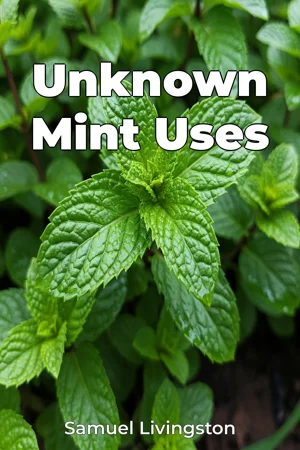
About This Book
Did you know that the humble mint plant, often relegated to flavoring gum or garnishing desserts, possesses a range of properties impacting both cognitive function and digestive health that are only now coming into sharper focus? "Unknown Mint Uses" delves into the surprising science behind this common herb, exploring its multifaceted role in promoting well-being. This book is not merely a culinary guide; it is a journey into the biological and chemical intricacies that render mint a potent, natural agent. We will embark on a detailed exploration of mint's effects on the brain, examining the latest research on how specific compounds in mint, such as menthol and rosmarinic acid, can influence memory, focus, and overall cognitive performance. In parallel, we will scrutinize mint's significant role in digestion, analyzing how it can alleviate symptoms of irritable bowel syndrome (IBS), reduce bloating, and promote healthy gut motility. These seemingly disparate areas are interconnected through the plant's unique biochemical profile. Historically, mint has been used in traditional medicine for centuries, suggesting an intuitive understanding of its therapeutic qualities long before modern scientific methods could validate these claims. However, much of this historical use lacks rigorous scientific backing. This book aims to bridge that gap by synthesizing historical applications with current scientific research, providing a comprehensive and evidence-based understanding of mint's potential. The central argument of "Unknown Mint Uses" is that mint offers quantifiable benefits for both cognitive and digestive health, substantiated by a growing body of scientific literature, and is thus underexplored in modern wellness practices. It provides actionable and applicable insight into how mint can be implemented to bolster health management. The structure of the book is as follows: First, we will introduce the key chemical compounds found in various mint species and their known mechanisms of action. Second, we will dedicate separate sections on mint's impact on cognitive function and digestive health, thoroughly explaining how its components interact with the body. Third, we will culminate with a discussion of practical applications, including proper usage guidelines, potential risks, and dosage recommendations, and a look at how mint integrates into broader wellness strategies. The evidence presented throughout the book will draw heavily from peer-reviewed studies in biology, chemistry, and medicine. We will analyze clinical trials, in-vitro experiments, and epidemiological data to provide a balanced and factual portrayal of mint's effects. A significant portion of the book will be dedicated to interpreting and synthesizing research findings, accounting for variables such as species of mint, method of consumption, and individual patient factors. The information presented naturally connects to fields such as neurology, gastroenterology, and pharmacology, as well as areas like botany and the study of natural remedies. This interdisciplinary approach enhances the book's argument by providing a more holistic view of mint's effects, situating it within a bigger context. What sets this book apart is its focus on translating complex scientific findings into accessible, actionable information for the general reader. It avoids overly technical jargon and emphasizes practical applications, empowering readers to make informed decisions about their health. Written in a clear, conversational style, "Unknown Mint Uses" avoids technical language where possible and ensures that the complex scientific concepts are easy to grasp. This ensures that the book is both informative and engaging. The target audience includes health-conscious individuals, those interested in natural remedies, and anyone seeking to improve their cognitive function or digestive health through evidence-based practices. It would also appeal to students and professionals in related fields seeking a current review of the literature. As a work of non-fiction falling into the categories of Biology, Health & Fitness, and Science (Life Sciences), this book adheres to the standards of accuracy, objectivity, and transparency. All claims are supported by credible sources, and potential biases or limitations are openly acknowledged. The scope of "Unknown Mint Uses" is limited to the documented effects of mint on cognitive function and digestive health, with a focus on the most commonly studied species, such as peppermint and spearmint. It does not delve into the broader applications of mint in aromatherapy or cosmetic products, which is a separate area of study. The real-world applications described in the book are numerous, ranging from simple lifestyle modifications, such as incorporating mint tea into one’s daily routine, to more targeted therapeutic interventions, such as using enteric-coated peppermint oil capsules for IBS relief. While the overall body of research supports mint's efficacy for certain conditions, controversies remain regarding optimal dosage, long-term effects, and the specific mechanisms underlying its benefits. "Unknown Mint Uses" will address these debates, presenting different viewpoints and highlighting areas where further research is needed.
Did you know that the humble mint plant, often relegated to flavoring gum or garnishing desserts, possesses a range of properties impacting both cognitive function and digestive health that are only now coming into sharper focus? "Unknown Mint Uses" delves into the surprising science behind this common herb, exploring its multifaceted role in promoting well-being. This book is not merely a culinary guide; it is a journey into the biological and chemical intricacies that render mint a potent, natural agent. We will embark on a detailed exploration of mint's effects on the brain, examining the latest research on how specific compounds in mint, such as menthol and rosmarinic acid, can influence memory, focus, and overall cognitive performance. In parallel, we will scrutinize mint's significant role in digestion, analyzing how it can alleviate symptoms of irritable bowel syndrome (IBS), reduce bloating, and promote healthy gut motility. These seemingly disparate areas are interconnected through the plant's unique biochemical profile. Historically, mint has been used in traditional medicine for centuries, suggesting an intuitive understanding of its therapeutic qualities long before modern scientific methods could validate these claims. However, much of this historical use lacks rigorous scientific backing. This book aims to bridge that gap by synthesizing historical applications with current scientific research, providing a comprehensive and evidence-based understanding of mint's potential. The central argument of "Unknown Mint Uses" is that mint offers quantifiable benefits for both cognitive and digestive health, substantiated by a growing body of scientific literature, and is thus underexplored in modern wellness practices. It provides actionable and applicable insight into how mint can be implemented to bolster health management. The structure of the book is as follows: First, we will introduce the key chemical compounds found in various mint species and their known mechanisms of action. Second, we will dedicate separate sections on mint's impact on cognitive function and digestive health, thoroughly explaining how its components interact with the body. Third, we will culminate with a discussion of practical applications, including proper usage guidelines, potential risks, and dosage recommendations, and a look at how mint integrates into broader wellness strategies. The evidence presented throughout the book will draw heavily from peer-reviewed studies in biology, chemistry, and medicine. We will analyze clinical trials, in-vitro experiments, and epidemiological data to provide a balanced and factual portrayal of mint's effects. A significant portion of the book will be dedicated to interpreting and synthesizing research findings, accounting for variables such as species of mint, method of consumption, and individual patient factors. The information presented naturally connects to fields such as neurology, gastroenterology, and pharmacology, as well as areas like botany and the study of natural remedies. This interdisciplinary approach enhances the book's argument by providing a more holistic view of mint's effects, situating it within a bigger context. What sets this book apart is its focus on translating complex scientific findings into accessible, actionable information for the general reader. It avoids overly technical jargon and emphasizes practical applications, empowering readers to make informed decisions about their health. Written in a clear, conversational style, "Unknown Mint Uses" avoids technical language where possible and ensures that the complex scientific concepts are easy to grasp. This ensures that the book is both informative and engaging. The target audience includes health-conscious individuals, those interested in natural remedies, and anyone seeking to improve their cognitive function or digestive health through evidence-based practices. It would also appeal to students and professionals in related fields seeking a current review of the literature. As a work of non-fiction falling into the categories of Biology, Health & Fitness, and Science (Life Sciences), this book adheres to the standards of accuracy, objectivity, and transparency. All claims are supported by credible sources, and potential biases or limitations are openly acknowledged. The scope of "Unknown Mint Uses" is limited to the documented effects of mint on cognitive function and digestive health, with a focus on the most commonly studied species, such as peppermint and spearmint. It does not delve into the broader applications of mint in aromatherapy or cosmetic products, which is a separate area of study. The real-world applications described in the book are numerous, ranging from simple lifestyle modifications, such as incorporating mint tea into one’s daily routine, to more targeted therapeutic interventions, such as using enteric-coated peppermint oil capsules for IBS relief. While the overall body of research supports mint's efficacy for certain conditions, controversies remain regarding optimal dosage, long-term effects, and the specific mechanisms underlying its benefits. "Unknown Mint Uses" will address these debates, presenting different viewpoints and highlighting areas where further research is needed.
"Unknown Mint Uses" explores the surprising health benefits of mint, moving beyond its common culinary uses to reveal its impact on cognitive function and digestive health. It highlights how compounds like menthol and rosmarinic acid found in peppermint and spearmint may improve memory and focus, while also alleviating symptoms of Irritable Bowel Syndrome (IBS) and promoting gut health. Mint's historical use in traditional medicine hinted at these benefits, and this book bridges the gap between those traditions and modern scientific validation. The book presents evidence-based insights into how mint can be used to enhance wellness, substantiated by research in biology, chemistry, and medicine. It begins by introducing the key chemical compounds in mint, then dedicates sections to mint's effects on cognitive function and digestive health. It culminates with practical applications, including usage guidelines and dosage recommendations, making complex scientific findings accessible and actionable for a general audience interested in natural remedies and wellness.
Book Details
ISBN
9788233973278
Publisher
Publifye AS
Your Licenses
You don't own any licenses for this book
Purchase a license below to unlock this book and download the EPUB.
Purchase License
Select a tier to unlock this book
Need bulk licensing?
Contact us for enterprise agreements.