
About This Book
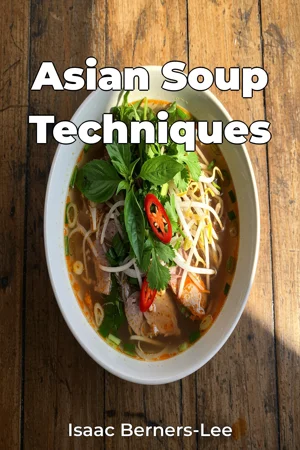
Have you ever considered the profound cultural significance contained within a single bowl of soup? "Asian Soup Techniques" delves into the heart of East and Southeast Asian culinary traditions, exploring the diverse and nuanced world of broths, ingredients, and techniques that define this fundamental food. This book examines not only the "how" of creating exquisite Asian soups but also the "why," revealing the historical, social, and cultural influences that have shaped these beloved dishes. The book centers around three key topics: the foundational broths, the regional variations in ingredients, and the specialized techniques employed in creating authentic Asian soups. Understanding these elements is crucial for anyone seeking to replicate or innovate within this culinary landscape. Broths, often simmered for hours or even days, form the soul of the soup, while regional ingredients – from Japanese seaweed to Southeast Asian spices – dictate the flavor profiles. Finally, mastering techniques such as blanching, layering flavors, and achieving the perfect texture elevates a simple soup into a culinary masterpiece. "Asian Soup Techniques" argues that soup-making in East and Southeast Asia is far more than a mere cooking process; it is a reflection of cultural values, regional identities, and historical exchange. This argument is supported by detailed analysis of soup traditions across various countries, tracing the origins and evolutions of specific recipes and techniques. The book examines soy-based and miso-based approaches to broth creation, common in certain regions, while contrasting them with clearer, lighter broths found elsewhere. The book begins by establishing the importance of soup in Asian cuisine and outlining the basic principles of broth-making. It then progresses through regional chapters, each dedicated to a specific area, such as Japan, Korea, China, Vietnam, and Thailand. These sections detail the signature soups of each region, exploring their unique ingredients, preparation methods, and cultural significance. The book culminates in a discussion of modern adaptations and innovations in Asian soup-making, encouraging readers to experiment and create their own variations while respecting traditional techniques. The research presented in "Asian Soup Techniques" draws upon a variety of sources, including historical cookbooks, culinary anthropology studies, and interviews with chefs and home cooks. It incorporates detailed recipes, step-by-step instructions, and vibrant photographs to illustrate key techniques and ingredients. The book connects to broader fields of study, including anthropology, history, and nutrition. By examining the cultural context of soup-making, it offers insights into the social values and dietary habits of different communities. Furthermore, by analyzing the nutritional content of various soups, it provides valuable information for health-conscious cooks. "Asian Soup Techniques" offers a unique perspective by combining practical cooking instruction with scholarly analysis. It avoids overly simplistic generalizations, instead presenting a nuanced and detailed account of the diverse soup traditions of East and Southeast Asia. Written in a clear and accessible style, the book is aimed at home cooks, culinary students, and food enthusiasts interested in expanding their knowledge of Asian cuisine. It will appeal to those who appreciate authentic flavors, traditional techniques, and the cultural significance of food. As a work of food writing, "Asian Soup Techniques" adheres to the conventions of the genre by providing detailed recipes, vivid descriptions, and engaging narratives. It also incorporates elements of historical and cultural analysis, elevating it beyond a simple cookbook. The book intentionally limits its scope to East and Southeast Asia, focusing on regions where soup plays a central role in the culinary landscape. While it acknowledges the existence of soup traditions in other parts of Asia, it does not attempt to provide comprehensive coverage of the entire continent. The techniques and recipes presented in "Asian Soup Techniques" can be applied in a variety of real-world settings, from home kitchens to professional restaurants. Readers can use the book to recreate classic Asian soups, experiment with new flavors, and develop their own unique creations. While the fundamental principles of Asian soup-making are generally accepted, there are ongoing debates about the authenticity of certain recipes and the best methods for preparing specific ingredients. "Asian Soup Techniques" acknowledges these debates, presenting different perspectives and encouraging readers to form their own opinions.
Have you ever considered the profound cultural significance contained within a single bowl of soup? "Asian Soup Techniques" delves into the heart of East and Southeast Asian culinary traditions, exploring the diverse and nuanced world of broths, ingredients, and techniques that define this fundamental food. This book examines not only the "how" of creating exquisite Asian soups but also the "why," revealing the historical, social, and cultural influences that have shaped these beloved dishes. The book centers around three key topics: the foundational broths, the regional variations in ingredients, and the specialized techniques employed in creating authentic Asian soups. Understanding these elements is crucial for anyone seeking to replicate or innovate within this culinary landscape. Broths, often simmered for hours or even days, form the soul of the soup, while regional ingredients – from Japanese seaweed to Southeast Asian spices – dictate the flavor profiles. Finally, mastering techniques such as blanching, layering flavors, and achieving the perfect texture elevates a simple soup into a culinary masterpiece. "Asian Soup Techniques" argues that soup-making in East and Southeast Asia is far more than a mere cooking process; it is a reflection of cultural values, regional identities, and historical exchange. This argument is supported by detailed analysis of soup traditions across various countries, tracing the origins and evolutions of specific recipes and techniques. The book examines soy-based and miso-based approaches to broth creation, common in certain regions, while contrasting them with clearer, lighter broths found elsewhere. The book begins by establishing the importance of soup in Asian cuisine and outlining the basic principles of broth-making. It then progresses through regional chapters, each dedicated to a specific area, such as Japan, Korea, China, Vietnam, and Thailand. These sections detail the signature soups of each region, exploring their unique ingredients, preparation methods, and cultural significance. The book culminates in a discussion of modern adaptations and innovations in Asian soup-making, encouraging readers to experiment and create their own variations while respecting traditional techniques. The research presented in "Asian Soup Techniques" draws upon a variety of sources, including historical cookbooks, culinary anthropology studies, and interviews with chefs and home cooks. It incorporates detailed recipes, step-by-step instructions, and vibrant photographs to illustrate key techniques and ingredients. The book connects to broader fields of study, including anthropology, history, and nutrition. By examining the cultural context of soup-making, it offers insights into the social values and dietary habits of different communities. Furthermore, by analyzing the nutritional content of various soups, it provides valuable information for health-conscious cooks. "Asian Soup Techniques" offers a unique perspective by combining practical cooking instruction with scholarly analysis. It avoids overly simplistic generalizations, instead presenting a nuanced and detailed account of the diverse soup traditions of East and Southeast Asia. Written in a clear and accessible style, the book is aimed at home cooks, culinary students, and food enthusiasts interested in expanding their knowledge of Asian cuisine. It will appeal to those who appreciate authentic flavors, traditional techniques, and the cultural significance of food. As a work of food writing, "Asian Soup Techniques" adheres to the conventions of the genre by providing detailed recipes, vivid descriptions, and engaging narratives. It also incorporates elements of historical and cultural analysis, elevating it beyond a simple cookbook. The book intentionally limits its scope to East and Southeast Asia, focusing on regions where soup plays a central role in the culinary landscape. While it acknowledges the existence of soup traditions in other parts of Asia, it does not attempt to provide comprehensive coverage of the entire continent. The techniques and recipes presented in "Asian Soup Techniques" can be applied in a variety of real-world settings, from home kitchens to professional restaurants. Readers can use the book to recreate classic Asian soups, experiment with new flavors, and develop their own unique creations. While the fundamental principles of Asian soup-making are generally accepted, there are ongoing debates about the authenticity of certain recipes and the best methods for preparing specific ingredients. "Asian Soup Techniques" acknowledges these debates, presenting different perspectives and encouraging readers to form their own opinions.
"Asian Soup Techniques" explores the rich culinary traditions of East and Southeast Asian soups, revealing the deep cultural significance held within each bowl. This book delves into foundational broths, regional ingredients, and specialized techniques, highlighting how soup making is a reflection of cultural values and historical exchange. Did you know that broths are often simmered for hours or even days, forming the soul of the soup? Or that regional ingredients, from Japanese seaweed to Southeast Asian spices, dictate the diverse flavor profiles? The book presents a detailed analysis of soup traditions across regions like Japan, Korea, China, Vietnam, and Thailand, tracing the origins and evolutions of specific recipes. It begins by establishing the importance of soup in Asian cuisine, then progresses through regional chapters. Recipes and step-by-step instructions, combined with vibrant photographs, illustrate key techniques. Ultimately, the book encourages readers to experiment while respecting traditional techniques, making it valuable for home cooks, culinary students, and food enthusiasts alike.
Book Details
ISBN
9788233972752
Publisher
Publifye AS
Your Licenses
You don't own any licenses for this book
Purchase a license below to unlock this book and download the EPUB.
Purchase License
Select a tier to unlock this book
Need bulk licensing?
Contact us for enterprise agreements.