
About This Book
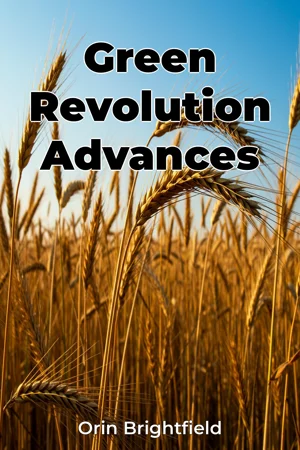
How did selective breeding and scientific innovation dramatically reshape global agriculture and avert widespread famine in the 20th century? "Green Revolution Advances" investigates the dramatic increase in crop yields achieved through the introduction of high-yielding crop varieties and the related scientific advancements that underpinned this transformation. This book explores the central argument that the Green Revolution, while undeniably successful in boosting agricultural output, presents a complex legacy of both benefits and challenges for global sustainability. This book delves into three key topics. First, the development and dissemination of high-yielding varieties (HYVs) of staple crops like wheat, rice, and maize are examined, with particular attention paid to the scientific breakthroughs in genetics and plant breeding that made these advancements possible. Second, the book analyzes the impact of these HYVs on agricultural productivity, food security, and rural economies in different regions of the world, focusing on both the successes and the unintended consequences. Third, the book explores related scientific findings and technological advancements, such as fertilizers, pesticides, and irrigation techniques, that were crucial for maximizing the potential of HYVs. Understanding the Green Revolution requires situating it within the historical context of the mid-20th century, a period marked by rapid population growth, widespread food shortages, and Cold War geopolitics. The book provides background on the social, economic, and political factors that motivated the push for increased agricultural productivity. The book's structure begins with an introduction to the core concepts of plant breeding, genetics, and agronomy necessary for understanding the scientific basis of the Green Revolution. It then develops the argument through three major sections. The first section details the scientific breakthroughs that led to the development of HYVs, examining the contributions of key figures such as Norman Borlaug and the research institutions that spearheaded these efforts. The second section analyzes the socio-economic impacts of the Green Revolution, focusing on case studies from different regions of the world and addressing issues such as income inequality, environmental degradation, and the displacement of traditional farming practices. The third section explores the ongoing debates surrounding the Green Revolution, considering alternative approaches to sustainable agriculture and the challenges of feeding a growing global population in the face of climate change. The book culminates with a discussion of the lessons learned from the Green Revolution and their implications for future agricultural development strategies. The evidence presented in this book draws upon a range of sources, including scientific publications, historical archives, government reports, and case studies of agricultural development projects. It utilizes quantitative data on crop yields, fertilizer use, and economic indicators, as well as qualitative data from interviews with farmers, scientists, and policymakers. "Green Revolution Advances" connects to several other fields, including environmental science (examining the ecological impacts of intensive agriculture), economics (analyzing the effects of agricultural policies on market structures and income distribution), and sociology (exploring the social consequences of technological change in rural communities). This book adopts a balanced and nuanced perspective, acknowledging the significant contributions of the Green Revolution while also critically examining its limitations and negative consequences. The tone is academic yet accessible, aiming to provide a rigorous analysis of the topic while remaining engaging for a broad audience. The target audience includes students and researchers in agricultural science, environmental studies, history, and development studies, as well as policymakers and practitioners working in the field of food security and sustainable agriculture. The book would be valuable to anyone seeking a deeper understanding of the complex relationship between science, technology, and society in the context of global food production. In keeping with the conventions of non-fiction historical analysis, the book provides a comprehensive and well-documented account of the Green Revolution, drawing upon a variety of primary and secondary sources to support its arguments. The scope of the book is global, encompassing a wide range of geographical regions and agricultural systems. However, it focuses primarily on the major staple crops and the key technological advancements that contributed to the Green Revolution, with less emphasis on other aspects of agricultural development. The information presented can be applied to inform current debates about sustainable agriculture, food security, and climate change adaptation. It provides insights into the potential benefits and risks of technological interventions in agriculture and highlights the importance of considering social, economic, and environmental factors in the design of agricultural policies. The book addresses ongoing debates surrounding the Green Revolution such as the environmental impact of pesticides and fertilizers, the dependence on monoculture farming, and the marginalization of smallholder farmers.
How did selective breeding and scientific innovation dramatically reshape global agriculture and avert widespread famine in the 20th century? "Green Revolution Advances" investigates the dramatic increase in crop yields achieved through the introduction of high-yielding crop varieties and the related scientific advancements that underpinned this transformation. This book explores the central argument that the Green Revolution, while undeniably successful in boosting agricultural output, presents a complex legacy of both benefits and challenges for global sustainability. This book delves into three key topics. First, the development and dissemination of high-yielding varieties (HYVs) of staple crops like wheat, rice, and maize are examined, with particular attention paid to the scientific breakthroughs in genetics and plant breeding that made these advancements possible. Second, the book analyzes the impact of these HYVs on agricultural productivity, food security, and rural economies in different regions of the world, focusing on both the successes and the unintended consequences. Third, the book explores related scientific findings and technological advancements, such as fertilizers, pesticides, and irrigation techniques, that were crucial for maximizing the potential of HYVs. Understanding the Green Revolution requires situating it within the historical context of the mid-20th century, a period marked by rapid population growth, widespread food shortages, and Cold War geopolitics. The book provides background on the social, economic, and political factors that motivated the push for increased agricultural productivity. The book's structure begins with an introduction to the core concepts of plant breeding, genetics, and agronomy necessary for understanding the scientific basis of the Green Revolution. It then develops the argument through three major sections. The first section details the scientific breakthroughs that led to the development of HYVs, examining the contributions of key figures such as Norman Borlaug and the research institutions that spearheaded these efforts. The second section analyzes the socio-economic impacts of the Green Revolution, focusing on case studies from different regions of the world and addressing issues such as income inequality, environmental degradation, and the displacement of traditional farming practices. The third section explores the ongoing debates surrounding the Green Revolution, considering alternative approaches to sustainable agriculture and the challenges of feeding a growing global population in the face of climate change. The book culminates with a discussion of the lessons learned from the Green Revolution and their implications for future agricultural development strategies. The evidence presented in this book draws upon a range of sources, including scientific publications, historical archives, government reports, and case studies of agricultural development projects. It utilizes quantitative data on crop yields, fertilizer use, and economic indicators, as well as qualitative data from interviews with farmers, scientists, and policymakers. "Green Revolution Advances" connects to several other fields, including environmental science (examining the ecological impacts of intensive agriculture), economics (analyzing the effects of agricultural policies on market structures and income distribution), and sociology (exploring the social consequences of technological change in rural communities). This book adopts a balanced and nuanced perspective, acknowledging the significant contributions of the Green Revolution while also critically examining its limitations and negative consequences. The tone is academic yet accessible, aiming to provide a rigorous analysis of the topic while remaining engaging for a broad audience. The target audience includes students and researchers in agricultural science, environmental studies, history, and development studies, as well as policymakers and practitioners working in the field of food security and sustainable agriculture. The book would be valuable to anyone seeking a deeper understanding of the complex relationship between science, technology, and society in the context of global food production. In keeping with the conventions of non-fiction historical analysis, the book provides a comprehensive and well-documented account of the Green Revolution, drawing upon a variety of primary and secondary sources to support its arguments. The scope of the book is global, encompassing a wide range of geographical regions and agricultural systems. However, it focuses primarily on the major staple crops and the key technological advancements that contributed to the Green Revolution, with less emphasis on other aspects of agricultural development. The information presented can be applied to inform current debates about sustainable agriculture, food security, and climate change adaptation. It provides insights into the potential benefits and risks of technological interventions in agriculture and highlights the importance of considering social, economic, and environmental factors in the design of agricultural policies. The book addresses ongoing debates surrounding the Green Revolution such as the environmental impact of pesticides and fertilizers, the dependence on monoculture farming, and the marginalization of smallholder farmers.
"Green Revolution Advances" explores the transformative period in the mid-20th century when agricultural innovation, particularly high-yielding varieties (HYVs) of crops like wheat and rice, dramatically increased food production. This era, driven by figures like Norman Borlaug, averted potential widespread famine. The book investigates how genetics and plant breeding played a critical role in developing HYVs, leading to significant increases in crop yields and reshaping global agriculture. Readers will gain insights into how these scientific breakthroughs impacted agricultural productivity, food security, and the economies of various regions. The book also delves into the unintended consequences of the Green Revolution, such as environmental degradation and the displacement of traditional farming practices, acknowledging the complex legacy of this period. The book's approach progresses systematically, beginning with the core concepts of plant breeding and genetics, then analyzing the socio-economic impacts and finally exploring ongoing debates surrounding sustainable agriculture. Case studies and quantitative data are used to support arguments, providing a balanced perspective suitable for students, researchers, and anyone interested in the intersection of history, biology, and global food production.
Book Details
ISBN
9788233972257
Publisher
Publifye AS
Your Licenses
You don't own any licenses for this book
Purchase a license below to unlock this book and download the EPUB.
Purchase License
Select a tier to unlock this book
Need bulk licensing?
Contact us for enterprise agreements.