
About This Book
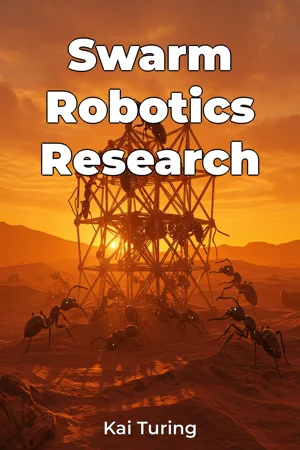
Can the intricate coordination observed in insect colonies unlock the future of robotics? *Swarm Robotics Research* delves into the fascinating world of multi-robot coordination, drawing direct inspiration from the collective behaviors of social insects. This book explores how engineering can learn from nature's most efficient problem-solvers, and why understanding swarm intelligence is increasingly vital in a world demanding adaptable and autonomous robotic systems. The core topics of this book are centered around bio-inspired algorithms, decentralized control architectures, and the application of swarm robotics in real-world scenarios. Bio-inspired algorithms, mimicking the communication and task allocation strategies of ants, bees, and termites, offer robust and scalable solutions for coordinating large numbers of robots. Decentralized control architectures, where individual robots make decisions based on local information, are crucial for achieving fault tolerance and adaptability in dynamic environments. The practical applications demonstrate why swarm robotics are poised to revolutionize fields ranging from environmental monitoring to search and rescue operations. Contextually, the book builds upon decades of research in artificial intelligence, evolutionary computation, and robotics. A foundational understanding of basic programming concepts and linear algebra will aid the reader, although explanations are tailored for accessibility across disciplines. Historically, the limitations of centralized control systems in robotics spurred the exploration of decentralized, bio-inspired approaches, leading to the emergence of swarm robotics as a distinct field. The central argument posits that effective multi-robot coordination hinges on embracing the principles of swarm intelligence: simplicity, robustness, and decentralization. Nature provides a blueprint for creating resilient and adaptive robotic systems capable of tackling complex tasks in unpredictable environments. This argument is crucial because it challenges conventional top-down control paradigms in robotics, advocating for a more bottom-up, emergent approach. The book systematically introduces the core concepts of swarm robotics, starting with an overview of relevant insect behaviors and their mathematical models. It then develops these ideas through three major sections. The first section focuses on algorithm design, presenting various bio-inspired algorithms for task allocation, path planning, and object clustering. The second details communication strategies; including stigmergy, explicit communication protocols, and sensor-based interaction. The third explores real-world applications, presenting case studies of swarm robotics deployments in agriculture, disaster relief, and infrastructure maintenance. The argument culminates in a discussion of the ethical considerations and future directions of swarm robotics research. The evidence presented throughout the book relies on peer-reviewed engineering studies, simulation results, and experimental data from physical robot deployments. Emphasis is placed on quantitative analysis and rigorous evaluation of algorithm performance. Unique data sources include custom-built robot platforms and open-source simulation environments, allowing for reproducible research and comparative analysis. Interdisciplinary connections are explored through the lens of biology, computer science, and engineering. The book draws inspiration from insect behavior and social organization, translating biological principles into computational algorithms. It leverages concepts from computer science, such as distributed computing and artificial intelligence, to design efficient and scalable control systems. It implements these algorithms on physical robotic platforms using control systems engineering. These connections strengthen the book's argument by demonstrating the synergy between different fields in advancing swarm robotics research. A unique aspect of this book is its emphasis on translating theoretical concepts into practical implementations. It provides detailed design guidelines and implementation strategies for building and deploying swarm robotic systems. This practical focus sets it apart from purely theoretical treatments of swarm intelligence. The tone of the book is academic, yet accessible, balancing theoretical rigor with practical insights. It aims to present complex information in a clear and concise manner, making it suitable for both researchers and practitioners. The target audience includes researchers, engineers, and students interested in robotics, artificial intelligence, and bio-inspired computing. This book is valuable to them because it provides a comprehensive overview of the field, covering both theoretical foundations and practical applications. It serves as a valuable resource for anyone seeking to design, develop, or deploy swarm robotic systems. As a work in the genre of Technology and AI & Semantics, the book aligns with genre conventions by providing precise explanations of the underlying algorithms and technologies. It also addresses the ethical and societal implications of AI-driven robotic systems. The scope of the book encompasses a broad range of topics within swarm robotics, from algorithm design to hardware implementation. However, it intentionally limits its coverage of specific robotic platforms, focusing instead on general principles and design strategies. The information presented can be applied to a wide range of real-world problems, including environmental monitoring, precision agriculture, and search and rescue operations. Readers can use the design guidelines and implementation strategies outlined in the book to build and deploy their own swarm robotic systems. The book also addresses ongoing debates in the field, such as the trade-offs between centralized and decentralized control, and the challenges of scaling swarm robotic systems to very large numbers of robots.
Can the intricate coordination observed in insect colonies unlock the future of robotics? *Swarm Robotics Research* delves into the fascinating world of multi-robot coordination, drawing direct inspiration from the collective behaviors of social insects. This book explores how engineering can learn from nature's most efficient problem-solvers, and why understanding swarm intelligence is increasingly vital in a world demanding adaptable and autonomous robotic systems. The core topics of this book are centered around bio-inspired algorithms, decentralized control architectures, and the application of swarm robotics in real-world scenarios. Bio-inspired algorithms, mimicking the communication and task allocation strategies of ants, bees, and termites, offer robust and scalable solutions for coordinating large numbers of robots. Decentralized control architectures, where individual robots make decisions based on local information, are crucial for achieving fault tolerance and adaptability in dynamic environments. The practical applications demonstrate why swarm robotics are poised to revolutionize fields ranging from environmental monitoring to search and rescue operations. Contextually, the book builds upon decades of research in artificial intelligence, evolutionary computation, and robotics. A foundational understanding of basic programming concepts and linear algebra will aid the reader, although explanations are tailored for accessibility across disciplines. Historically, the limitations of centralized control systems in robotics spurred the exploration of decentralized, bio-inspired approaches, leading to the emergence of swarm robotics as a distinct field. The central argument posits that effective multi-robot coordination hinges on embracing the principles of swarm intelligence: simplicity, robustness, and decentralization. Nature provides a blueprint for creating resilient and adaptive robotic systems capable of tackling complex tasks in unpredictable environments. This argument is crucial because it challenges conventional top-down control paradigms in robotics, advocating for a more bottom-up, emergent approach. The book systematically introduces the core concepts of swarm robotics, starting with an overview of relevant insect behaviors and their mathematical models. It then develops these ideas through three major sections. The first section focuses on algorithm design, presenting various bio-inspired algorithms for task allocation, path planning, and object clustering. The second details communication strategies; including stigmergy, explicit communication protocols, and sensor-based interaction. The third explores real-world applications, presenting case studies of swarm robotics deployments in agriculture, disaster relief, and infrastructure maintenance. The argument culminates in a discussion of the ethical considerations and future directions of swarm robotics research. The evidence presented throughout the book relies on peer-reviewed engineering studies, simulation results, and experimental data from physical robot deployments. Emphasis is placed on quantitative analysis and rigorous evaluation of algorithm performance. Unique data sources include custom-built robot platforms and open-source simulation environments, allowing for reproducible research and comparative analysis. Interdisciplinary connections are explored through the lens of biology, computer science, and engineering. The book draws inspiration from insect behavior and social organization, translating biological principles into computational algorithms. It leverages concepts from computer science, such as distributed computing and artificial intelligence, to design efficient and scalable control systems. It implements these algorithms on physical robotic platforms using control systems engineering. These connections strengthen the book's argument by demonstrating the synergy between different fields in advancing swarm robotics research. A unique aspect of this book is its emphasis on translating theoretical concepts into practical implementations. It provides detailed design guidelines and implementation strategies for building and deploying swarm robotic systems. This practical focus sets it apart from purely theoretical treatments of swarm intelligence. The tone of the book is academic, yet accessible, balancing theoretical rigor with practical insights. It aims to present complex information in a clear and concise manner, making it suitable for both researchers and practitioners. The target audience includes researchers, engineers, and students interested in robotics, artificial intelligence, and bio-inspired computing. This book is valuable to them because it provides a comprehensive overview of the field, covering both theoretical foundations and practical applications. It serves as a valuable resource for anyone seeking to design, develop, or deploy swarm robotic systems. As a work in the genre of Technology and AI & Semantics, the book aligns with genre conventions by providing precise explanations of the underlying algorithms and technologies. It also addresses the ethical and societal implications of AI-driven robotic systems. The scope of the book encompasses a broad range of topics within swarm robotics, from algorithm design to hardware implementation. However, it intentionally limits its coverage of specific robotic platforms, focusing instead on general principles and design strategies. The information presented can be applied to a wide range of real-world problems, including environmental monitoring, precision agriculture, and search and rescue operations. Readers can use the design guidelines and implementation strategies outlined in the book to build and deploy their own swarm robotic systems. The book also addresses ongoing debates in the field, such as the trade-offs between centralized and decentralized control, and the challenges of scaling swarm robotic systems to very large numbers of robots.
"Swarm Robotics Research" explores the fascinating intersection of robotics and swarm intelligence, drawing inspiration from the cooperative behaviors of social insects to develop advanced multi-robot systems. It delves into bio-inspired algorithms and decentralized control, revealing how mimicking nature's strategies can lead to robust and adaptable autonomous systems. For example, algorithms inspired by ant colonies can optimize task allocation among robots, demonstrating the power of decentralized decision-making. The book uniquely emphasizes practical implementations, providing design guidelines for building and deploying swarm robotic systems. Progressing from foundational concepts to real-world applications like agriculture and disaster relief, it showcases how swarm robotics can revolutionize various fields. Chapters cover algorithm design, communication strategies, and ethical considerations, offering a comprehensive overview of the field.
Book Details
ISBN
9788233971908
Publisher
Publifye AS
Your Licenses
You don't own any licenses for this book
Purchase a license below to unlock this book and download the EPUB.
Purchase License
Select a tier to unlock this book
Need bulk licensing?
Contact us for enterprise agreements.