
About This Book
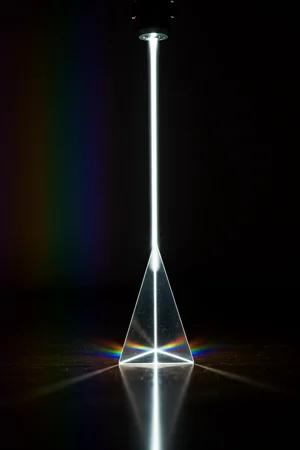
Why does a prism split white light into a rainbow, and why is water transparent when it's made of molecules that absorb light? "Transparent Colors" delves into the captivating world of light refraction and transparency, exploring how seemingly simple materials like glass and water interact with light to create the vibrant colors we see daily. These phenomena are not merely aesthetic; they are governed by fundamental principles of physics that have shaped our understanding of the universe. This book examines the core principles governing light's interaction with matter. We begin by dissecting the nature of light itself, tracing its historical understanding from classical wave theories to quantum electrodynamics. A crucial element is the index of refraction, which governs how light bends when entering a medium. This is not just about rainbows; it is fundamental to how lenses work in microscopes and telescopes, extending our ability to observe the very small and the extremely distant. We then explore the concept of transparency, demonstrating how some materials allow light to pass through them with minimal scattering, while others absorb or reflect it completely. This understanding hinges on the molecular structure of materials and the interaction of photons with electrons at the atomic level. "Transparent Colors" is structured to provide a gradual, yet thorough exploration. It opens with an introduction to the fundamental wave nature of light and the electromagnetic spectrum, providing the scientific background necessary to comprehend the subsequent chapters. Building on this basis, the second part of the book explores the concept of refraction, detailing Snell's Law and its implications for lenses and optical instruments. The third section discusses the quantum mechanical explanation of transparency. Finally, the book examines applications of these principles in diverse fields, from art and design to advanced materials science. The arguments within "Transparent Colors" are supported by a wealth of experimental data and theoretical models drawn from physics, chemistry, and materials science. The book references classic experiments, such as Young's double-slit experiment, as well as contemporary research using advanced spectroscopic techniques and computational modeling. The study of light and material interaction has significant implications for other disciplines. In chemistry, it is integral to understanding molecular structure and properties. In materials science, it guides the development of new optical materials for a variety of applications. In art and design, understanding how light interacts with different mediums is crucial for creating aesthetically pleasing and functional objects. "Transparent Colors" offers a unique perspective by blending classical optics with quantum mechanical explanations, presenting a contemporary view accessible to a broad audience. The tone of the book is informative and engaging, designed to make complex scientific concepts accessible to non-experts while still providing enough depth to satisfy readers with a scientific background. The intended audience includes students of physics, chemistry, and materials science, as well as anyone with a general interest in understanding the science behind everyday phenomena. The book aligns with the conventions of popular science writing, presenting complex information in a clear, concise, and engaging manner. While the book strives for comprehensive coverage, it focuses primarily on the fundamental principles of light refraction and transparency in common materials. It does not delve extensively into advanced topics such as nonlinear optics or specialized optical materials, to keep the material approachable and well-focused. The concepts discussed in "Transparent Colors" have numerous real-world applications. Understanding light refraction is crucial for designing better lenses for cameras, microscopes, and telescopes. Knowledge of transparency and light absorption is essential for developing more energy-efficient windows, solar cells, and optical coatings. These applications underscore the practical significance of the fundamental principles explored in this book.
Why does a prism split white light into a rainbow, and why is water transparent when it's made of molecules that absorb light? "Transparent Colors" delves into the captivating world of light refraction and transparency, exploring how seemingly simple materials like glass and water interact with light to create the vibrant colors we see daily. These phenomena are not merely aesthetic; they are governed by fundamental principles of physics that have shaped our understanding of the universe. This book examines the core principles governing light's interaction with matter. We begin by dissecting the nature of light itself, tracing its historical understanding from classical wave theories to quantum electrodynamics. A crucial element is the index of refraction, which governs how light bends when entering a medium. This is not just about rainbows; it is fundamental to how lenses work in microscopes and telescopes, extending our ability to observe the very small and the extremely distant. We then explore the concept of transparency, demonstrating how some materials allow light to pass through them with minimal scattering, while others absorb or reflect it completely. This understanding hinges on the molecular structure of materials and the interaction of photons with electrons at the atomic level. "Transparent Colors" is structured to provide a gradual, yet thorough exploration. It opens with an introduction to the fundamental wave nature of light and the electromagnetic spectrum, providing the scientific background necessary to comprehend the subsequent chapters. Building on this basis, the second part of the book explores the concept of refraction, detailing Snell's Law and its implications for lenses and optical instruments. The third section discusses the quantum mechanical explanation of transparency. Finally, the book examines applications of these principles in diverse fields, from art and design to advanced materials science. The arguments within "Transparent Colors" are supported by a wealth of experimental data and theoretical models drawn from physics, chemistry, and materials science. The book references classic experiments, such as Young's double-slit experiment, as well as contemporary research using advanced spectroscopic techniques and computational modeling. The study of light and material interaction has significant implications for other disciplines. In chemistry, it is integral to understanding molecular structure and properties. In materials science, it guides the development of new optical materials for a variety of applications. In art and design, understanding how light interacts with different mediums is crucial for creating aesthetically pleasing and functional objects. "Transparent Colors" offers a unique perspective by blending classical optics with quantum mechanical explanations, presenting a contemporary view accessible to a broad audience. The tone of the book is informative and engaging, designed to make complex scientific concepts accessible to non-experts while still providing enough depth to satisfy readers with a scientific background. The intended audience includes students of physics, chemistry, and materials science, as well as anyone with a general interest in understanding the science behind everyday phenomena. The book aligns with the conventions of popular science writing, presenting complex information in a clear, concise, and engaging manner. While the book strives for comprehensive coverage, it focuses primarily on the fundamental principles of light refraction and transparency in common materials. It does not delve extensively into advanced topics such as nonlinear optics or specialized optical materials, to keep the material approachable and well-focused. The concepts discussed in "Transparent Colors" have numerous real-world applications. Understanding light refraction is crucial for designing better lenses for cameras, microscopes, and telescopes. Knowledge of transparency and light absorption is essential for developing more energy-efficient windows, solar cells, and optical coatings. These applications underscore the practical significance of the fundamental principles explored in this book.
"Transparent Colors" explores the fascinating physics behind how light interacts with everyday materials, focusing on light refraction and transparency. Why does a prism create a rainbow, and how can water be transparent despite its light-absorbing molecules? The book delves into these questions by examining the wave nature of light and the electromagnetic spectrum, illustrating how light bends when entering a medium, a phenomenon governed by the index of refraction. This concept isn't just about pretty colors; it’s fundamental to how optical instruments like lenses in microscopes and telescopes extend our vision. The book progresses from classical wave theories to quantum electrodynamics, offering a contemporary view of optics. Snell's Law is explained in detail, along with its implications for lenses and other optical devices. It further explains how some materials allow light to pass through with minimal scattering, while others absorb it, linking these properties to the molecular structure of materials. By blending classical optics with quantum mechanical explanations, "Transparent Colors" provides a unique, accessible perspective suitable for anyone interested in the science behind our visual world. Supported by experimental data and theoretical models, the book reveals how understanding light and material interaction is crucial in various fields. From designing better lenses to developing energy-efficient windows and solar cells, the principles discussed have significant real-world applications. The book balances scientific depth with accessibility, making complex concepts understandable for both science enthusiasts and students alike.
Book Details
ISBN
9788233970871
Publisher
Publifye AS
Your Licenses
You don't own any licenses for this book
Purchase a license below to unlock this book and download the EPUB.
Purchase License
Select a tier to unlock this book
Need bulk licensing?
Contact us for enterprise agreements.