
About This Book
Have you ever wondered why certain colors dominate festivals around the world? This book, *Color in Festivals*, delves into the fascinating and often overlooked role of color in global celebrations and traditions. We examine not just the aesthetics of vibrant displays, but also the deeper cultural, historical, and social meanings embedded within them. Understanding these meanings provides insight into the values, beliefs, and histories of diverse communities. Our central argument is that color, far from being merely decorative, functions as a powerful symbolic language that communicates complex ideas about identity, spirituality, social order, and the cyclical nature of life. By analyzing the pervasive use of certain colors in recurring celebrations, we can uncover shared human experiences and appreciate the unique cultural expressions of communities across the globe. This exploration unfolds through several thematic sections. First, we introduce the basic principles of color theory and symbolism, providing a foundation for understanding how different cultures perceive and interpret color. We then investigate specific case studies, examining festivals in various regions – from Holi in India and the Day of the Dead in Mexico, to Lunar New Year celebrations across Asia and harvest festivals in Africa. These examples illustrate how color choices reflect historical events, religious beliefs, and social structures. The book develops those ideas by considering the practical aspects of color production and accessibility throughout history, recognizing that the availability and cost of dyes and pigments often shaped their usage and symbolic value. The book culminates by synthesizing these diverse examples to reveal overarching patterns in the global use of color during festivals, highlighting both universal themes and culturally specific interpretations. Finally, we explore how these understandings can be applied to contemporary contexts, promoting cross-cultural understanding and appreciation. The book draws upon a wide range of sources, including historical records, ethnographic studies, art historical analyses, and contemporary accounts. We analyze visual materials, such as photographs, paintings, and textiles, to decode the meanings associated with different colors in specific cultural contexts. Our research also incorporates interviews with cultural practitioners and experts to gain firsthand insights into the significance of color in their traditions. *Color in Festivals* connects to several disciplines, including anthropology, sociology, art history, and religious studies. By examining the intersection of color, culture, and ritual, the book offers an interdisciplinary perspective on the role of symbolism in shaping human behavior and social identity. Our approach is unique in its global scope and its emphasis on the symbolic language of color as a means of understanding cultural diversity and shared human experiences. This book is written in an accessible and engaging style, aimed at a broad audience interested in world cultures, history, and social sciences. While grounded in scholarly research, the writing avoids jargon and prioritizes clarity and readability. It is suitable for students, travelers, cultural enthusiasts, and anyone seeking a deeper understanding of the world's diverse traditions. The scope of this book is limited to analyzing the symbolic use of colors in festivals. While we acknowledge the broader role of color in daily life, our focus remains on the intensified and ritualized use of color during celebratory events. We recognize that cultural meanings are constantly evolving and that interpretations may vary within communities. We aim to present a nuanced and respectful account of the diverse ways in which color is used to express cultural identity and shared values. The information in this book can be used to design culturally sensitive events, promote cross-cultural dialogue, and develop educational programs that foster global awareness.
Have you ever wondered why certain colors dominate festivals around the world? This book, *Color in Festivals*, delves into the fascinating and often overlooked role of color in global celebrations and traditions. We examine not just the aesthetics of vibrant displays, but also the deeper cultural, historical, and social meanings embedded within them. Understanding these meanings provides insight into the values, beliefs, and histories of diverse communities. Our central argument is that color, far from being merely decorative, functions as a powerful symbolic language that communicates complex ideas about identity, spirituality, social order, and the cyclical nature of life. By analyzing the pervasive use of certain colors in recurring celebrations, we can uncover shared human experiences and appreciate the unique cultural expressions of communities across the globe. This exploration unfolds through several thematic sections. First, we introduce the basic principles of color theory and symbolism, providing a foundation for understanding how different cultures perceive and interpret color. We then investigate specific case studies, examining festivals in various regions – from Holi in India and the Day of the Dead in Mexico, to Lunar New Year celebrations across Asia and harvest festivals in Africa. These examples illustrate how color choices reflect historical events, religious beliefs, and social structures. The book develops those ideas by considering the practical aspects of color production and accessibility throughout history, recognizing that the availability and cost of dyes and pigments often shaped their usage and symbolic value. The book culminates by synthesizing these diverse examples to reveal overarching patterns in the global use of color during festivals, highlighting both universal themes and culturally specific interpretations. Finally, we explore how these understandings can be applied to contemporary contexts, promoting cross-cultural understanding and appreciation. The book draws upon a wide range of sources, including historical records, ethnographic studies, art historical analyses, and contemporary accounts. We analyze visual materials, such as photographs, paintings, and textiles, to decode the meanings associated with different colors in specific cultural contexts. Our research also incorporates interviews with cultural practitioners and experts to gain firsthand insights into the significance of color in their traditions. *Color in Festivals* connects to several disciplines, including anthropology, sociology, art history, and religious studies. By examining the intersection of color, culture, and ritual, the book offers an interdisciplinary perspective on the role of symbolism in shaping human behavior and social identity. Our approach is unique in its global scope and its emphasis on the symbolic language of color as a means of understanding cultural diversity and shared human experiences. This book is written in an accessible and engaging style, aimed at a broad audience interested in world cultures, history, and social sciences. While grounded in scholarly research, the writing avoids jargon and prioritizes clarity and readability. It is suitable for students, travelers, cultural enthusiasts, and anyone seeking a deeper understanding of the world's diverse traditions. The scope of this book is limited to analyzing the symbolic use of colors in festivals. While we acknowledge the broader role of color in daily life, our focus remains on the intensified and ritualized use of color during celebratory events. We recognize that cultural meanings are constantly evolving and that interpretations may vary within communities. We aim to present a nuanced and respectful account of the diverse ways in which color is used to express cultural identity and shared values. The information in this book can be used to design culturally sensitive events, promote cross-cultural dialogue, and develop educational programs that foster global awareness.
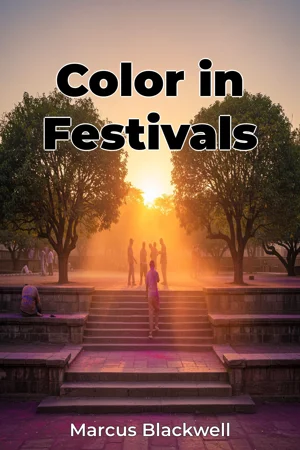
"Color in Festivals" explores the profound role of color in global celebrations, revealing how it functions as a symbolic language that communicates identity, spirituality, and social order. The book argues that color is not merely decorative but a powerful tool for understanding cultural values and histories. For example, the prevalence of red in many festivals often symbolizes good fortune and vitality, while white frequently represents purity or mourning, depending on the cultural context. The book progresses thematically, beginning with color theory and symbolism, then delving into case studies from around the world, such as Holi in India and Day of the Dead in Mexico. It emphasizes the historical context of color usage, noting how the availability and cost of dyes influenced their symbolic value. By analyzing historical records, ethnographic studies, and visual materials, the book uncovers overarching patterns in the global use of color, highlighting both universal themes and culturally specific interpretations. This approach provides a unique lens for cross-cultural understanding, making it valuable for anyone interested in world history and social science.
Book Details
ISBN
9788233970819
Publisher
Publifye AS
Your Licenses
You don't own any licenses for this book
Purchase a license below to unlock this book and download the EPUB.
Purchase License
Select a tier to unlock this book
Need bulk licensing?
Contact us for enterprise agreements.