
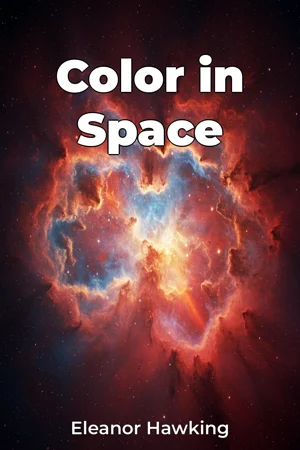
About This Book
Have you ever wondered why Mars is red, or why some stars blaze with a sapphire hue while others glow a warm orange? Color, often taken for granted here on Earth, reveals a wealth of information about celestial bodies and the vast expanse of space. This book, "Color in Space," delves into the fascinating science behind the colors we observe in the cosmos, exploring the physics that governs the emission, absorption, and reflection of light from planets, stars, and cosmic dust. This exploration is crucial because the color of a celestial object is not merely an aesthetic feature; it's a fundamental property that reveals its composition, temperature, age, and even its motion. By understanding the physics behind cosmic colors, we can unlock secrets about the universe's evolution and our place within it. To fully appreciate the nuances of color in space, we’ll need to touch upon the nature of light itself, elements of thermodynamics, and basic atomic physics. We’ll briefly explore the history of astronomical observation, from naked-eye observations to modern spectroscopic techniques, which will provide context for how our understanding of cosmic colors has evolved. The central argument of this book is that color serves as an indispensable tool for astronomers and astrophysicists, providing crucial insights into the physical properties and processes occurring throughout the universe. By deciphering the colors of celestial objects, we can gain a deeper comprehension of cosmic phenomena that are otherwise inaccessible. This book unfolds in a structured manner, beginning with an introduction to the fundamental principles of light and its interaction with matter. We will then journey through the diverse palette of the cosmos. The second major section, "The Colors of Stars," explores how stellar temperature, chemical composition, and age influence the color of stars, using the blackbody radiation theory and spectral analysis as key tools. We will then discuss the Hertzsprung-Russell diagram and how stellar color is directly related to the classification of stars on this diagram. The third section, "Planetary Hues and Cosmic Dust," examines the factors that determine the colors of planets, moons, and nebulae, from atmospheric scattering and surface composition to the effects of interstellar dust. The book culminates by exploring implications, such as how future space-based telescopes might use color data to discover exoplanets and assess their potential habitability. Throughout "Color in Space," theoretical explanations will be supported by evidence from observational astronomy, including data from telescopes like Hubble and James Webb. We will examine real-world examples of celestial bodies and their corresponding spectra, translating complex data into accessible visualizations and explanations. Where appropriate, the book references published academic papers and astronomical databases to substantiate its claims. The study of color in space inevitably connects to other scientific domains. For example, material science is related to this topic because it provides insights into the composition and properties of celestial bodies. Chemistry also has connections because we will study the chemical elements that are present in space and how they interact with light to produce color. Finally, computer science comes into play because digital image processing helps us to analyze and interpret astronomical data. These connections emphasize the interdisciplinary nature of astrophysics. This book takes a unique approach by integrating theoretical physics with observational data to provide a holistic understanding of cosmic colors. Rather than focusing solely on one aspect, such as stellar evolution or planetary geology, it synthesizes information from various fields to present a unified perspective. The tone of this book is informative and engaging, aiming to bridge the gap between complex scientific concepts and accessible explanations. The writing style is designed to be clear and concise, using illustrative examples. The target audience for "Color in Space" includes science enthusiasts, amateur astronomers, undergraduate students in physics and astronomy, and anyone curious about the universe. The book’s value lies in its ability to demystify complex astrophysical phenomena. As a work of science and physics, "Color in Space" adheres to the standards of accuracy, objectivity, and evidence-based reasoning. It aims to present a comprehensive overview of the topic. The book’s scope is limited to the visible and near-visible spectrum of electromagnetic radiation, with a focus on the colors that can be perceived or detected by human eyes. The practical applications of color in space range from interpreting astronomical images to understanding exoplanetary environments. Finally, the book recognizes that certain aspects of astrophysics are subject to ongoing research and debate. For instance, the precise composition of interstellar dust and its impact on observed colors are still areas of active investigation. These controversies are acknowledged to offer a balanced perspective in the field.
Have you ever wondered why Mars is red, or why some stars blaze with a sapphire hue while others glow a warm orange? Color, often taken for granted here on Earth, reveals a wealth of information about celestial bodies and the vast expanse of space. This book, "Color in Space," delves into the fascinating science behind the colors we observe in the cosmos, exploring the physics that governs the emission, absorption, and reflection of light from planets, stars, and cosmic dust. This exploration is crucial because the color of a celestial object is not merely an aesthetic feature; it's a fundamental property that reveals its composition, temperature, age, and even its motion. By understanding the physics behind cosmic colors, we can unlock secrets about the universe's evolution and our place within it. To fully appreciate the nuances of color in space, we’ll need to touch upon the nature of light itself, elements of thermodynamics, and basic atomic physics. We’ll briefly explore the history of astronomical observation, from naked-eye observations to modern spectroscopic techniques, which will provide context for how our understanding of cosmic colors has evolved. The central argument of this book is that color serves as an indispensable tool for astronomers and astrophysicists, providing crucial insights into the physical properties and processes occurring throughout the universe. By deciphering the colors of celestial objects, we can gain a deeper comprehension of cosmic phenomena that are otherwise inaccessible. This book unfolds in a structured manner, beginning with an introduction to the fundamental principles of light and its interaction with matter. We will then journey through the diverse palette of the cosmos. The second major section, "The Colors of Stars," explores how stellar temperature, chemical composition, and age influence the color of stars, using the blackbody radiation theory and spectral analysis as key tools. We will then discuss the Hertzsprung-Russell diagram and how stellar color is directly related to the classification of stars on this diagram. The third section, "Planetary Hues and Cosmic Dust," examines the factors that determine the colors of planets, moons, and nebulae, from atmospheric scattering and surface composition to the effects of interstellar dust. The book culminates by exploring implications, such as how future space-based telescopes might use color data to discover exoplanets and assess their potential habitability. Throughout "Color in Space," theoretical explanations will be supported by evidence from observational astronomy, including data from telescopes like Hubble and James Webb. We will examine real-world examples of celestial bodies and their corresponding spectra, translating complex data into accessible visualizations and explanations. Where appropriate, the book references published academic papers and astronomical databases to substantiate its claims. The study of color in space inevitably connects to other scientific domains. For example, material science is related to this topic because it provides insights into the composition and properties of celestial bodies. Chemistry also has connections because we will study the chemical elements that are present in space and how they interact with light to produce color. Finally, computer science comes into play because digital image processing helps us to analyze and interpret astronomical data. These connections emphasize the interdisciplinary nature of astrophysics. This book takes a unique approach by integrating theoretical physics with observational data to provide a holistic understanding of cosmic colors. Rather than focusing solely on one aspect, such as stellar evolution or planetary geology, it synthesizes information from various fields to present a unified perspective. The tone of this book is informative and engaging, aiming to bridge the gap between complex scientific concepts and accessible explanations. The writing style is designed to be clear and concise, using illustrative examples. The target audience for "Color in Space" includes science enthusiasts, amateur astronomers, undergraduate students in physics and astronomy, and anyone curious about the universe. The book’s value lies in its ability to demystify complex astrophysical phenomena. As a work of science and physics, "Color in Space" adheres to the standards of accuracy, objectivity, and evidence-based reasoning. It aims to present a comprehensive overview of the topic. The book’s scope is limited to the visible and near-visible spectrum of electromagnetic radiation, with a focus on the colors that can be perceived or detected by human eyes. The practical applications of color in space range from interpreting astronomical images to understanding exoplanetary environments. Finally, the book recognizes that certain aspects of astrophysics are subject to ongoing research and debate. For instance, the precise composition of interstellar dust and its impact on observed colors are still areas of active investigation. These controversies are acknowledged to offer a balanced perspective in the field.
"Color in Space" explores the crucial role of color in understanding the universe, arguing that it's more than just an aesthetic feature. The book investigates how the colors of stars, planets, and cosmic dust reveal their temperature, composition, and motion. For example, the red hue of Mars and the varying colors of stars offer insights into their physical properties. The book begins with the fundamentals of light and its interaction with matter, then progresses to stellar colors and planetary hues. It examines how stellar temperature and chemical composition influence star color, using tools like the Hertzsprung-Russell diagram. Later chapters delve into the factors determining the colors of planets and nebulae, such as atmospheric scattering and surface composition. The book also touches on how future telescopes might use color data to find habitable exoplanets. Throughout, "Color in Space" supports theoretical explanations with observational data from telescopes like Hubble and James Webb. It uniquely integrates theoretical physics with real-world astronomical observations, providing a comprehensive view of how cosmic colors serve as a vital tool in astrophysics and astronomy.
Book Details
ISBN
9788233970734
Publisher
Publifye AS
Your Licenses
You don't own any licenses for this book
Purchase a license below to unlock this book and download the EPUB.
Purchase License
Select a tier to unlock this book
Need bulk licensing?
Contact us for enterprise agreements.