
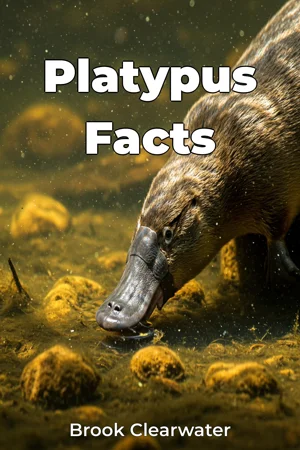
About This Book
Did you know that a mammal can lay eggs and possess venom? This book, "Platypus Facts," delves into the peculiar world of the platypus, an animal so strange it once baffled the scientific community. We will explore the unique biology of this Australian native, focusing on its venomous spurs, egg-laying habits, and unusual physical characteristics. Understanding the platypus’s biology provides essential insights into evolution and adaptation within the animal kingdom, and highlights the complex processes that drive biodiversity. This book's central argument is that the platypus represents a critical evolutionary bridge, showcasing a blend of reptilian and mammalian traits that challenges traditional classifications, demanding a re-evaluation of evolutionary pathways and biodiversity. Our journey begins with an introduction to the platypus's evolutionary history and taxonomic classification, clarifying its position within the mammalian lineage and detailing the initial scientific confusion surrounding its discovery. We then transition into exploring its anatomy and physiology. The book dedicates significant attention to the platypus’s venom delivery system, primarily found in males. We investigate the composition of the venom, its effects, and its potential evolutionary purposes. A detailed discussion on platypus reproduction follows, focusing on its egg-laying characteristics – a feature that sets it apart from most other mammals. This section will explain the development of the eggs, the incubation process, and the early life stages of platypus young, known as puggles. The evidence presented in this book comes from a variety of sources, including anatomical studies, genetic analyses, field observations, and laboratory experiments. Data will include comparative physiological data, and detailed morphological analyses. "Platypus Facts" integrates several interdisciplinary perspectives. Firstly, it connects to the field of evolutionary biology, using the platypus as a case study to understand transitional species and evolutionary adaptations. Secondly, it relates to zoology, providing an in-depth examination of a unique mammal and its ecological role. Finally, it touches upon toxicology, specifically discussing the properties and effects of platypus venom. These connections enrich our understanding of the platypus, by placing it within a broader scientific context. This book takes a fact-based approach, presenting information in a clear, concise, and accessible manner. "Platypus Facts" aims to present scientific information about the platypus to students, researchers, and general readers. Its scope is limited to the biological and ecological aspects of the platypus, intentionally excluding cultural or mythological interpretations. Understanding the platypus can offer practical benefits. For instance, research into its venom could potentially lead to new pharmaceutical discoveries due to its unique composition. Conservation efforts aimed at protecting platypus habitats are also of paramount importance, given the threats these animals face from habitat destruction and climate change. The book also touches upon the ongoing debate surrounding the precise evolutionary relationships of monotremes (the group to which platypuses belong) and their place within the mammalian family tree. Different genetic and anatomical studies have proposed varying classifications, and this book will present an overview of these conflicting perspectives, highlighting the areas of consensus and disagreement among scientists.
Did you know that a mammal can lay eggs and possess venom? This book, "Platypus Facts," delves into the peculiar world of the platypus, an animal so strange it once baffled the scientific community. We will explore the unique biology of this Australian native, focusing on its venomous spurs, egg-laying habits, and unusual physical characteristics. Understanding the platypus’s biology provides essential insights into evolution and adaptation within the animal kingdom, and highlights the complex processes that drive biodiversity. This book's central argument is that the platypus represents a critical evolutionary bridge, showcasing a blend of reptilian and mammalian traits that challenges traditional classifications, demanding a re-evaluation of evolutionary pathways and biodiversity. Our journey begins with an introduction to the platypus's evolutionary history and taxonomic classification, clarifying its position within the mammalian lineage and detailing the initial scientific confusion surrounding its discovery. We then transition into exploring its anatomy and physiology. The book dedicates significant attention to the platypus’s venom delivery system, primarily found in males. We investigate the composition of the venom, its effects, and its potential evolutionary purposes. A detailed discussion on platypus reproduction follows, focusing on its egg-laying characteristics – a feature that sets it apart from most other mammals. This section will explain the development of the eggs, the incubation process, and the early life stages of platypus young, known as puggles. The evidence presented in this book comes from a variety of sources, including anatomical studies, genetic analyses, field observations, and laboratory experiments. Data will include comparative physiological data, and detailed morphological analyses. "Platypus Facts" integrates several interdisciplinary perspectives. Firstly, it connects to the field of evolutionary biology, using the platypus as a case study to understand transitional species and evolutionary adaptations. Secondly, it relates to zoology, providing an in-depth examination of a unique mammal and its ecological role. Finally, it touches upon toxicology, specifically discussing the properties and effects of platypus venom. These connections enrich our understanding of the platypus, by placing it within a broader scientific context. This book takes a fact-based approach, presenting information in a clear, concise, and accessible manner. "Platypus Facts" aims to present scientific information about the platypus to students, researchers, and general readers. Its scope is limited to the biological and ecological aspects of the platypus, intentionally excluding cultural or mythological interpretations. Understanding the platypus can offer practical benefits. For instance, research into its venom could potentially lead to new pharmaceutical discoveries due to its unique composition. Conservation efforts aimed at protecting platypus habitats are also of paramount importance, given the threats these animals face from habitat destruction and climate change. The book also touches upon the ongoing debate surrounding the precise evolutionary relationships of monotremes (the group to which platypuses belong) and their place within the mammalian family tree. Different genetic and anatomical studies have proposed varying classifications, and this book will present an overview of these conflicting perspectives, highlighting the areas of consensus and disagreement among scientists.
"Platypus Facts" explores the extraordinary biology of the platypus, an Australian monotreme that challenges traditional classifications of mammals. This book highlights the animal's unique features, such as its egg-laying habits and the venomous spurs found on males, which distinguish it from most other mammals. The text delves into the evolutionary significance of this remarkable creature, emphasizing its role as a critical link between reptilian and mammalian traits. The book investigates the platypus's evolutionary history, anatomy, and physiology. It examines the composition and effects of platypus venom, potentially valuable for pharmaceutical research. The book progresses through chapters detailing the platypus's classification within the mammalian lineage, its venom delivery system, reproductive strategies, and the development of its young, known as puggles. It offers insights into animal adaptation and mammalian evolution by integrating anatomical studies, genetic analyses, and field observations.
Book Details
ISBN
9788233970529
Publisher
Publifye AS
Your Licenses
You don't own any licenses for this book
Purchase a license below to unlock this book and download the EPUB.
Purchase License
Select a tier to unlock this book
Need bulk licensing?
Contact us for enterprise agreements.