
About This Book
Did you know that a plant often dismissed as a pesky weed holds secrets to survival, sustenance, and sophisticated engineering? "Dandelion Facts" delves into the multifaceted world of Taraxacum officinale, revealing the surprising depths of this common yet complex organism. This book will explore the dandelion's remarkable methods of seed dispersal, its surprising nutritional value as an edible plant, and its incredible resilience in diverse environments, offering a comprehensive understanding of this ubiquitous flora. The book is structured around three primary themes. First, we examine the biomechanics and environmental factors that contribute to the dandelion's exceptional seed dispersal. This includes an analysis of the pappus, the intricate parachute-like structure enabling wind-driven distribution over vast distances. Second, we investigate the dandelion's role as a valuable food source, discussing its historical uses, nutritional profile, and potential benefits for human health. We will review the plant's vitamin and mineral content, as well as its traditional medicinal applications. Third, we explore the physiological and genetic adaptations that enable dandelions to thrive in seemingly inhospitable conditions, from compacted urban soils to nutrient-poor environments. This section includes a discussion of its deep taproot system and its ability to reproduce both sexually and asexually. "Dandelion Facts" argues that the dandelion, far from being a mere weed, represents a pinnacle of evolutionary adaptation and ecological ingenuity. By understanding the dandelion's biological mechanisms, we can gain insights into broader principles of plant biology, ecological resilience, and sustainable living. The significance of this argument lies in challenging conventional perceptions of nature and appreciating the value of often-overlooked species. The book unfolds in a logical progression: beginning with an introduction to the dandelion's taxonomic classification and global distribution, followed by detailed explorations of its seed dispersal mechanisms, nutritional properties, and adaptive strategies. Each section draws upon a wealth of scientific literature, experimental data, and field observations. The concluding chapters synthesize these findings, highlighting the dandelion's potential applications in areas such as urban ecology, sustainable agriculture, and biomimicry. The evidence presented throughout this book is derived from a variety of sources, including peer-reviewed scientific publications, botanical surveys, nutritional analyses, and ecological studies. We also incorporate original data from controlled experiments examining dandelion growth under varying environmental conditions. Methodologies utilized include microscopy, chemical analysis, ecological modeling, and comparative genomics. "Dandelion Facts" connects to several other fields of study. It bridges botany and engineering through its analysis of the pappus structure, revealing principles applicable to micro-aerial vehicles. It connects biology and nutrition by exploring the dandelion's potential as a functional food. It also intersects with environmental science through discussions of the dandelion's role in disturbed ecosystems and its potential for phytoremediation. This book will be written in a clear and accessible style, designed to appeal to a broad audience, including students, educators, gardeners, naturalists, and anyone curious about the natural world. While maintaining scientific accuracy, the text avoids excessive jargon and incorporates engaging real-world examples. The target audience is broad, encompassing anyone with an interest in botany, ecology, nutrition, or sustainable living. The book's appeal lies in its ability to transform a common, often-disregarded plant into a subject of scientific fascination and practical value. As a work of non-fiction, "Dandelion Facts" adheres to principles of accuracy, objectivity, and evidence-based reasoning. It strives to present a balanced perspective, acknowledging both the benefits and potential drawbacks of dandelions in different contexts. The scope of this book is intentionally limited to Taraxacum officinale, allowing for in-depth exploration of its specific characteristics and adaptations. While other dandelion species are mentioned, the primary focus remains on this widely distributed and well-studied variety. The information contained within "Dandelion Facts" has numerous real-world applications. Readers can learn how to identify and utilize dandelions as a sustainable food source, implement dandelion-based solutions for soil remediation, and draw inspiration from dandelion seed dispersal mechanisms for engineering innovations. While the dandelion is generally regarded as safe, some controversies exist regarding its use as a medicinal herb. The book will address these concerns, presenting a balanced assessment of the available evidence and highlighting potential risks and benefits.
Did you know that a plant often dismissed as a pesky weed holds secrets to survival, sustenance, and sophisticated engineering? "Dandelion Facts" delves into the multifaceted world of Taraxacum officinale, revealing the surprising depths of this common yet complex organism. This book will explore the dandelion's remarkable methods of seed dispersal, its surprising nutritional value as an edible plant, and its incredible resilience in diverse environments, offering a comprehensive understanding of this ubiquitous flora. The book is structured around three primary themes. First, we examine the biomechanics and environmental factors that contribute to the dandelion's exceptional seed dispersal. This includes an analysis of the pappus, the intricate parachute-like structure enabling wind-driven distribution over vast distances. Second, we investigate the dandelion's role as a valuable food source, discussing its historical uses, nutritional profile, and potential benefits for human health. We will review the plant's vitamin and mineral content, as well as its traditional medicinal applications. Third, we explore the physiological and genetic adaptations that enable dandelions to thrive in seemingly inhospitable conditions, from compacted urban soils to nutrient-poor environments. This section includes a discussion of its deep taproot system and its ability to reproduce both sexually and asexually. "Dandelion Facts" argues that the dandelion, far from being a mere weed, represents a pinnacle of evolutionary adaptation and ecological ingenuity. By understanding the dandelion's biological mechanisms, we can gain insights into broader principles of plant biology, ecological resilience, and sustainable living. The significance of this argument lies in challenging conventional perceptions of nature and appreciating the value of often-overlooked species. The book unfolds in a logical progression: beginning with an introduction to the dandelion's taxonomic classification and global distribution, followed by detailed explorations of its seed dispersal mechanisms, nutritional properties, and adaptive strategies. Each section draws upon a wealth of scientific literature, experimental data, and field observations. The concluding chapters synthesize these findings, highlighting the dandelion's potential applications in areas such as urban ecology, sustainable agriculture, and biomimicry. The evidence presented throughout this book is derived from a variety of sources, including peer-reviewed scientific publications, botanical surveys, nutritional analyses, and ecological studies. We also incorporate original data from controlled experiments examining dandelion growth under varying environmental conditions. Methodologies utilized include microscopy, chemical analysis, ecological modeling, and comparative genomics. "Dandelion Facts" connects to several other fields of study. It bridges botany and engineering through its analysis of the pappus structure, revealing principles applicable to micro-aerial vehicles. It connects biology and nutrition by exploring the dandelion's potential as a functional food. It also intersects with environmental science through discussions of the dandelion's role in disturbed ecosystems and its potential for phytoremediation. This book will be written in a clear and accessible style, designed to appeal to a broad audience, including students, educators, gardeners, naturalists, and anyone curious about the natural world. While maintaining scientific accuracy, the text avoids excessive jargon and incorporates engaging real-world examples. The target audience is broad, encompassing anyone with an interest in botany, ecology, nutrition, or sustainable living. The book's appeal lies in its ability to transform a common, often-disregarded plant into a subject of scientific fascination and practical value. As a work of non-fiction, "Dandelion Facts" adheres to principles of accuracy, objectivity, and evidence-based reasoning. It strives to present a balanced perspective, acknowledging both the benefits and potential drawbacks of dandelions in different contexts. The scope of this book is intentionally limited to Taraxacum officinale, allowing for in-depth exploration of its specific characteristics and adaptations. While other dandelion species are mentioned, the primary focus remains on this widely distributed and well-studied variety. The information contained within "Dandelion Facts" has numerous real-world applications. Readers can learn how to identify and utilize dandelions as a sustainable food source, implement dandelion-based solutions for soil remediation, and draw inspiration from dandelion seed dispersal mechanisms for engineering innovations. While the dandelion is generally regarded as safe, some controversies exist regarding its use as a medicinal herb. The book will address these concerns, presenting a balanced assessment of the available evidence and highlighting potential risks and benefits.
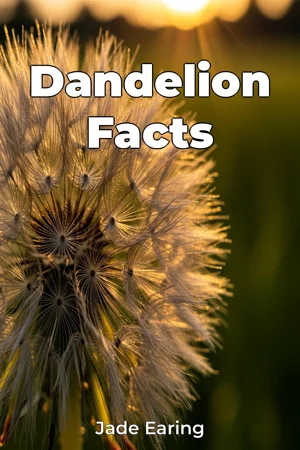
"Dandelion Facts" unveils the hidden world of Taraxacum officinale, a plant often dismissed as a weed. It explores the dandelion's sophisticated seed dispersal, surprising nutritional value, and incredible ecological resilience. This book challenges common perceptions by revealing the dandelion's potential as a valuable resource and a marvel of natural engineering. Learn how its unique pappus structure allows seeds to travel vast distances on the wind, and discover its rich vitamin and mineral content, making it a surprisingly beneficial edible plant. The book investigates the dandelion's biology, ecology, and potential applications. It begins with the plant's classification and distribution, then delves into its seed dispersal, nutritional properties, and adaptive strategies. By understanding the dandelion, readers can gain insights into plant biology, ecological resilience, and sustainable living, appreciating the value of often-overlooked species in our environment.
Book Details
ISBN
9788233970406
Publisher
Publifye AS
Your Licenses
You don't own any licenses for this book
Purchase a license below to unlock this book and download the EPUB.
Purchase License
Select a tier to unlock this book
Need bulk licensing?
Contact us for enterprise agreements.