
About This Book
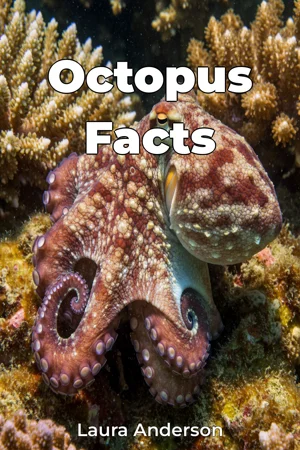
Have you ever wondered what it's like to possess a mind so alien, so unlike our own, that it challenges the very definition of intelligence? "Octopus Facts" delves into the captivating world of octopuses, revealing not just their remarkable camouflage and problem-solving skills, but also the very essence of their complex minds. This book explores the fascinating aspects of octopus intelligence, their unparalleled camouflage abilities, and their surprisingly sophisticated problem-solving techniques, arguing that octopuses represent a unique evolutionary pathway to intelligence, separate from the vertebrate model with which we are most familiar. Understanding these cephalopods provides invaluable insights into the potential diversity of cognitive architectures on our planet and perhaps beyond. This book provides essential context by exploring the evolutionary history of cephalopods, tracing their lineage back hundreds of millions of years. It highlights the environmental pressures that may have driven the development of their unique intelligence and camouflage abilities. No prior knowledge of marine biology is required, but an interest in animal behavior and cognition will enhance the reader's appreciation. "Octopus Facts" is structured to provide a comprehensive understanding of these fascinating creatures. It begins by introducing the basic biology of octopuses, including their anatomy, physiology, and life cycle. It then moves on to explore their cognitive abilities in detail, examining evidence for learning, memory, and decision-making. Central to the book are dedicated sections on camouflage and problem-solving. The camouflage section details the sophisticated mechanisms octopuses use to alter their skin color and texture, and the neural control behind these changes. The problem-solving section covers a range of experiments and observations, from opening jars to navigating complex mazes, highlighting the octopus's capacity for flexible and innovative behavior. The culmination explores implications regarding the nature of intelligence, consciousness, and the potential for diverse forms of cognition in the universe. Practical applications and implications are covered by highlighting the potential use of octopus-inspired technologies and methods. The book relies on a wealth of scientific evidence, drawing from published research in fields such as marine biology, neuroscience, and animal behavior. It includes data from laboratory experiments, field observations, and anatomical studies. The methodologies discussed include behavioral assays, neuroimaging techniques, and genetic analyses. "Octopus Facts" also connects to other disciplines, such as robotics (inspired by octopus movement), materials science (mimicking octopus skin), and philosophy (exploring the nature of consciousness). These interdisciplinary connections enrich the book's argument by demonstrating the broader significance of octopus research. A unique aspect of this book is its focus on the distributed nature of octopus intelligence, with each arm possessing a degree of autonomy. This challenges traditional views of centralized brain function and offers a novel perspective on the organization of intelligence. Written in an engaging and accessible style, “Octopus Facts” is aimed at anyone with an interest in marine life, animal behavior, or the science of intelligence. It will appeal to students, researchers, and general readers alike. Adhering to the conventions of science writing and non-fiction, "Octopus Facts" presents information objectively and accurately, with clear citations and references to support its claims. While the book strives for breadth in its coverage of octopus biology and behavior, it is limited by the available scientific data and the inherent challenges of studying these elusive creatures in their natural environment. The reader will come to understand how the camouflage techniques utilized by octopuses might inspire new technologies in adaptive camouflage for military or civilian applications. Moreover, the book will address controversies within the scientific community, such as ongoing debates about the extent of octopus consciousness and the role of genetics versus environment in shaping their behavior.
Have you ever wondered what it's like to possess a mind so alien, so unlike our own, that it challenges the very definition of intelligence? "Octopus Facts" delves into the captivating world of octopuses, revealing not just their remarkable camouflage and problem-solving skills, but also the very essence of their complex minds. This book explores the fascinating aspects of octopus intelligence, their unparalleled camouflage abilities, and their surprisingly sophisticated problem-solving techniques, arguing that octopuses represent a unique evolutionary pathway to intelligence, separate from the vertebrate model with which we are most familiar. Understanding these cephalopods provides invaluable insights into the potential diversity of cognitive architectures on our planet and perhaps beyond. This book provides essential context by exploring the evolutionary history of cephalopods, tracing their lineage back hundreds of millions of years. It highlights the environmental pressures that may have driven the development of their unique intelligence and camouflage abilities. No prior knowledge of marine biology is required, but an interest in animal behavior and cognition will enhance the reader's appreciation. "Octopus Facts" is structured to provide a comprehensive understanding of these fascinating creatures. It begins by introducing the basic biology of octopuses, including their anatomy, physiology, and life cycle. It then moves on to explore their cognitive abilities in detail, examining evidence for learning, memory, and decision-making. Central to the book are dedicated sections on camouflage and problem-solving. The camouflage section details the sophisticated mechanisms octopuses use to alter their skin color and texture, and the neural control behind these changes. The problem-solving section covers a range of experiments and observations, from opening jars to navigating complex mazes, highlighting the octopus's capacity for flexible and innovative behavior. The culmination explores implications regarding the nature of intelligence, consciousness, and the potential for diverse forms of cognition in the universe. Practical applications and implications are covered by highlighting the potential use of octopus-inspired technologies and methods. The book relies on a wealth of scientific evidence, drawing from published research in fields such as marine biology, neuroscience, and animal behavior. It includes data from laboratory experiments, field observations, and anatomical studies. The methodologies discussed include behavioral assays, neuroimaging techniques, and genetic analyses. "Octopus Facts" also connects to other disciplines, such as robotics (inspired by octopus movement), materials science (mimicking octopus skin), and philosophy (exploring the nature of consciousness). These interdisciplinary connections enrich the book's argument by demonstrating the broader significance of octopus research. A unique aspect of this book is its focus on the distributed nature of octopus intelligence, with each arm possessing a degree of autonomy. This challenges traditional views of centralized brain function and offers a novel perspective on the organization of intelligence. Written in an engaging and accessible style, “Octopus Facts” is aimed at anyone with an interest in marine life, animal behavior, or the science of intelligence. It will appeal to students, researchers, and general readers alike. Adhering to the conventions of science writing and non-fiction, "Octopus Facts" presents information objectively and accurately, with clear citations and references to support its claims. While the book strives for breadth in its coverage of octopus biology and behavior, it is limited by the available scientific data and the inherent challenges of studying these elusive creatures in their natural environment. The reader will come to understand how the camouflage techniques utilized by octopuses might inspire new technologies in adaptive camouflage for military or civilian applications. Moreover, the book will address controversies within the scientific community, such as ongoing debates about the extent of octopus consciousness and the role of genetics versus environment in shaping their behavior.
"Octopus Facts" explores the fascinating world of octopuses, focusing on their unique intelligence and adaptive camouflage. These cephalopods showcase problem-solving skills that challenge our understanding of cognition, offering insights into alternative evolutionary pathways to intelligence distinct from vertebrates. Did you know each octopus arm possesses a degree of autonomy? This distributed intelligence allows for complex behaviors and decision-making processes. The book progresses from basic octopus biology to detailed analyses of their cognitive abilities, including learning, memory, and camouflage. It highlights the sophisticated mechanisms octopuses use to change skin color and texture, as well as their capacity for innovative behavior, such as opening jars and navigating mazes. By examining these marine creatures, "Octopus Facts" delves into the nature of consciousness and the potential for diverse forms of cognition, revealing how octopus-inspired technologies might influence fields like robotics and materials science.
Book Details
ISBN
9788233970277
Publisher
Publifye AS
Your Licenses
You don't own any licenses for this book
Purchase a license below to unlock this book and download the EPUB.
Purchase License
Select a tier to unlock this book
Need bulk licensing?
Contact us for enterprise agreements.