
About This Book
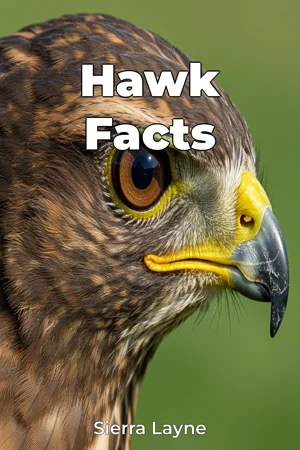
Have you ever witnessed a dive executed with such speed and accuracy that it defies belief? "Hawk Facts" delves into the world of these avian predators, exploring the biological and behavioral elements that make them some of nature's most efficient hunters. This book examines the science behind their success, focusing on their exceptional eyesight, sophisticated hunting strategies, and remarkable flight capabilities. We begin by investigating the fundamental characteristics that define hawks as a group, differentiating them from other raptors and outlining their global distribution. This overview provides a crucial foundation for understanding the specific adaptations that will be discussed in detail throughout the book. Understanding the hawk’s place in the avian world is fundamental before focusing on its unique attributes. The book's core is structured around three central themes: the science of hawk vision, the biomechanics of their flight and hunting techniques, and the ecological significance of hawks in various ecosystems. First, we explore the anatomy and physiology of hawk eyes, examining how their unique retinal structure allows for exceptional visual acuity and depth perception. We analyze how their vision adapts to varied light conditions and distances, enabling them to detect prey from great heights. Second, we dissect the physics and biology of hawk flight, covering wing morphology, flight dynamics, and the muscular systems that power their aerial maneuvers. We consider diverse hunting strategies, from soaring and diving to still-hunting and cooperative tactics, each adapted to specific prey and habitats. Finally, the book analyzes the ecological roles hawks play as apex predators, examining their impact on prey populations, their contributions to ecosystem health, and the conservation challenges they face in a changing world. The central argument of "Hawk Facts" is that the hawk's evolutionary success is due to a convergence of highly specialized adaptations across multiple biological systems. We present evidence from diverse sources, including field studies of hawk behavior, laboratory analyses of hawk physiology, and comparative genomics, to support this claim. Data is drawn from long-term research projects, providing a comprehensive and reliable foundation for the conclusions. This book also makes connections to other scientific fields, including ecology, evolutionary biology, and conservation science. By examining the hawk's role in its environment, we shed light on broader ecological principles such as predator-prey dynamics and trophic cascades. By tracing the evolutionary history of hawks, we gain insights into the processes of adaptation and speciation. By addressing the conservation challenges facing hawk populations, we underscore the importance of biodiversity and ecosystem preservation. This work stands apart by integrating cutting-edge research with accessible explanations. We bridge the gap between scientific jargon and general understanding, presenting complex concepts in a clear and engaging manner suitable for a wide audience. While "Hawk Facts" aims to provide a broad overview of hawk biology, it primarily focuses on well-studied species and habitats, acknowledging that much remains to be discovered about the diversity of hawk species worldwide. The intended audience includes bird enthusiasts, students of biology, and anyone interested in learning more about the natural world. This book offers valuable insights for those studying ornithology, wildlife management, or environmental science. Furthermore, the real-world implications of hawk research extend to fields such as biomimicry, where hawk adaptations inspire technological innovations. "Hawk Facts" invites readers to discover the intricate science behind these remarkable birds and foster a deeper appreciation for the natural world.
Have you ever witnessed a dive executed with such speed and accuracy that it defies belief? "Hawk Facts" delves into the world of these avian predators, exploring the biological and behavioral elements that make them some of nature's most efficient hunters. This book examines the science behind their success, focusing on their exceptional eyesight, sophisticated hunting strategies, and remarkable flight capabilities. We begin by investigating the fundamental characteristics that define hawks as a group, differentiating them from other raptors and outlining their global distribution. This overview provides a crucial foundation for understanding the specific adaptations that will be discussed in detail throughout the book. Understanding the hawk’s place in the avian world is fundamental before focusing on its unique attributes. The book's core is structured around three central themes: the science of hawk vision, the biomechanics of their flight and hunting techniques, and the ecological significance of hawks in various ecosystems. First, we explore the anatomy and physiology of hawk eyes, examining how their unique retinal structure allows for exceptional visual acuity and depth perception. We analyze how their vision adapts to varied light conditions and distances, enabling them to detect prey from great heights. Second, we dissect the physics and biology of hawk flight, covering wing morphology, flight dynamics, and the muscular systems that power their aerial maneuvers. We consider diverse hunting strategies, from soaring and diving to still-hunting and cooperative tactics, each adapted to specific prey and habitats. Finally, the book analyzes the ecological roles hawks play as apex predators, examining their impact on prey populations, their contributions to ecosystem health, and the conservation challenges they face in a changing world. The central argument of "Hawk Facts" is that the hawk's evolutionary success is due to a convergence of highly specialized adaptations across multiple biological systems. We present evidence from diverse sources, including field studies of hawk behavior, laboratory analyses of hawk physiology, and comparative genomics, to support this claim. Data is drawn from long-term research projects, providing a comprehensive and reliable foundation for the conclusions. This book also makes connections to other scientific fields, including ecology, evolutionary biology, and conservation science. By examining the hawk's role in its environment, we shed light on broader ecological principles such as predator-prey dynamics and trophic cascades. By tracing the evolutionary history of hawks, we gain insights into the processes of adaptation and speciation. By addressing the conservation challenges facing hawk populations, we underscore the importance of biodiversity and ecosystem preservation. This work stands apart by integrating cutting-edge research with accessible explanations. We bridge the gap between scientific jargon and general understanding, presenting complex concepts in a clear and engaging manner suitable for a wide audience. While "Hawk Facts" aims to provide a broad overview of hawk biology, it primarily focuses on well-studied species and habitats, acknowledging that much remains to be discovered about the diversity of hawk species worldwide. The intended audience includes bird enthusiasts, students of biology, and anyone interested in learning more about the natural world. This book offers valuable insights for those studying ornithology, wildlife management, or environmental science. Furthermore, the real-world implications of hawk research extend to fields such as biomimicry, where hawk adaptations inspire technological innovations. "Hawk Facts" invites readers to discover the intricate science behind these remarkable birds and foster a deeper appreciation for the natural world.
Hawks, as explored in "Hawk Facts," stand out as nature's remarkable avian predators, showcasing a blend of biology and behavior that underpins their hunting prowess. These raptors exhibit exceptional eyesight, allowing them to spot prey from incredible distances, and employ sophisticated hunting strategies honed by evolution. The book begins by establishing the fundamental characteristics of hawks, setting the stage for an in-depth exploration of their unique adaptations and global distribution, differentiating them from other avian species. The book then progresses by dissecting hawk vision, flight mechanics, and ecological roles. The anatomy and physiology of hawk eyes, with their unique retinal structure enabling visual acuity and depth perception, are examined. Furthermore, it analyzes the ecological roles hawks play as apex predators, examining their impact on prey populations, and their contributions to ecosystem health. It emphasizes the convergence of specialized adaptations across biological systems that contributes to the hawk's evolutionary success, substantiated by field studies, lab analysis, and comparative genomics. What sets this book apart is its ability to integrate cutting-edge research with accessible explanations, bridging the gap between scientific jargon and general understanding. By focusing on well-studied species and habitats, it provides a comprehensive overview of hawk biology, while also acknowledging the vast diversity that remains to be explored. This approach makes it an invaluable resource for bird enthusiasts, students of biology, and anyone keen to understand the science behind these magnificent birds.
Book Details
ISBN
9788233970079
Publisher
Publifye AS
Your Licenses
You don't own any licenses for this book
Purchase a license below to unlock this book and download the EPUB.
Purchase License
Select a tier to unlock this book
Need bulk licensing?
Contact us for enterprise agreements.