
About This Book
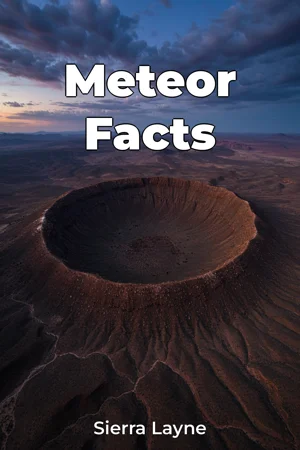
Have you ever looked up at the night sky and wondered about the fiery trails of meteors streaking across the darkness, or considered the immense power of an asteroid impact? "Meteor Facts" unravels the captivating story of these celestial phenomena, exploring their scientific origins, Earthly consequences, and lasting geological legacies. This book delves into the realms of space science, earth sciences, and geography to provide a comprehensive understanding of meteors, asteroids, and the craters they leave behind. These topics are critical because they illuminate Earth's place in the solar system and its long, eventful history. Understanding meteor showers helps us predict and prepare for potential future impacts, while studying impact craters gives us insights into Earth's geological past and even the evolution of life. "Meteor Facts" presents a core argument: that the study of meteors and asteroid impacts is not just an academic exercise, but a crucial endeavor for understanding planetary evolution and mitigating potential future threats to our planet. This understanding is achievable through the synthesis of data from various scientific disciplines. The structure of this book is designed to build this understanding systematically. We begin with an introduction to the basic definitions and properties of meteors, meteoroids, and asteroids, clarifying common misconceptions. Next, we will delve into the origins of these space rocks, tracing their formation back to the early solar system and the asteroid belt. The book then focuses on Earth-crossing asteroids and the dynamics of impacts, covering topics such as impact velocities, energy release calculations, and the formation of impact craters. A major section of "Meteor Facts" is dedicated to exploring famous impact craters on Earth. From the well-preserved Barringer Crater in Arizona to the massive Vredefort Dome in South Africa, each case study will be examined with detailed geological data, including crater morphology, impact breccias, and shocked minerals. The evidence presented includes geological surveys, remote sensing data, and geochemical analyses. This section relies heavily on data from geological surveys, remote sensing technology, and geochemical analysis of rock samples collected from impact sites. Furthermore, "Meteor Facts" considers the interdisciplinary aspects of meteoritics and impact geology. It connects to astronomy through the study of asteroid trajectories and orbital dynamics. It links to climate science by examining the environmental effects of large impacts, such as global dust clouds and mass extinction events. Finally, it relates to biology through discussions of the role of impacts in shaping the course of evolution. A unique perspective adopted in this book is the integration of both observational data and theoretical modeling to provide a comprehensive view of impact events. This approach combines empirical evidence with computational simulations to better understand the complex physical processes involved. "Meteor Facts" is written in a fact-based, informative style that aims to be accessible to a broad audience, including students, amateur astronomers, and anyone with an interest in space and Earth science. It avoids sensationalism and focuses on presenting the scientific evidence in a clear and engaging manner. The book is tailored for readers seeking a solid scientific foundation in meteoritics and impact geology. The intended audience ranges from high school students to amateur astronomers, as well as undergraduates studying geology, planetary science, or environmental science. The book is thorough but focused, covering the essentials of meteoritics and impact cratering while acknowledging the boundaries of current knowledge. While "Meteor Facts" provides in-depth analysis of selected impact craters, it does not attempt to catalogue every known impact structure on Earth. The knowledge presented in "Meteor Facts" has several real-world applications. It informs planetary defense strategies aimed at detecting and mitigating potential asteroid threats. It also provides insights into resource exploration, as some impact structures are associated with mineral deposits. Finally, "Meteor Facts" addresses some of the ongoing debates in the field, such as the precise role of impacts in past extinction events and the potential for future large-scale impacts. By engaging with these controversies, the book aims to stimulate further research and discussion in this dynamic area of science.
Have you ever looked up at the night sky and wondered about the fiery trails of meteors streaking across the darkness, or considered the immense power of an asteroid impact? "Meteor Facts" unravels the captivating story of these celestial phenomena, exploring their scientific origins, Earthly consequences, and lasting geological legacies. This book delves into the realms of space science, earth sciences, and geography to provide a comprehensive understanding of meteors, asteroids, and the craters they leave behind. These topics are critical because they illuminate Earth's place in the solar system and its long, eventful history. Understanding meteor showers helps us predict and prepare for potential future impacts, while studying impact craters gives us insights into Earth's geological past and even the evolution of life. "Meteor Facts" presents a core argument: that the study of meteors and asteroid impacts is not just an academic exercise, but a crucial endeavor for understanding planetary evolution and mitigating potential future threats to our planet. This understanding is achievable through the synthesis of data from various scientific disciplines. The structure of this book is designed to build this understanding systematically. We begin with an introduction to the basic definitions and properties of meteors, meteoroids, and asteroids, clarifying common misconceptions. Next, we will delve into the origins of these space rocks, tracing their formation back to the early solar system and the asteroid belt. The book then focuses on Earth-crossing asteroids and the dynamics of impacts, covering topics such as impact velocities, energy release calculations, and the formation of impact craters. A major section of "Meteor Facts" is dedicated to exploring famous impact craters on Earth. From the well-preserved Barringer Crater in Arizona to the massive Vredefort Dome in South Africa, each case study will be examined with detailed geological data, including crater morphology, impact breccias, and shocked minerals. The evidence presented includes geological surveys, remote sensing data, and geochemical analyses. This section relies heavily on data from geological surveys, remote sensing technology, and geochemical analysis of rock samples collected from impact sites. Furthermore, "Meteor Facts" considers the interdisciplinary aspects of meteoritics and impact geology. It connects to astronomy through the study of asteroid trajectories and orbital dynamics. It links to climate science by examining the environmental effects of large impacts, such as global dust clouds and mass extinction events. Finally, it relates to biology through discussions of the role of impacts in shaping the course of evolution. A unique perspective adopted in this book is the integration of both observational data and theoretical modeling to provide a comprehensive view of impact events. This approach combines empirical evidence with computational simulations to better understand the complex physical processes involved. "Meteor Facts" is written in a fact-based, informative style that aims to be accessible to a broad audience, including students, amateur astronomers, and anyone with an interest in space and Earth science. It avoids sensationalism and focuses on presenting the scientific evidence in a clear and engaging manner. The book is tailored for readers seeking a solid scientific foundation in meteoritics and impact geology. The intended audience ranges from high school students to amateur astronomers, as well as undergraduates studying geology, planetary science, or environmental science. The book is thorough but focused, covering the essentials of meteoritics and impact cratering while acknowledging the boundaries of current knowledge. While "Meteor Facts" provides in-depth analysis of selected impact craters, it does not attempt to catalogue every known impact structure on Earth. The knowledge presented in "Meteor Facts" has several real-world applications. It informs planetary defense strategies aimed at detecting and mitigating potential asteroid threats. It also provides insights into resource exploration, as some impact structures are associated with mineral deposits. Finally, "Meteor Facts" addresses some of the ongoing debates in the field, such as the precise role of impacts in past extinction events and the potential for future large-scale impacts. By engaging with these controversies, the book aims to stimulate further research and discussion in this dynamic area of science.
"Meteor Facts" explores the fascinating world of meteors, asteroid impacts, and their profound effects on Earth. It examines how these celestial events have shaped our planet's geology, influenced the evolution of life, and continue to pose potential threats. Did you know that the study of impact craters reveals clues about Earth's past, with some craters holding valuable mineral deposits? The book emphasizes the importance of understanding these phenomena for planetary defense and resource exploration, highlighting the interdisciplinary nature of meteoritics, linking astronomy, climate science, and biology. The book progresses systematically, starting with basic definitions and the origins of meteors and asteroids in the solar system. It then delves into the dynamics of impacts and the formation of impact craters, supported by geological surveys and remote sensing data. A significant portion is devoted to case studies of famous impact craters, such as the Barringer Crater and the Vredefort Dome, providing detailed geological data and analysis. Understanding meteor showers helps us predict and prepare for potential future impacts. "Meteor Facts" uniquely integrates observational data with theoretical modeling, offering a comprehensive view of impact events. The book aims to make complex scientific concepts accessible to a broad audience, from students to amateur astronomers, without sensationalism. It presents scientific evidence in a clear and engaging manner, tailored for those seeking a solid foundation in meteoritics and impact geology.
Book Details
ISBN
9788233969806
Publisher
Publifye AS
Your Licenses
You don't own any licenses for this book
Purchase a license below to unlock this book and download the EPUB.
Purchase License
Select a tier to unlock this book
Need bulk licensing?
Contact us for enterprise agreements.