
About This Book
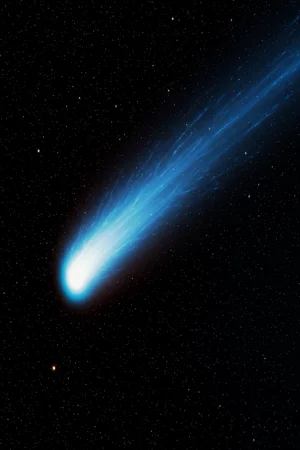
Have you ever looked up at the night sky and wondered about the silent wanderers with glowing tails that occasionally grace our view? "Comet Facts" seeks to illuminate these celestial objects, presenting a comprehensive look at their nature, origins, and significance. This exploration is vital because understanding comets provides insight into the formation of our solar system and helps assess potential risks to our planet. This book delves into three main areas: the composition and structure of comets, their origins in the outer reaches of the solar system, and the dynamics of their tails as they interact with the sun, all within the context of our quest to understand our place in the universe. It is built on the premise that comets are not simply space debris but valuable time capsules preserving clues about the solar system's infancy. We will first establish a foundational understanding of the current models of solar system formation, orbital mechanics, and the physical properties of icy bodies. We will then introduce the structure of comets, detailing their nucleus, coma, and tails, and discuss the materials they are made of. The book then examines the two primary reservoirs of comets: the Kuiper Belt and the Oort Cloud, detailing the evidence for their existence and the processes by which comets are ejected from these regions and sent towards the sun. The book will also explore the interaction of comets with the solar wind and radiation, explaining how these interactions lead to the formation of their characteristic tails. The book is structured into three major sections, each building upon the previous one. Part one introduces the basic properties of comets, their orbits, and their place in the solar system. Part two explores their origins, investigating the Kuiper Belt and Oort Cloud, and the processes that lead to cometary formation. Part three details the processes involved in the formation of cometary tails and the interaction with the Sun. Each section culminates in a discussion of the key unanswered questions and areas of ongoing research. "Comet Facts" draws upon a wide range of data, including observations from ground-based telescopes, space-based observatories like Hubble and Spitzer, and data collected by spacecraft missions such as Rosetta, Deep Impact, and Stardust. It will also make use of theoretical models and simulations to explain complex phenomena. The study of comets connects to several disciplines, including astrophysics, planetary science, and even astrobiology. Comets may have played a crucial role in delivering water and organic molecules to early Earth, making their study relevant to our search for the origins of life. This book also touches on the hazard assessment of potential Earth-impacting comets, linking it to impact cratering and extinction events. Finally, the book will also discuss the societal impacts of cometary apparitions, including their influence on human history and culture. This book offers a balanced perspective, presenting both established facts and ongoing debates within the scientific community. The information will be presented in a clear, concise manner, avoiding jargon where possible and providing explanations for technical terms. The target audience includes amateur astronomers, students of astronomy and planetary science, and anyone with a general interest in space and the solar system. Readers will gain a comprehensive, up-to-date understanding of comets and their significance. As a work of non-fiction, this book adheres to the principles of accuracy, objectivity, and evidence-based reasoning. All claims are supported by scientific data and references to peer-reviewed literature. While comprehensive, the book focuses primarily on the physical and dynamical aspects of comets, with less emphasis on their chemical composition. Understanding comets has practical applications, such as improving our ability to predict and mitigate potential impact hazards, as well as providing clues about the ingredients necessary for the formation of habitable planets. The book addresses some of the ongoing debates in the field, such as the exact size and distribution of objects in the Oort Cloud, and the relative contributions of different sources to Earth's water. "Comet Facts" provides a deep, informative exploration of comets, offering readers a new appreciation for these icy wanderers and their role in the grand story of our solar system.
Have you ever looked up at the night sky and wondered about the silent wanderers with glowing tails that occasionally grace our view? "Comet Facts" seeks to illuminate these celestial objects, presenting a comprehensive look at their nature, origins, and significance. This exploration is vital because understanding comets provides insight into the formation of our solar system and helps assess potential risks to our planet. This book delves into three main areas: the composition and structure of comets, their origins in the outer reaches of the solar system, and the dynamics of their tails as they interact with the sun, all within the context of our quest to understand our place in the universe. It is built on the premise that comets are not simply space debris but valuable time capsules preserving clues about the solar system's infancy. We will first establish a foundational understanding of the current models of solar system formation, orbital mechanics, and the physical properties of icy bodies. We will then introduce the structure of comets, detailing their nucleus, coma, and tails, and discuss the materials they are made of. The book then examines the two primary reservoirs of comets: the Kuiper Belt and the Oort Cloud, detailing the evidence for their existence and the processes by which comets are ejected from these regions and sent towards the sun. The book will also explore the interaction of comets with the solar wind and radiation, explaining how these interactions lead to the formation of their characteristic tails. The book is structured into three major sections, each building upon the previous one. Part one introduces the basic properties of comets, their orbits, and their place in the solar system. Part two explores their origins, investigating the Kuiper Belt and Oort Cloud, and the processes that lead to cometary formation. Part three details the processes involved in the formation of cometary tails and the interaction with the Sun. Each section culminates in a discussion of the key unanswered questions and areas of ongoing research. "Comet Facts" draws upon a wide range of data, including observations from ground-based telescopes, space-based observatories like Hubble and Spitzer, and data collected by spacecraft missions such as Rosetta, Deep Impact, and Stardust. It will also make use of theoretical models and simulations to explain complex phenomena. The study of comets connects to several disciplines, including astrophysics, planetary science, and even astrobiology. Comets may have played a crucial role in delivering water and organic molecules to early Earth, making their study relevant to our search for the origins of life. This book also touches on the hazard assessment of potential Earth-impacting comets, linking it to impact cratering and extinction events. Finally, the book will also discuss the societal impacts of cometary apparitions, including their influence on human history and culture. This book offers a balanced perspective, presenting both established facts and ongoing debates within the scientific community. The information will be presented in a clear, concise manner, avoiding jargon where possible and providing explanations for technical terms. The target audience includes amateur astronomers, students of astronomy and planetary science, and anyone with a general interest in space and the solar system. Readers will gain a comprehensive, up-to-date understanding of comets and their significance. As a work of non-fiction, this book adheres to the principles of accuracy, objectivity, and evidence-based reasoning. All claims are supported by scientific data and references to peer-reviewed literature. While comprehensive, the book focuses primarily on the physical and dynamical aspects of comets, with less emphasis on their chemical composition. Understanding comets has practical applications, such as improving our ability to predict and mitigate potential impact hazards, as well as providing clues about the ingredients necessary for the formation of habitable planets. The book addresses some of the ongoing debates in the field, such as the exact size and distribution of objects in the Oort Cloud, and the relative contributions of different sources to Earth's water. "Comet Facts" provides a deep, informative exploration of comets, offering readers a new appreciation for these icy wanderers and their role in the grand story of our solar system.
"Comet Facts" unveils the captivating world of comets, exploring their composition, origins, and interactions within our solar system. These icy bodies, often referred to as "dirty snowballs," hold vital clues about the solar system's formation. Did you know that comets originate from two primary regions: the Kuiper Belt, beyond Neptune, and the distant Oort Cloud, a vast, spherical shell surrounding the solar system? The book delves into these origins and examines how solar radiation creates the mesmerizing comet tails we observe. This book methodically progresses through three key sections. First, it establishes a foundation by detailing the properties and orbits of comets. Next, it investigates their origins in the Kuiper Belt and Oort Cloud, explaining cometary formation. Finally, it examines how comet tails form through interactions with the sun. By integrating data from telescopes and space missions like Rosetta and Deep Impact, "Comet Facts" presents a balanced perspective on established knowledge and ongoing scientific debates, making it valuable for amateur astronomers and anyone curious about these celestial objects.
Book Details
ISBN
9788233969523
Publisher
Publifye AS
Your Licenses
You don't own any licenses for this book
Purchase a license below to unlock this book and download the EPUB.
Purchase License
Select a tier to unlock this book
Need bulk licensing?
Contact us for enterprise agreements.