
About This Book
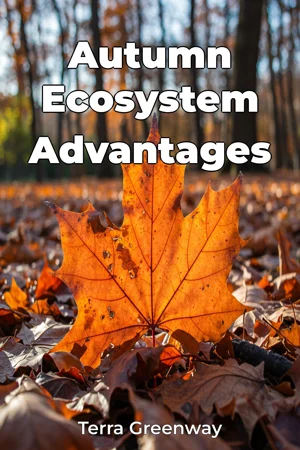
Have you ever considered autumn as more than just a season of scenic beauty and pumpkin spice? "Autumn Ecosystem Advantages" delves into the often-overlooked ecological significance of autumn, revealing its crucial role in sustaining life cycles and shaping the environment. This book explores nutrient cycling, seed dispersal strategies, and wildlife adaptation mechanisms, demonstrating how these processes contribute to environmental health and biodiversity. Autumn is not merely an end but a vital transition, a period of intense biological activity essential for the vitality of ecosystems. The book emphasizes why understanding these autumnal processes is crucial for environmental conservation and ecological balance. It provides context by examining the interplay between seasonal changes and ecological functions, highlighting the historical neglect of autumn in environmental studies compared to research focused on spring and summer growth. This oversight necessitates a deeper investigation into autumn's contributions. The central argument is that autumn’s ecological benefits are more significant and complex than commonly perceived. We contend that the season's natural processes are fundamental for long-term ecosystem stability and resilience. The book outlines a structured investigation, beginning with an introduction to key autumnal phenomena. We then develop this foundation in three major sections: examining the release and redistribution of nutrients via leaf litter decomposition, reviewing diverse methods of seed dispersal that ensure future plant propagation, and detailing the strategies animals employ to prepare for winter. We culminate by synthesizing these ecological processes, illustrating their combined impact on ecosystem health, and discussing practical implications for environmental management and conservation efforts. Our analysis draws upon a wide range of environmental studies, including data from long-term ecological research sites across various biomes. We incorporate findings from soil science, botany, zoology, and climatology to support our arguments, using empirical data and established theoretical frameworks within ecology, going beyond observations of the visible changes. “Autumn Ecosystem Advantages” connects to several interdisciplinary fields, including climate science, agricultural science, and urban planning. For example, understanding nutrient cycling in autumn has direct relevance for sustainable agriculture practices and management of urban forests. These interdisciplinary connections reinforce the book’s central argument by demonstrating the far-reaching implications of autumnal processes. The book adopts a fact-based, analytical tone, presenting information clearly and concisely, suitable for both academic and general audiences. The intended readership includes ecologists, conservation biologists, environmental scientists, students, and anyone interested in understanding the natural world. The book would be valuable to them because it provides a comprehensive, evidence-based overview of autumn's ecological roles, offering new insights into ecosystem dynamics. As a work of non-fiction, the book adheres to the conventions of scientific accuracy, presenting information in a structured and logical manner, with proper citations and references. The book’s scope encompasses a broad range of ecosystems, but we focus on temperate and boreal regions to provide in-depth analysis. We acknowledge that tropical and arid ecosystems exhibit different seasonal dynamics, representing a limitation of the book's scope. The information presented has real-world applications in areas such as forest management, wildlife conservation, and landscape restoration. Understanding autumn’s processes can inform more effective strategies for mitigating climate change impacts and protecting biodiversity. While the ecological significance of autumn is increasingly recognized, debates persist regarding the extent to which human activities, such as deforestation and pollution, disrupt these processes. The book addresses these debates, presenting evidence-based perspectives on the challenges and opportunities for preserving autumnal ecosystems. "Autumn Ecosystem Advantages" invites readers to reconsider the importance of a season often viewed aesthetically, revealing its critical functions in the natural world and promoting a greater understanding of the environmental processes that sustain us all. The book presents its argument through scientific research and broad ecological principles.
Have you ever considered autumn as more than just a season of scenic beauty and pumpkin spice? "Autumn Ecosystem Advantages" delves into the often-overlooked ecological significance of autumn, revealing its crucial role in sustaining life cycles and shaping the environment. This book explores nutrient cycling, seed dispersal strategies, and wildlife adaptation mechanisms, demonstrating how these processes contribute to environmental health and biodiversity. Autumn is not merely an end but a vital transition, a period of intense biological activity essential for the vitality of ecosystems. The book emphasizes why understanding these autumnal processes is crucial for environmental conservation and ecological balance. It provides context by examining the interplay between seasonal changes and ecological functions, highlighting the historical neglect of autumn in environmental studies compared to research focused on spring and summer growth. This oversight necessitates a deeper investigation into autumn's contributions. The central argument is that autumn’s ecological benefits are more significant and complex than commonly perceived. We contend that the season's natural processes are fundamental for long-term ecosystem stability and resilience. The book outlines a structured investigation, beginning with an introduction to key autumnal phenomena. We then develop this foundation in three major sections: examining the release and redistribution of nutrients via leaf litter decomposition, reviewing diverse methods of seed dispersal that ensure future plant propagation, and detailing the strategies animals employ to prepare for winter. We culminate by synthesizing these ecological processes, illustrating their combined impact on ecosystem health, and discussing practical implications for environmental management and conservation efforts. Our analysis draws upon a wide range of environmental studies, including data from long-term ecological research sites across various biomes. We incorporate findings from soil science, botany, zoology, and climatology to support our arguments, using empirical data and established theoretical frameworks within ecology, going beyond observations of the visible changes. “Autumn Ecosystem Advantages” connects to several interdisciplinary fields, including climate science, agricultural science, and urban planning. For example, understanding nutrient cycling in autumn has direct relevance for sustainable agriculture practices and management of urban forests. These interdisciplinary connections reinforce the book’s central argument by demonstrating the far-reaching implications of autumnal processes. The book adopts a fact-based, analytical tone, presenting information clearly and concisely, suitable for both academic and general audiences. The intended readership includes ecologists, conservation biologists, environmental scientists, students, and anyone interested in understanding the natural world. The book would be valuable to them because it provides a comprehensive, evidence-based overview of autumn's ecological roles, offering new insights into ecosystem dynamics. As a work of non-fiction, the book adheres to the conventions of scientific accuracy, presenting information in a structured and logical manner, with proper citations and references. The book’s scope encompasses a broad range of ecosystems, but we focus on temperate and boreal regions to provide in-depth analysis. We acknowledge that tropical and arid ecosystems exhibit different seasonal dynamics, representing a limitation of the book's scope. The information presented has real-world applications in areas such as forest management, wildlife conservation, and landscape restoration. Understanding autumn’s processes can inform more effective strategies for mitigating climate change impacts and protecting biodiversity. While the ecological significance of autumn is increasingly recognized, debates persist regarding the extent to which human activities, such as deforestation and pollution, disrupt these processes. The book addresses these debates, presenting evidence-based perspectives on the challenges and opportunities for preserving autumnal ecosystems. "Autumn Ecosystem Advantages" invites readers to reconsider the importance of a season often viewed aesthetically, revealing its critical functions in the natural world and promoting a greater understanding of the environmental processes that sustain us all. The book presents its argument through scientific research and broad ecological principles.
"Autumn Ecosystem Advantages" unveils the hidden ecological importance of autumn, a season often undervalued beyond its scenic beauty. It argues that autumn is not an end but a crucial transition period marked by intense biological activity, essential for ecosystem vitality. Delving into nutrient cycling, the book reveals how leaf litter decomposition enriches the soil, supporting future growth. It also explores diverse seed dispersal methods that ensure plant propagation and details wildlife adaptation strategies for winter survival, highlighting their combined impact on ecosystem health. The book emphasizes how understanding autumnal processes is crucial for environmental conservation, addressing a historical neglect of autumn in environmental studies. By examining the interplay between seasonal changes and ecological functions, the book demonstrates how autumn's natural processes are fundamental for long-term ecosystem stability. The book begins with an introduction to autumnal phenomena before developing this foundation in three major sections. It culminates by synthesizing these ecological processes, illustrating their combined impact on ecosystem health, and discussing practical implications for environmental management and conservation efforts.
Book Details
ISBN
9788233968694
Publisher
Publifye AS
Your Licenses
You don't own any licenses for this book
Purchase a license below to unlock this book and download the EPUB.
Purchase License
Select a tier to unlock this book
Need bulk licensing?
Contact us for enterprise agreements.