
About This Book
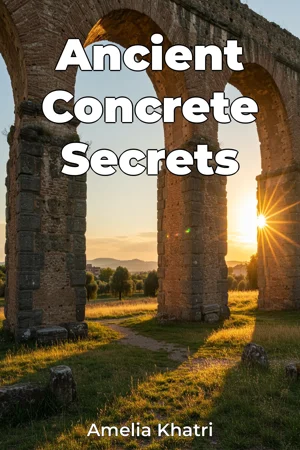
What if the secrets to sustainable infrastructure were buried beneath our feet, waiting to be rediscovered? "Ancient Concrete Secrets" delves into the remarkably durable and ingenious concrete formulations developed by the Romans, offering a much needed re-evaluation of modern construction practices and potential solutions to the current challenges of building sustainability. This book examines Roman concrete not merely as a historical curiosity, but as a source of profound insights into creating resilient and environmentally conscious structures for the future. The central argument posits that Roman concrete achieved unmatched longevity and resilience not through sheer luck, but through a deep understanding of material science, informed by locally-sourced materials and innovative mixing techniques. We will investigate the unique chemical and physical properties of Roman concrete, highlighting the crucial role played by volcanic ash and other additives. The book challenges the modern assumption that concrete must be formulated using Portland cement, advocating instead for a more nuanced, context-specific approach inspired by Roman ingenuity. "Ancient Concrete Secrets" provides a comprehensive overview of Roman concrete technology. Initially, the book introduces the social, economic, and geographical context that fostered the development of Roman construction techniques. It then transitions to a scientific exploration of Roman concrete’s composition, comparing and contrasting it with modern Portland cement-based concrete. Chapters will focus on the sourcing and preparation of key ingredients such as pozzolana, lime, and aggregates, informed by archaeological evidence and modern analytical techniques including X-ray diffraction and scanning electron microscopy. A significant portion of the book will be dedicated to the analysis of concrete structures from diverse locations within the Roman Empire, drawing on findings from Mediterranean excavations to illustrate the variability and adaptability of Roman concrete recipes. The concluding chapters shift focus to the implications of Roman concrete research for modern construction. We will explore how Roman principles can be applied to develop sustainable and resilient concrete alternatives that reduce carbon emissions and enhance structural longevity. Practical examples and case studies will be presented, demonstrating the feasibility of incorporating Roman techniques into contemporary projects. The book's evidence is primarily drawn from two distinct but complementary sources: archaeological findings from numerous Mediterranean excavation sites and cutting-edge material analysis conducted on Roman concrete samples. Data from sites, coupled with results from laboratory tests, provides a holistic understanding of the material's performance over centuries. This dual approach allows for both a contextual understanding of how Roman concrete was used and a rigorous scientific assessment of its properties. "Ancient Concrete Secrets" bridges the gap between archaeology, material science, and civil engineering, encouraging collaborative research and practical application of historical knowledge. Furthermore, the book touches upon environmental science by emphasizing the lower carbon footprint associated with some Roman concrete formulations compared to modern Portland cement, highlighting the potential for sustainable construction practices. The study of ancient history is also relevant, as understanding the rise and fall of civilizations can be intertwined with how well they managed to adapt and construct their environments. The book adopts a scientifically rigorous yet accessible tone, blending detailed technical analysis with engaging narrative descriptions of the archaeological sites and historical context. "Ancient Concrete Secrets" is aimed at civil engineers, architects, material scientists, archaeologists, and anyone interested in sustainable construction practices and the history of technology. It offers valuable insights into the potential for rediscovering ancient wisdom to address modern challenges. While the book focuses on the technological aspects of Roman concrete, it acknowledges the broader social and economic factors that influenced its development and implementation. The scope is intentionally limited to concrete and related construction techniques, rather than encompassing all aspects of Roman engineering. Ultimately, "Ancient Concrete Secrets" offers a compelling case for re-evaluating modern construction practices through the lens of ancient innovation, advocating for a more sustainable and resilient future built upon the foundations of the past. The information presented can be applied practically by engineers and architects seeking to incorporate sustainable materials and techniques into their projects, while also offering valuable insights for policymakers and researchers interested in promoting environmentally responsible construction. The book addresses some of the ongoing debates surrounding the use of supplementary cementitious materials in modern concrete, presenting Roman concrete as a compelling example of a successful alternative to traditional Portland cement formulations.
What if the secrets to sustainable infrastructure were buried beneath our feet, waiting to be rediscovered? "Ancient Concrete Secrets" delves into the remarkably durable and ingenious concrete formulations developed by the Romans, offering a much needed re-evaluation of modern construction practices and potential solutions to the current challenges of building sustainability. This book examines Roman concrete not merely as a historical curiosity, but as a source of profound insights into creating resilient and environmentally conscious structures for the future. The central argument posits that Roman concrete achieved unmatched longevity and resilience not through sheer luck, but through a deep understanding of material science, informed by locally-sourced materials and innovative mixing techniques. We will investigate the unique chemical and physical properties of Roman concrete, highlighting the crucial role played by volcanic ash and other additives. The book challenges the modern assumption that concrete must be formulated using Portland cement, advocating instead for a more nuanced, context-specific approach inspired by Roman ingenuity. "Ancient Concrete Secrets" provides a comprehensive overview of Roman concrete technology. Initially, the book introduces the social, economic, and geographical context that fostered the development of Roman construction techniques. It then transitions to a scientific exploration of Roman concrete’s composition, comparing and contrasting it with modern Portland cement-based concrete. Chapters will focus on the sourcing and preparation of key ingredients such as pozzolana, lime, and aggregates, informed by archaeological evidence and modern analytical techniques including X-ray diffraction and scanning electron microscopy. A significant portion of the book will be dedicated to the analysis of concrete structures from diverse locations within the Roman Empire, drawing on findings from Mediterranean excavations to illustrate the variability and adaptability of Roman concrete recipes. The concluding chapters shift focus to the implications of Roman concrete research for modern construction. We will explore how Roman principles can be applied to develop sustainable and resilient concrete alternatives that reduce carbon emissions and enhance structural longevity. Practical examples and case studies will be presented, demonstrating the feasibility of incorporating Roman techniques into contemporary projects. The book's evidence is primarily drawn from two distinct but complementary sources: archaeological findings from numerous Mediterranean excavation sites and cutting-edge material analysis conducted on Roman concrete samples. Data from sites, coupled with results from laboratory tests, provides a holistic understanding of the material's performance over centuries. This dual approach allows for both a contextual understanding of how Roman concrete was used and a rigorous scientific assessment of its properties. "Ancient Concrete Secrets" bridges the gap between archaeology, material science, and civil engineering, encouraging collaborative research and practical application of historical knowledge. Furthermore, the book touches upon environmental science by emphasizing the lower carbon footprint associated with some Roman concrete formulations compared to modern Portland cement, highlighting the potential for sustainable construction practices. The study of ancient history is also relevant, as understanding the rise and fall of civilizations can be intertwined with how well they managed to adapt and construct their environments. The book adopts a scientifically rigorous yet accessible tone, blending detailed technical analysis with engaging narrative descriptions of the archaeological sites and historical context. "Ancient Concrete Secrets" is aimed at civil engineers, architects, material scientists, archaeologists, and anyone interested in sustainable construction practices and the history of technology. It offers valuable insights into the potential for rediscovering ancient wisdom to address modern challenges. While the book focuses on the technological aspects of Roman concrete, it acknowledges the broader social and economic factors that influenced its development and implementation. The scope is intentionally limited to concrete and related construction techniques, rather than encompassing all aspects of Roman engineering. Ultimately, "Ancient Concrete Secrets" offers a compelling case for re-evaluating modern construction practices through the lens of ancient innovation, advocating for a more sustainable and resilient future built upon the foundations of the past. The information presented can be applied practically by engineers and architects seeking to incorporate sustainable materials and techniques into their projects, while also offering valuable insights for policymakers and researchers interested in promoting environmentally responsible construction. The book addresses some of the ongoing debates surrounding the use of supplementary cementitious materials in modern concrete, presenting Roman concrete as a compelling example of a successful alternative to traditional Portland cement formulations.
"Ancient Concrete Secrets" explores the lost art of Roman concrete, positioning it as a key to unlocking sustainable construction practices. It challenges the dominance of modern Portland cement by examining the enduring strength and environmental benefits of Roman concrete, which has stood the test of time for millennia. The book reveals that the Romans ingeniously combined locally-sourced materials like pozzolana and lime, creating resilient structures that minimized environmental impact. Roman infrastructure wasn't just about durability; it was also about sustainability. The book journeys through architecture history, starting with the social and economic factors that shaped Roman construction. It then delves into the material science behind Roman concrete, contrasting it with modern methods and materials. Through archaeological evidence and material analysis, the book highlights the unique properties of Roman concrete, emphasizing the importance of pozzolana and innovative mixing techniques. Concluding with practical applications, "Ancient Concrete Secrets" demonstrates how Roman principles can inspire sustainable alternatives in contemporary civil engineering and architecture. By blending historical insights with modern science, the book offers a compelling vision for resilient structures and environmentally conscious construction. It advocates for rediscovering and adapting ancient wisdom to address the challenges of modern construction.
Book Details
ISBN
9788233968601
Publisher
Publifye AS
Your Licenses
You don't own any licenses for this book
Purchase a license below to unlock this book and download the EPUB.
Purchase License
Select a tier to unlock this book
Need bulk licensing?
Contact us for enterprise agreements.