
About This Book
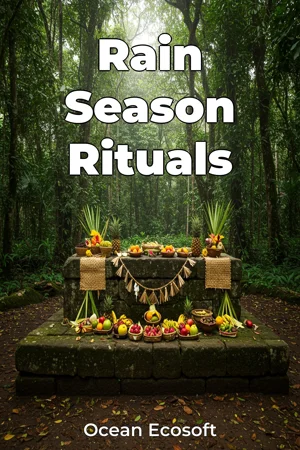
When the skies refuse to yield their life-giving waters, how have societies across the globe sought to influence the heavens? *Rain Season Rituals* delves into the historical and anthropological records of monsoon and rainfall ceremonies performed across tropical regions, exploring the profound intersection of culture, climate, and human agency. This book examines the intricate rituals, beliefs, and societal structures developed in response to the vital yet unpredictable nature of monsoonal rains. Our central focus rests upon three key thematic pillars: the historical evolution of rain-making ceremonies, the diverse cultural interpretations embedded within these rituals, and the socio-political functions these practices serve within their respective communities. These topics are important because they reveal the deep-seated human need to understand and control the natural world, particularly when faced with environmental vulnerability. Understanding these ceremonies provides insights into risk mitigation strategies, traditional ecological knowledge, and the enduring relationship between humanity and its environment. The book provides critical background by tracing the historical development of agriculture and settled societies in monsoon-dependent regions. It examines the rise of early states and their reliance on predictable rainfall for sustenance and stability. Basic knowledge of climate patterns, agricultural practices, and anthropological methods will enhance the reader’s understanding of the material, though all concepts are clearly defined within the text. The central argument of *Rain Season Rituals* is that monsoon and rainfall ceremonies, while often viewed as superstitious practices in the modern world, represent sophisticated systems of environmental knowledge, social cohesion, and political legitimacy. These rituals are not merely desperate attempts to conjure rain but rather complex expressions of a community's understanding of its environment and its place within it. This argument challenges simplistic views of traditional societies and highlights the ingenuity of human adaptation. The book’s structure unfolds in a logical progression. The introduction establishes the importance of monsoon rains for tropical societies and introduces the main themes. Subsequent chapters explore specific case studies from regions across the globe, including but not limited to India, Southeast Asia, and parts of Africa and South America. These chapters each offer a detailed analysis of the historical context, ritual practices, and social significance of rain ceremonies in each region. The concluding chapter synthesizes the findings, drawing comparisons and contrasts across the case studies, highlighting the common threads that unite these diverse practices, and exploring the implications of these traditions for contemporary environmental challenges. The evidence presented draws from a wide range of sources, including historical chronicles, ethnographic studies, archaeological reports, and linguistic analyses. Unique data sources include previously untranslated accounts of early European explorers witnessing rain ceremonies, as well as detailed analyses of indigenous languages documenting the symbolic language used in rituals. This book connects to other fields such as religious studies through its exploration of belief systems, political science through its analysis of power dynamics, and environmental studies through its examination of human-environment interactions. These interdisciplinary connections enrich the book's argument by providing multiple perspectives on the complexities of monsoon and rainfall ceremonies. *Rain Season Rituals* offers a unique perspective by treating these rituals not as isolated phenomena but as integral parts of broader socio-ecological systems. It rejects the notion that these ceremonies are irrational or primitive, instead highlighting their adaptive value and intellectual sophistication. The tone adopted is academic yet accessible, striving to present complex information in a clear and engaging manner. The target audience includes students and scholars of history, anthropology, religious studies, and environmental studies, as well as general readers interested in cultural diversity and the human relationship with nature. The book’s value lies in its comprehensive examination of a topic that is often overlooked or misunderstood. As a work of history and social science, the book adheres to the conventions of rigorous research, clear argumentation, and objective analysis. The book's scope is limited to tropical regions with pronounced monsoon seasons, focusing primarily on societies where rain ceremonies played a significant role in their cultural and political life. While it acknowledges the existence of similar practices in other climate zones, it deliberately narrows its focus to allow for in-depth analysis. The information presented in *Rain Season Rituals* has practical applications for understanding contemporary challenges related to climate change, water resource management, and cultural preservation. It provides valuable insights into traditional ecological knowledge and adaptive strategies that may be relevant for building resilience in vulnerable communities. The book also addresses potential controversies surrounding cultural appropriation and the ethical implications of studying and interpreting indigenous practices, engaging with ongoing debates about the representation and preservation of cultural heritage.
When the skies refuse to yield their life-giving waters, how have societies across the globe sought to influence the heavens? *Rain Season Rituals* delves into the historical and anthropological records of monsoon and rainfall ceremonies performed across tropical regions, exploring the profound intersection of culture, climate, and human agency. This book examines the intricate rituals, beliefs, and societal structures developed in response to the vital yet unpredictable nature of monsoonal rains. Our central focus rests upon three key thematic pillars: the historical evolution of rain-making ceremonies, the diverse cultural interpretations embedded within these rituals, and the socio-political functions these practices serve within their respective communities. These topics are important because they reveal the deep-seated human need to understand and control the natural world, particularly when faced with environmental vulnerability. Understanding these ceremonies provides insights into risk mitigation strategies, traditional ecological knowledge, and the enduring relationship between humanity and its environment. The book provides critical background by tracing the historical development of agriculture and settled societies in monsoon-dependent regions. It examines the rise of early states and their reliance on predictable rainfall for sustenance and stability. Basic knowledge of climate patterns, agricultural practices, and anthropological methods will enhance the reader’s understanding of the material, though all concepts are clearly defined within the text. The central argument of *Rain Season Rituals* is that monsoon and rainfall ceremonies, while often viewed as superstitious practices in the modern world, represent sophisticated systems of environmental knowledge, social cohesion, and political legitimacy. These rituals are not merely desperate attempts to conjure rain but rather complex expressions of a community's understanding of its environment and its place within it. This argument challenges simplistic views of traditional societies and highlights the ingenuity of human adaptation. The book’s structure unfolds in a logical progression. The introduction establishes the importance of monsoon rains for tropical societies and introduces the main themes. Subsequent chapters explore specific case studies from regions across the globe, including but not limited to India, Southeast Asia, and parts of Africa and South America. These chapters each offer a detailed analysis of the historical context, ritual practices, and social significance of rain ceremonies in each region. The concluding chapter synthesizes the findings, drawing comparisons and contrasts across the case studies, highlighting the common threads that unite these diverse practices, and exploring the implications of these traditions for contemporary environmental challenges. The evidence presented draws from a wide range of sources, including historical chronicles, ethnographic studies, archaeological reports, and linguistic analyses. Unique data sources include previously untranslated accounts of early European explorers witnessing rain ceremonies, as well as detailed analyses of indigenous languages documenting the symbolic language used in rituals. This book connects to other fields such as religious studies through its exploration of belief systems, political science through its analysis of power dynamics, and environmental studies through its examination of human-environment interactions. These interdisciplinary connections enrich the book's argument by providing multiple perspectives on the complexities of monsoon and rainfall ceremonies. *Rain Season Rituals* offers a unique perspective by treating these rituals not as isolated phenomena but as integral parts of broader socio-ecological systems. It rejects the notion that these ceremonies are irrational or primitive, instead highlighting their adaptive value and intellectual sophistication. The tone adopted is academic yet accessible, striving to present complex information in a clear and engaging manner. The target audience includes students and scholars of history, anthropology, religious studies, and environmental studies, as well as general readers interested in cultural diversity and the human relationship with nature. The book’s value lies in its comprehensive examination of a topic that is often overlooked or misunderstood. As a work of history and social science, the book adheres to the conventions of rigorous research, clear argumentation, and objective analysis. The book's scope is limited to tropical regions with pronounced monsoon seasons, focusing primarily on societies where rain ceremonies played a significant role in their cultural and political life. While it acknowledges the existence of similar practices in other climate zones, it deliberately narrows its focus to allow for in-depth analysis. The information presented in *Rain Season Rituals* has practical applications for understanding contemporary challenges related to climate change, water resource management, and cultural preservation. It provides valuable insights into traditional ecological knowledge and adaptive strategies that may be relevant for building resilience in vulnerable communities. The book also addresses potential controversies surrounding cultural appropriation and the ethical implications of studying and interpreting indigenous practices, engaging with ongoing debates about the representation and preservation of cultural heritage.
*Rain Season Rituals* explores the historical and cultural significance of monsoon and rainfall ceremonies in tropical regions, revealing how societies have sought to influence the heavens when faced with unpredictable rains. The book examines these rituals as sophisticated systems of environmental knowledge, challenging the notion that they are merely superstitious practices. It highlights the deep-seated human need to understand and manage the natural world, particularly in environments vulnerable to climate variations. The book delves into the historical evolution, cultural interpretations, and socio-political functions of these rituals, emphasizing their role in social cohesion and political legitimacy. For example, the rise of early states in monsoon-dependent regions often relied on predictable rainfall, making these ceremonies crucial for maintaining stability. Through case studies from India, Southeast Asia, Africa, and South America, the book illustrates the diverse expressions of these traditions, drawing from historical chronicles, ethnographic studies, and archaeological reports. The concluding chapter synthesizes these findings, comparing and contrasting the case studies to reveal common threads and exploring implications for contemporary environmental challenges. Using an accessible yet academic approach, it treats rain ceremonies as integral parts of socio-ecological systems, rejecting simplistic views and highlighting their adaptive value.
Book Details
ISBN
9788233968267
Publisher
Publifye AS
Your Licenses
You don't own any licenses for this book
Purchase a license below to unlock this book and download the EPUB.
Purchase License
Select a tier to unlock this book
Need bulk licensing?
Contact us for enterprise agreements.