
About This Book
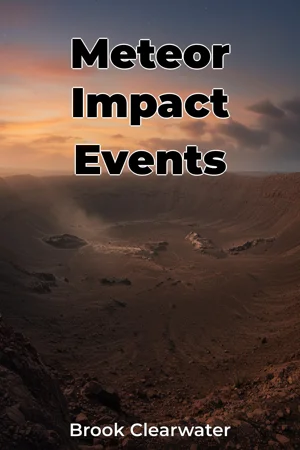
Could a rock from space reshape the trajectory of life on Earth? "Meteor Impact Events" delves into the fascinating and often catastrophic history of extraterrestrial collisions with our planet, exploring the geological fingerprints and environmental upheavals these events have left behind. This book aims to provide a comprehensive analysis of major impact events, from the well-known Chicxulub impact, linked to the extinction of the dinosaurs, to the more recent and less devastating Tunguska event, offering insights into the processes that govern these phenomena and their profound consequences. The central argument of this book is that meteor impacts, while seemingly infrequent on human timescales, are a fundamental geological and biological force that has punctuated Earth's history, driving evolutionary change and shaping the planet's surface. Understanding these events is crucial for comprehending the Earth's past, present, and potential future. This is particularly important as near-Earth objects continue to pose a tangible, albeit low-probability, threat to our modern civilization. This book is structured to guide the reader through a logical progression of understanding. It begins by introducing the fundamental concepts of impact cratering, including the physics of hypervelocity impacts and the formation of impact structures. It proceeds to examine several key impact events in detail. The Chicxulub impact is analyzed thoroughly, reviewing evidence from geological strata, geochemical anomalies, and paleontological records to reconstruct the immediate and long-term environmental consequences. The book then broadens its scope to include other significant craters worldwide, such as the Vredefort and Sudbury basins, exploring their formation processes and their impact on regional geology and resources. The Tunguska event, a rare example of an airburst impact, is investigated using historical accounts, tree-ring analysis, and remote sensing data to understand the atmospheric dynamics and surface effects of such events. Finally, the book concludes by assessing the current threat posed by near-Earth objects and discussing potential mitigation strategies, linking geological history to contemporary planetary defense efforts. The evidence presented is drawn from diverse sources, including field studies of impact craters, laboratory analyses of shocked minerals and impact breccias, remote sensing data from satellites and aerial surveys, and computer simulations of impact processes. It integrates data from diverse scientific disciplines, including geochemistry, geophysics, sedimentology, and paleontology, to provide a holistic understanding of impact events. This book connects interdisciplinary fields such as astronomy, geology, and environmental science, highlighting the complex interplay between celestial mechanics, planetary processes, and biological evolution. By synthesizing these perspectives, the book offers a unique vantage point on the Earth's dynamic history and its place in the solar system. "Meteor Impact Events" adopts a fact-based, non-fiction approach, presenting information in a clear and accessible manner suitable for students, researchers, and anyone interested in Earth sciences, planetary science, and environmental history. While encompassing a broad overview, the text does not delve into esoteric mathematical models, keeping the focus on observational data and the interpretation of physical evidence. The target audience includes undergraduate and graduate students in earth sciences, geology, planetary science, and environmental science, as well as amateur geologists, astronomy enthusiasts, and general readers interested in natural history and catastrophic events. This book will provide valuable insights into the geological, environmental, and biological consequences of meteor impacts and the ongoing efforts to understand and mitigate the threat posed by near-Earth objects. The book also addresses debates about the frequency and influence of impact events in Earth's history, presenting multiple perspectives and evaluating the evidence for each. Ultimately, "Meteor Impact Events" aims to illuminate the profound and lasting consequences of these cosmic collisions, emphasizing their role in shaping the world we inhabit and underscoring the importance of understanding the potential risks and opportunities they present. By providing a comprehensive and accessible overview of this dynamic field, the book encourages a deeper appreciation for the interconnectedness of our planet and the cosmos.
Could a rock from space reshape the trajectory of life on Earth? "Meteor Impact Events" delves into the fascinating and often catastrophic history of extraterrestrial collisions with our planet, exploring the geological fingerprints and environmental upheavals these events have left behind. This book aims to provide a comprehensive analysis of major impact events, from the well-known Chicxulub impact, linked to the extinction of the dinosaurs, to the more recent and less devastating Tunguska event, offering insights into the processes that govern these phenomena and their profound consequences. The central argument of this book is that meteor impacts, while seemingly infrequent on human timescales, are a fundamental geological and biological force that has punctuated Earth's history, driving evolutionary change and shaping the planet's surface. Understanding these events is crucial for comprehending the Earth's past, present, and potential future. This is particularly important as near-Earth objects continue to pose a tangible, albeit low-probability, threat to our modern civilization. This book is structured to guide the reader through a logical progression of understanding. It begins by introducing the fundamental concepts of impact cratering, including the physics of hypervelocity impacts and the formation of impact structures. It proceeds to examine several key impact events in detail. The Chicxulub impact is analyzed thoroughly, reviewing evidence from geological strata, geochemical anomalies, and paleontological records to reconstruct the immediate and long-term environmental consequences. The book then broadens its scope to include other significant craters worldwide, such as the Vredefort and Sudbury basins, exploring their formation processes and their impact on regional geology and resources. The Tunguska event, a rare example of an airburst impact, is investigated using historical accounts, tree-ring analysis, and remote sensing data to understand the atmospheric dynamics and surface effects of such events. Finally, the book concludes by assessing the current threat posed by near-Earth objects and discussing potential mitigation strategies, linking geological history to contemporary planetary defense efforts. The evidence presented is drawn from diverse sources, including field studies of impact craters, laboratory analyses of shocked minerals and impact breccias, remote sensing data from satellites and aerial surveys, and computer simulations of impact processes. It integrates data from diverse scientific disciplines, including geochemistry, geophysics, sedimentology, and paleontology, to provide a holistic understanding of impact events. This book connects interdisciplinary fields such as astronomy, geology, and environmental science, highlighting the complex interplay between celestial mechanics, planetary processes, and biological evolution. By synthesizing these perspectives, the book offers a unique vantage point on the Earth's dynamic history and its place in the solar system. "Meteor Impact Events" adopts a fact-based, non-fiction approach, presenting information in a clear and accessible manner suitable for students, researchers, and anyone interested in Earth sciences, planetary science, and environmental history. While encompassing a broad overview, the text does not delve into esoteric mathematical models, keeping the focus on observational data and the interpretation of physical evidence. The target audience includes undergraduate and graduate students in earth sciences, geology, planetary science, and environmental science, as well as amateur geologists, astronomy enthusiasts, and general readers interested in natural history and catastrophic events. This book will provide valuable insights into the geological, environmental, and biological consequences of meteor impacts and the ongoing efforts to understand and mitigate the threat posed by near-Earth objects. The book also addresses debates about the frequency and influence of impact events in Earth's history, presenting multiple perspectives and evaluating the evidence for each. Ultimately, "Meteor Impact Events" aims to illuminate the profound and lasting consequences of these cosmic collisions, emphasizing their role in shaping the world we inhabit and underscoring the importance of understanding the potential risks and opportunities they present. By providing a comprehensive and accessible overview of this dynamic field, the book encourages a deeper appreciation for the interconnectedness of our planet and the cosmos.
"Meteor Impact Events" explores the dramatic history of collisions between Earth and space rocks, revealing how these catastrophic events have profoundly shaped our planet. It examines major impacts, such as the Chicxulub impact linked to dinosaur extinction, and the Tunguska event, a rare airburst. Such events highlight the ongoing threat from near-Earth objects. The book begins with the physics of impact cratering and then analyzes key events using geological strata, geochemical anomalies, and historical accounts. It integrates diverse scientific disciplines to offer a holistic understanding. By synthesizing perspectives from astronomy, geology, and environmental science, "Meteor Impact Events" provides a unique view of Earth's dynamic history. The text progresses logically, connecting geological history to contemporary planetary defense efforts. This book offers a comprehensive, accessible overview suitable for anyone interested in earth sciences and planetary science.
Book Details
ISBN
9788233968069
Publisher
Publifye AS
Your Licenses
You don't own any licenses for this book
Purchase a license below to unlock this book and download the EPUB.
Purchase License
Select a tier to unlock this book
Need bulk licensing?
Contact us for enterprise agreements.