
About This Book
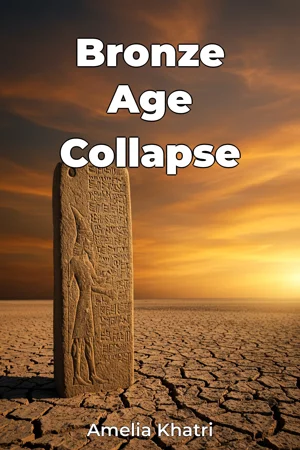
What if the seeds of societal collapse are sown not by singular events, but by the complex interplay of environmental shifts, economic vulnerabilities, and sociopolitical instability? This book examines the interconnected factors that contributed to the widespread collapse of Mediterranean civilizations around 1200 BCE, a period marked by the decline of powerful Bronze Age societies. This era, often referred to as the Late Bronze Age collapse, serves as a critical case study for understanding systemic failures in complex societies, offering insights relevant to contemporary challenges. The book delves into three key areas: environmental stressors, trade network disruptions, and sociopolitical fragility. Environmental changes, such as prolonged droughts, placed immense pressure on agricultural systems, leading to resource scarcity and displacement. Simultaneously, the intricate trade networks that connected these civilizations became increasingly vulnerable due to piracy, political instability, and potentially natural disasters, hindering the flow of essential goods. These stresses exacerbated existing sociopolitical tensions within and between states, contributing to internal strife, warfare, and ultimately, the disintegration of established power structures. Understanding the Late Bronze Age collapse requires acknowledging the sophisticated nature of the societies involved. These were not primitive cultures but complex, interconnected civilizations with advanced administrative systems, specialized labor, and extensive trade routes. The collapse, therefore, represents a failure of these systems to adapt and respond effectively to cumulative pressures. The central argument of this book posits that the collapse was not the result of a single catastrophic event, but rather a cascading series of failures across multiple domains. Individually, each challenge – drought, trade disruption, internal rebellion – might have been manageable. However, their convergence created a systemic crisis that overwhelmed the resilience of even the most powerful Bronze Age kingdoms. This book is structured to first introduce the major players and their environments, setting the stage with an overview of the Late Bronze Age Mediterranean world, including the Mycenaean kingdoms, the Hittite Empire, and Egypt. Following this, the analysis moves into a detailed examination of the environmental evidence for climate change and its impact on agriculture and resource availability. Subsequently, the book explores the disruption of trade networks, examining archaeological evidence for changes in trade routes, the rise of piracy, and the impact on resource distribution. The analysis then transitions to the sociopolitical dynamics of the period, exploring evidence of internal conflicts, migrations (such as those speculated to be caused by the Sea Peoples), and the breakdown of diplomatic relations between major powers. The concluding chapters synthesize these factors, presenting a model of systemic collapse and drawing parallels to contemporary challenges, such as climate change, globalization, and political instability. The analysis relies heavily on archaeological evidence, including settlement patterns, destruction layers, and material culture, as well as contemporary written records from Egypt, Ugarit, and other sites, providing insights into the political and economic conditions of the time. Data on climate proxies such as pollen records and sea levels, combined with textual evidence of crop failures and resource shortages, paint a picture of environmental stress. The book connects to fields such as climate science, economics, and political science, offering insights into the complex interactions between environmental factors, economic systems, and political structures. By examining the Late Bronze Age collapse through an interdisciplinary lens, this book offers a nuanced understanding of systemic risk. This book adopts an analytical and evidence-based approach, presenting information in a clear and accessible manner using historical narrative and scholarly analysis. We aim to be rigorous and accessible, making it valuable for students, researchers, and general readers interested in history, archaeology, and the dynamics of societal collapse. The book’s scope encompasses the major civilizations of the Eastern Mediterranean and Near East during the Late Bronze Age, but it intentionally limits its focus to the systemic factors contributing to the collapse, rather than providing a detailed narrative of each individual civilization. The information within this book can be applied to understanding contemporary global challenges, providing a framework for assessing systemic risks and developing strategies for building more resilient societies. While there are various theories surrounding the causes of the Late Bronze Age collapse, including invasion, natural disasters, and internal rebellion, this book addresses these positions while arguing for a more comprehensive and systemic explanation.
What if the seeds of societal collapse are sown not by singular events, but by the complex interplay of environmental shifts, economic vulnerabilities, and sociopolitical instability? This book examines the interconnected factors that contributed to the widespread collapse of Mediterranean civilizations around 1200 BCE, a period marked by the decline of powerful Bronze Age societies. This era, often referred to as the Late Bronze Age collapse, serves as a critical case study for understanding systemic failures in complex societies, offering insights relevant to contemporary challenges. The book delves into three key areas: environmental stressors, trade network disruptions, and sociopolitical fragility. Environmental changes, such as prolonged droughts, placed immense pressure on agricultural systems, leading to resource scarcity and displacement. Simultaneously, the intricate trade networks that connected these civilizations became increasingly vulnerable due to piracy, political instability, and potentially natural disasters, hindering the flow of essential goods. These stresses exacerbated existing sociopolitical tensions within and between states, contributing to internal strife, warfare, and ultimately, the disintegration of established power structures. Understanding the Late Bronze Age collapse requires acknowledging the sophisticated nature of the societies involved. These were not primitive cultures but complex, interconnected civilizations with advanced administrative systems, specialized labor, and extensive trade routes. The collapse, therefore, represents a failure of these systems to adapt and respond effectively to cumulative pressures. The central argument of this book posits that the collapse was not the result of a single catastrophic event, but rather a cascading series of failures across multiple domains. Individually, each challenge – drought, trade disruption, internal rebellion – might have been manageable. However, their convergence created a systemic crisis that overwhelmed the resilience of even the most powerful Bronze Age kingdoms. This book is structured to first introduce the major players and their environments, setting the stage with an overview of the Late Bronze Age Mediterranean world, including the Mycenaean kingdoms, the Hittite Empire, and Egypt. Following this, the analysis moves into a detailed examination of the environmental evidence for climate change and its impact on agriculture and resource availability. Subsequently, the book explores the disruption of trade networks, examining archaeological evidence for changes in trade routes, the rise of piracy, and the impact on resource distribution. The analysis then transitions to the sociopolitical dynamics of the period, exploring evidence of internal conflicts, migrations (such as those speculated to be caused by the Sea Peoples), and the breakdown of diplomatic relations between major powers. The concluding chapters synthesize these factors, presenting a model of systemic collapse and drawing parallels to contemporary challenges, such as climate change, globalization, and political instability. The analysis relies heavily on archaeological evidence, including settlement patterns, destruction layers, and material culture, as well as contemporary written records from Egypt, Ugarit, and other sites, providing insights into the political and economic conditions of the time. Data on climate proxies such as pollen records and sea levels, combined with textual evidence of crop failures and resource shortages, paint a picture of environmental stress. The book connects to fields such as climate science, economics, and political science, offering insights into the complex interactions between environmental factors, economic systems, and political structures. By examining the Late Bronze Age collapse through an interdisciplinary lens, this book offers a nuanced understanding of systemic risk. This book adopts an analytical and evidence-based approach, presenting information in a clear and accessible manner using historical narrative and scholarly analysis. We aim to be rigorous and accessible, making it valuable for students, researchers, and general readers interested in history, archaeology, and the dynamics of societal collapse. The book’s scope encompasses the major civilizations of the Eastern Mediterranean and Near East during the Late Bronze Age, but it intentionally limits its focus to the systemic factors contributing to the collapse, rather than providing a detailed narrative of each individual civilization. The information within this book can be applied to understanding contemporary global challenges, providing a framework for assessing systemic risks and developing strategies for building more resilient societies. While there are various theories surrounding the causes of the Late Bronze Age collapse, including invasion, natural disasters, and internal rebellion, this book addresses these positions while arguing for a more comprehensive and systemic explanation.
"Bronze Age Collapse" explores the interwoven factors leading to the decline of Mediterranean civilizations around 1200 BCE. Rather than attributing the collapse to a single cause, the book investigates the combined impact of environmental stressors like prolonged droughts, disruptions to vital trade networks, and underlying sociopolitical fragility. These societies, including the Mycenaean kingdoms and the Hittite Empire, were complex systems whose vulnerabilities ultimately led to widespread systemic collapse. The book uniquely argues that the convergence of multiple challenges overwhelmed the resilience of even the most powerful kingdoms. Intriguingly, archaeological evidence suggests that climate change played a significant role, impacting agriculture and resource availability. Furthermore, the disruption of trade routes exacerbated existing tensions, contributing to internal conflicts and the breakdown of diplomatic relations. Presenting an analytical and evidence-based approach, the book begins by introducing the key civilizations and their environments before delving into the environmental, economic, and sociopolitical dynamics that contributed to the era's turmoil. By examining settlement patterns, written records, and climate proxies, this book provides a comprehensive view of how interconnected systems can fail. It progresses methodically, first setting the stage and then examining the impact of environmental stressors, trade network disruptions, and sociopolitical dynamics, culminating in a synthesis of these factors to understand societal collapse. This exploration offers valuable insights applicable to contemporary global challenges, highlighting the importance of understanding systemic risks and building more resilient societies.
Book Details
ISBN
9788233968014
Publisher
Publifye AS
Your Licenses
You don't own any licenses for this book
Purchase a license below to unlock this book and download the EPUB.
Purchase License
Select a tier to unlock this book
Need bulk licensing?
Contact us for enterprise agreements.