
About This Book
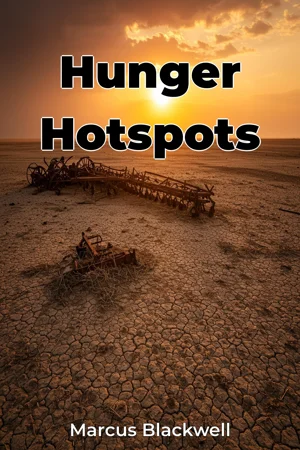
In an era of unprecedented agricultural production, why does hunger persist, and even intensify, across specific regions of the globe? "Hunger Hotspots" delves into this critical question by examining the complex interplay of factors contributing to extreme food insecurity in some of the world’s most vulnerable areas: Africa’s Sahel, Yemen, and Afghanistan. This book provides a detailed analysis of the humanitarian crises unfolding in these regions, scrutinizes the effectiveness of current intervention strategies, and highlights the persistent challenges that undermine long-term food security. The book focuses primarily on three core issues: the impact of climate change on agricultural yields, the destabilizing effects of armed conflict and political instability on food distribution networks, and the systemic failures in international aid and development programs. These topics are crucial because they underscore the multifaceted nature of food insecurity, revealing that hunger is not simply a result of insufficient food production but is deeply intertwined with environmental, political, and socio-economic factors. To understand the current crisis, "Hunger Hotspots" first establishes a historical context, tracing the roots of food insecurity in each region. It examines colonial legacies, historical patterns of resource exploitation, and the impact of past conflicts on current vulnerabilities. Knowledge of these historical factors is essential for grasping the long-term challenges and avoiding simplistic, ahistorical solutions. The central argument of "Hunger Hotspots" is that addressing extreme food insecurity requires a holistic and regionally specific approach that moves beyond short-term humanitarian aid and tackles the underlying structural issues that perpetuate hunger. This argument underscores the importance of sustainable development strategies, conflict resolution initiatives, and climate change adaptation measures tailored to the unique circumstances of each region. The book is structured to systematically explore these issues. It begins with an overview of the global food system and the factors contributing to food insecurity, introducing concepts such as food deserts, malnutrition indicators, and the food-water-energy nexus. The subsequent chapters focus on the Sahel, Yemen, and Afghanistan, respectively. Each chapter provides a detailed case study, examining the specific drivers of food insecurity in that region, analyzing the responses of local and international actors, and evaluating the outcomes of these interventions. The book culminates with a comparative analysis of the three regions, identifying common challenges and highlighting best practices for addressing food insecurity. It concludes with practical recommendations for policymakers, aid organizations, and researchers. "Hunger Hotspots" draws upon a range of evidence, including data from international organizations such as the World Food Programme, the Food and Agriculture Organization, and the United Nations. It also incorporates primary research, including interviews with aid workers, local farmers, and affected populations, to provide a human face to the statistics. The book employs a multidisciplinary approach, integrating insights from fields such as agricultural economics, political science, environmental studies, and international development. This interdisciplinary perspective enhances the book's argument by demonstrating the complex interactions between different factors and the need for integrated solutions. What sets "Hunger Hotspots" apart is its emphasis on the interconnectedness of environmental, political, and socio-economic factors in driving food insecurity. It moves away from simplistic narratives and offers a nuanced analysis that recognizes the importance of local contexts and the need for tailored solutions. The book is written in an accessible style, making it suitable for a broad audience, including students, policymakers, aid workers, and anyone interested in understanding the complex challenges of global food security. The scope of "Hunger Hotspots" is limited to a focused examination of the Sahel, Yemen, and Afghanistan, although the lessons learned are applicable to other regions facing similar challenges. The book provides a detailed analysis of current debates surrounding food aid, sustainable agriculture, and climate change adaptation, acknowledging ongoing controversies and presenting different perspectives. Ultimately, "Hunger Hotspots" aims to provide readers with a deeper understanding of the root causes of extreme food insecurity and to inspire action towards building more resilient and equitable food systems.
In an era of unprecedented agricultural production, why does hunger persist, and even intensify, across specific regions of the globe? "Hunger Hotspots" delves into this critical question by examining the complex interplay of factors contributing to extreme food insecurity in some of the world’s most vulnerable areas: Africa’s Sahel, Yemen, and Afghanistan. This book provides a detailed analysis of the humanitarian crises unfolding in these regions, scrutinizes the effectiveness of current intervention strategies, and highlights the persistent challenges that undermine long-term food security. The book focuses primarily on three core issues: the impact of climate change on agricultural yields, the destabilizing effects of armed conflict and political instability on food distribution networks, and the systemic failures in international aid and development programs. These topics are crucial because they underscore the multifaceted nature of food insecurity, revealing that hunger is not simply a result of insufficient food production but is deeply intertwined with environmental, political, and socio-economic factors. To understand the current crisis, "Hunger Hotspots" first establishes a historical context, tracing the roots of food insecurity in each region. It examines colonial legacies, historical patterns of resource exploitation, and the impact of past conflicts on current vulnerabilities. Knowledge of these historical factors is essential for grasping the long-term challenges and avoiding simplistic, ahistorical solutions. The central argument of "Hunger Hotspots" is that addressing extreme food insecurity requires a holistic and regionally specific approach that moves beyond short-term humanitarian aid and tackles the underlying structural issues that perpetuate hunger. This argument underscores the importance of sustainable development strategies, conflict resolution initiatives, and climate change adaptation measures tailored to the unique circumstances of each region. The book is structured to systematically explore these issues. It begins with an overview of the global food system and the factors contributing to food insecurity, introducing concepts such as food deserts, malnutrition indicators, and the food-water-energy nexus. The subsequent chapters focus on the Sahel, Yemen, and Afghanistan, respectively. Each chapter provides a detailed case study, examining the specific drivers of food insecurity in that region, analyzing the responses of local and international actors, and evaluating the outcomes of these interventions. The book culminates with a comparative analysis of the three regions, identifying common challenges and highlighting best practices for addressing food insecurity. It concludes with practical recommendations for policymakers, aid organizations, and researchers. "Hunger Hotspots" draws upon a range of evidence, including data from international organizations such as the World Food Programme, the Food and Agriculture Organization, and the United Nations. It also incorporates primary research, including interviews with aid workers, local farmers, and affected populations, to provide a human face to the statistics. The book employs a multidisciplinary approach, integrating insights from fields such as agricultural economics, political science, environmental studies, and international development. This interdisciplinary perspective enhances the book's argument by demonstrating the complex interactions between different factors and the need for integrated solutions. What sets "Hunger Hotspots" apart is its emphasis on the interconnectedness of environmental, political, and socio-economic factors in driving food insecurity. It moves away from simplistic narratives and offers a nuanced analysis that recognizes the importance of local contexts and the need for tailored solutions. The book is written in an accessible style, making it suitable for a broad audience, including students, policymakers, aid workers, and anyone interested in understanding the complex challenges of global food security. The scope of "Hunger Hotspots" is limited to a focused examination of the Sahel, Yemen, and Afghanistan, although the lessons learned are applicable to other regions facing similar challenges. The book provides a detailed analysis of current debates surrounding food aid, sustainable agriculture, and climate change adaptation, acknowledging ongoing controversies and presenting different perspectives. Ultimately, "Hunger Hotspots" aims to provide readers with a deeper understanding of the root causes of extreme food insecurity and to inspire action towards building more resilient and equitable food systems.
"Hunger Hotspots" investigates why, despite global agricultural abundance, extreme food insecurity persists in vulnerable regions, focusing on the Sahel, Yemen, and Afghanistan. This book provides a detailed analysis of these humanitarian crises, scrutinizing current interventions and highlighting challenges to long-term food security. It reveals that hunger isn't merely a production issue, but is deeply entwined with environmental, political, and socio-economic factors, such as how climate change impacts agricultural yields, or how conflict and political instability disrupt food distribution. The book takes a holistic approach, moving beyond short-term humanitarian aid to tackle underlying structural issues. It begins by establishing a historical context for each region, tracing the roots of food insecurity. Subsequent chapters delve into specific drivers of food insecurity in the Sahel, Yemen, and Afghanistan, analyzing local and international responses. The book emphasizes the interconnectedness of environmental, political, and socio-economic factors, highlighting that sustainable development and conflict resolution are vital for creating resilient and equitable food systems.
Book Details
ISBN
9788233967628
Publisher
Publifye AS
Your Licenses
You don't own any licenses for this book
Purchase a license below to unlock this book and download the EPUB.
Purchase License
Select a tier to unlock this book
Need bulk licensing?
Contact us for enterprise agreements.