
About This Book
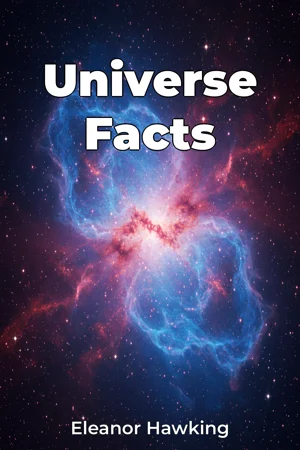
Have you ever wondered what lies beyond our world, beyond our galaxy, in the vast expanse of the universe? "Universe Facts" delves into the depths of cosmic mysteries, exploring the fundamental laws governing the cosmos, the origins of everything we know, and the captivating possibility of life existing beyond Earth. This book is crucial because understanding the universe allows us to address profound questions about our place in existence and our future within it. We begin by establishing a foundation in modern cosmological theory, tracing its development from early philosophical ponderings to the current data-driven models. Readers do not need advanced degrees; we present a clear overview of key concepts like spacetime, gravity, and the expanding universe. We methodically build our understanding, drawing on observations and experiments that have shaped our present perception of cosmic reality. The central argument of "Universe Facts" is that by synthesizing current knowledge from physics, astronomy, and astrobiology, we can achieve a more complete picture of the universe's past, present, and potential future. This synthesis is critical for fostering future scientific breakthroughs, and it empowers readers to evaluate evolving theories. The book's structure takes readers on a journey from the Big Bang to potential futures. It starts with an explanation of the Big Bang theory and the evidence supporting it, like cosmic microwave background radiation and the observed abundance of light elements. The book then moves on to galactic formation, stellar evolution, and the lifecycle of stars, highlighting the processes that forged the elements essential for life. A significant portion of the book explores exoplanets and the search for extraterrestrial life, critically analyzing the Drake equation, the Fermi paradox, and recent discoveries of potentially habitable worlds. We consider the limits of current methodologies and the impact of philosophical considerations. The information presented is firmly grounded in empirical evidence, using data obtained from telescopes, space probes, and particle accelerators. We cite research from leading scientific journals and institutions, providing readers with a rigorous and transparent account of the current state of knowledge. "Universe Facts" bridges physics, astronomy, and even philosophy. It explores how our understanding of fundamental physics informs our cosmological models, and how the search for extraterrestrial life raises profound philosophical questions about what it means to be alive and whether we are alone. These interdisciplinary connections enrich our understanding of the book's central themes. What sets this book apart is its approach to tackling complex topics by presenting the information through a factual lens, avoiding speculation. The tone is professional and accessible, aimed at fostering curiosity and understanding. The target audience includes science enthusiasts, students, and anyone curious about the cosmos. The book's value lies in providing a clear, concise, and up-to-date synthesis of our understanding of the universe, making complex topics accessible to a broad readership. In keeping with the science genre, the book maintains a high level of accuracy and objectivity, presenting information in a clear and logical manner. While the book aims to be comprehensive, it focuses primarily on established theories and observational data, acknowledging the limitations of our current understanding. The insights from this book can be applied to critical thinking and scientific literacy. By understanding the process of scientific discovery and the evidence-based approach to knowledge, readers are better equipped to evaluate scientific claims and make informed decisions. The book also touches on the ongoing debate about the nature of dark matter and dark energy, presenting different theoretical models and the evidence supporting them. These discussions highlight the dynamic nature of scientific inquiry and the ongoing quest to unravel the universe's mysteries.
Have you ever wondered what lies beyond our world, beyond our galaxy, in the vast expanse of the universe? "Universe Facts" delves into the depths of cosmic mysteries, exploring the fundamental laws governing the cosmos, the origins of everything we know, and the captivating possibility of life existing beyond Earth. This book is crucial because understanding the universe allows us to address profound questions about our place in existence and our future within it. We begin by establishing a foundation in modern cosmological theory, tracing its development from early philosophical ponderings to the current data-driven models. Readers do not need advanced degrees; we present a clear overview of key concepts like spacetime, gravity, and the expanding universe. We methodically build our understanding, drawing on observations and experiments that have shaped our present perception of cosmic reality. The central argument of "Universe Facts" is that by synthesizing current knowledge from physics, astronomy, and astrobiology, we can achieve a more complete picture of the universe's past, present, and potential future. This synthesis is critical for fostering future scientific breakthroughs, and it empowers readers to evaluate evolving theories. The book's structure takes readers on a journey from the Big Bang to potential futures. It starts with an explanation of the Big Bang theory and the evidence supporting it, like cosmic microwave background radiation and the observed abundance of light elements. The book then moves on to galactic formation, stellar evolution, and the lifecycle of stars, highlighting the processes that forged the elements essential for life. A significant portion of the book explores exoplanets and the search for extraterrestrial life, critically analyzing the Drake equation, the Fermi paradox, and recent discoveries of potentially habitable worlds. We consider the limits of current methodologies and the impact of philosophical considerations. The information presented is firmly grounded in empirical evidence, using data obtained from telescopes, space probes, and particle accelerators. We cite research from leading scientific journals and institutions, providing readers with a rigorous and transparent account of the current state of knowledge. "Universe Facts" bridges physics, astronomy, and even philosophy. It explores how our understanding of fundamental physics informs our cosmological models, and how the search for extraterrestrial life raises profound philosophical questions about what it means to be alive and whether we are alone. These interdisciplinary connections enrich our understanding of the book's central themes. What sets this book apart is its approach to tackling complex topics by presenting the information through a factual lens, avoiding speculation. The tone is professional and accessible, aimed at fostering curiosity and understanding. The target audience includes science enthusiasts, students, and anyone curious about the cosmos. The book's value lies in providing a clear, concise, and up-to-date synthesis of our understanding of the universe, making complex topics accessible to a broad readership. In keeping with the science genre, the book maintains a high level of accuracy and objectivity, presenting information in a clear and logical manner. While the book aims to be comprehensive, it focuses primarily on established theories and observational data, acknowledging the limitations of our current understanding. The insights from this book can be applied to critical thinking and scientific literacy. By understanding the process of scientific discovery and the evidence-based approach to knowledge, readers are better equipped to evaluate scientific claims and make informed decisions. The book also touches on the ongoing debate about the nature of dark matter and dark energy, presenting different theoretical models and the evidence supporting them. These discussions highlight the dynamic nature of scientific inquiry and the ongoing quest to unravel the universe's mysteries.
"Universe Facts" explores the vastness of space, diving into cosmology, astrophysics, and the search for extraterrestrial life. It tackles the Big Bang theory, galactic formation, and stellar evolution, highlighting how elements essential for life are forged within stars. The book emphasizes understanding our place in the cosmos by synthesizing knowledge from physics, astronomy, and astrobiology. It investigates exoplanets and analyzes questions such as the Drake equation and the Fermi paradox, all while remaining grounded in empirical evidence from telescopes and space probes. The book progresses from the universe's origins to its potential futures, explaining complex concepts like spacetime and gravity in accessible language. It critically examines the cosmic microwave background and the ongoing debates surrounding dark matter and dark energy. By avoiding speculation and presenting information through a factual lens, "Universe Facts" fosters scientific literacy and empowers readers to evaluate evolving theories about the universe.
Book Details
ISBN
9788233967437
Publisher
Publifye AS
Your Licenses
You don't own any licenses for this book
Purchase a license below to unlock this book and download the EPUB.
Purchase License
Select a tier to unlock this book
Need bulk licensing?
Contact us for enterprise agreements.