
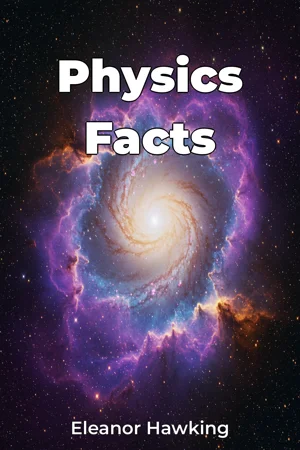
About This Book
Is reality as we perceive it truly the ultimate truth? Prepare to challenge your fundamental understanding of the universe as "Physics Facts" unravels the most revolutionary concepts in physics, from the mind-bending realms of relativity to the enigmatic world of quantum mechanics. This book delves into the core principles that govern our existence, exploring the nature of space, time, matter, and energy. We will examine two primary pillars of modern physics: Einstein's theory of relativity, which redefined our comprehension of gravity and the cosmos, and quantum mechanics, which governs the behavior of matter at the atomic and subatomic levels. These concepts form the bedrock of our current understanding of how the universe functions, impacting everything from satellite navigation to medical imaging. However, these fields often appear esoteric and disconnected from everyday experience. "Physics Facts" aims to bridge this gap, providing a clear and accessible explanation of these complex ideas. To fully appreciate these modern theories, we will first establish a foundation with classical physics, reviewing Newtonian mechanics, thermodynamics, and electromagnetism. This historical context is crucial to understanding the paradigm shifts brought about by relativity and quantum mechanics. We will address questions, such as: How did physicists reconcile seemingly contradictory observations to arrive at these groundbreaking theories? What are the key experiments that support these ideas? The central argument of "Physics Facts" is that while seemingly abstract, these physical laws have concrete, observable consequences and profound implications for our technological advancements and our understanding of reality itself. This book asserts that grasping these core principles is essential for any informed citizen in the 21st century. The book is structured to guide the reader through a logical progression of ideas. We begin by introducing the fundamental concepts of classical mechanics and electromagnetism, providing the necessary groundwork for understanding the challenges they faced. We then transition into special and general relativity, exploring space-time, gravity, and cosmology. Following this, the book delves into the intricacies of quantum mechanics, examining wave-particle duality, the uncertainty principle, and quantum entanglement. Finally, we examine the ongoing efforts to unify these two theories, exploring concepts like string theory and quantum gravity, and address how these theoretical advancements might shape future technologies and redefine our place in the cosmos. The evidence presented throughout the book will draw upon a wealth of established experimental results, thought experiments, and mathematical formalisms. We will reference key historical experiments, such as the Michelson-Morley experiment, the double-slit experiment, and observations of gravitational lensing, to illustrate the empirical basis for these theories. "Physics Facts" connects to other fields like mathematics (calculus, linear algebra, differential equations), philosophy (epistemology, metaphysics), and computer science (quantum computing, simulations). These interdisciplinary connections highlight the pervasive influence of physics on other areas of knowledge. A unique aspect of this book is its emphasis on conceptual understanding over mathematical rigor. While equations will be presented where necessary, the focus is on conveying the core ideas in a clear and intuitive manner. This book strives to clarify misconceptions about physics, offering a fresh perspective on often misunderstood concepts. The tone is accessible and conversational, aiming to engage readers without overwhelming them with technical jargon. The writing style is clear and concise, prioritizing accuracy and clarity. The target audience is anyone with an interest in science, technology, and the fundamental nature of reality. It is suitable for high school students, college undergraduates, and general readers who want to gain a better understanding of modern physics without requiring extensive prior knowledge. In accordance with the conventions of science writing, "Physics Facts" ensures clear distinctions between established facts, experimental evidence, and theoretical interpretations. It is important to acknowledge that this book covers a vast field, and certain topics may receive less attention than others. The scope is intentionally limited to the core concepts of relativity and quantum mechanics, while not delving into specialized subfields like particle physics or condensed matter physics in great detail. The principles discussed in the book have real-world applications in technologies we use every day: GPS, medical imaging (MRI, PET scans), lasers, and semiconductors. Understanding these principles provides a deeper appreciation for the technological marvels that shape our modern world. Finally, the book will address some ongoing debates and unresolved questions in physics, like the interpretation of quantum mechanics and the search for a unified theory of everything. It will also recognize potential limitations in existing models and highlight areas where further research is needed. "Physics Facts" provides a journey through modern physics, unveiling the core principles that govern our universe and highlighting the exciting frontiers of scientific inquiry.
Is reality as we perceive it truly the ultimate truth? Prepare to challenge your fundamental understanding of the universe as "Physics Facts" unravels the most revolutionary concepts in physics, from the mind-bending realms of relativity to the enigmatic world of quantum mechanics. This book delves into the core principles that govern our existence, exploring the nature of space, time, matter, and energy. We will examine two primary pillars of modern physics: Einstein's theory of relativity, which redefined our comprehension of gravity and the cosmos, and quantum mechanics, which governs the behavior of matter at the atomic and subatomic levels. These concepts form the bedrock of our current understanding of how the universe functions, impacting everything from satellite navigation to medical imaging. However, these fields often appear esoteric and disconnected from everyday experience. "Physics Facts" aims to bridge this gap, providing a clear and accessible explanation of these complex ideas. To fully appreciate these modern theories, we will first establish a foundation with classical physics, reviewing Newtonian mechanics, thermodynamics, and electromagnetism. This historical context is crucial to understanding the paradigm shifts brought about by relativity and quantum mechanics. We will address questions, such as: How did physicists reconcile seemingly contradictory observations to arrive at these groundbreaking theories? What are the key experiments that support these ideas? The central argument of "Physics Facts" is that while seemingly abstract, these physical laws have concrete, observable consequences and profound implications for our technological advancements and our understanding of reality itself. This book asserts that grasping these core principles is essential for any informed citizen in the 21st century. The book is structured to guide the reader through a logical progression of ideas. We begin by introducing the fundamental concepts of classical mechanics and electromagnetism, providing the necessary groundwork for understanding the challenges they faced. We then transition into special and general relativity, exploring space-time, gravity, and cosmology. Following this, the book delves into the intricacies of quantum mechanics, examining wave-particle duality, the uncertainty principle, and quantum entanglement. Finally, we examine the ongoing efforts to unify these two theories, exploring concepts like string theory and quantum gravity, and address how these theoretical advancements might shape future technologies and redefine our place in the cosmos. The evidence presented throughout the book will draw upon a wealth of established experimental results, thought experiments, and mathematical formalisms. We will reference key historical experiments, such as the Michelson-Morley experiment, the double-slit experiment, and observations of gravitational lensing, to illustrate the empirical basis for these theories. "Physics Facts" connects to other fields like mathematics (calculus, linear algebra, differential equations), philosophy (epistemology, metaphysics), and computer science (quantum computing, simulations). These interdisciplinary connections highlight the pervasive influence of physics on other areas of knowledge. A unique aspect of this book is its emphasis on conceptual understanding over mathematical rigor. While equations will be presented where necessary, the focus is on conveying the core ideas in a clear and intuitive manner. This book strives to clarify misconceptions about physics, offering a fresh perspective on often misunderstood concepts. The tone is accessible and conversational, aiming to engage readers without overwhelming them with technical jargon. The writing style is clear and concise, prioritizing accuracy and clarity. The target audience is anyone with an interest in science, technology, and the fundamental nature of reality. It is suitable for high school students, college undergraduates, and general readers who want to gain a better understanding of modern physics without requiring extensive prior knowledge. In accordance with the conventions of science writing, "Physics Facts" ensures clear distinctions between established facts, experimental evidence, and theoretical interpretations. It is important to acknowledge that this book covers a vast field, and certain topics may receive less attention than others. The scope is intentionally limited to the core concepts of relativity and quantum mechanics, while not delving into specialized subfields like particle physics or condensed matter physics in great detail. The principles discussed in the book have real-world applications in technologies we use every day: GPS, medical imaging (MRI, PET scans), lasers, and semiconductors. Understanding these principles provides a deeper appreciation for the technological marvels that shape our modern world. Finally, the book will address some ongoing debates and unresolved questions in physics, like the interpretation of quantum mechanics and the search for a unified theory of everything. It will also recognize potential limitations in existing models and highlight areas where further research is needed. "Physics Facts" provides a journey through modern physics, unveiling the core principles that govern our universe and highlighting the exciting frontiers of scientific inquiry.
"Physics Facts" explores the fundamental principles of the universe, venturing into relativity and quantum mechanics. It uniquely bridges the gap between abstract theories and everyday understanding. The book reveals how Einstein's relativity redefined gravity and the cosmos, while quantum mechanics governs matter at atomic levels. Highlighting the observable consequences of these physical laws, the book emphasizes their impact on technology and our perception of reality. Understanding these core principles is presented as vital for informed citizens. Beginning with classical physics as a foundation, the book transitions into modern concepts of space-time, gravity, and quantum entanglement. Key historical experiments, such as the Michelson-Morley experiment, are referenced to illustrate the empirical basis for these theories. The book emphasizes conceptual understanding over mathematical rigor, making complex ideas accessible. It progresses logically, starting with mechanics and electromagnetism, then delving into relativity and quantum physics, before exploring unification efforts like string theory.
Book Details
ISBN
9788233967413
Publisher
Publifye AS
Your Licenses
You don't own any licenses for this book
Purchase a license below to unlock this book and download the EPUB.
Purchase License
Select a tier to unlock this book
Need bulk licensing?
Contact us for enterprise agreements.