
About This Book
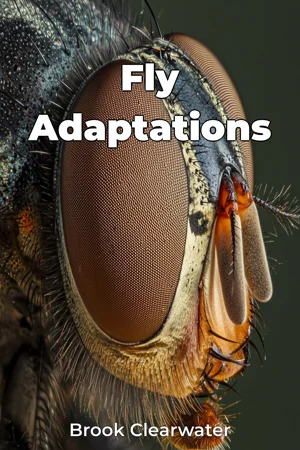
Have you ever wondered why flies seem almost impossible to swat, effortlessly evading our attempts with almost preternatural speed? "Fly Adaptations" delves into the intricate world of these ubiquitous insects, exploring not only their remarkable sensory abilities and escape mechanisms but also the less palatable aspects of their existence, particularly their role as vectors of disease. This book bridges the gap between casual observation and scientific understanding, revealing the complex biological adaptations that allow flies to thrive in diverse environments and, unfortunately, impact human health. Three key topics form the core of this exploration: the unique visual system of flies and its impact on their perception of time; the biomechanics and neural pathways that govern their rapid escape responses; and the mechanisms by which flies acquire and transmit pathogens, contributing to the spread of disease. These topics are significant because they shed light on fundamental principles of sensory biology, neuroethology, and public health. Understanding how flies perceive and react to their surroundings allows us to appreciate the diverse strategies organisms employ for survival. Furthermore, comprehending their role in disease transmission is crucial for developing effective control strategies. This book builds upon decades of research in entomology, sensory physiology, and epidemiology. Readers will benefit from a basic understanding of biology, particularly concepts related to sensory systems, neurology, and microbiology, but the material is presented in an accessible manner, minimizing technical jargon where possible. The central argument of "Fly Adaptations" is that the seemingly simple behaviors of flies are underpinned by a suite of highly specialized adaptations that have allowed them to successfully navigate and exploit a wide range of ecological niches. Understanding these adaptations is not only scientifically fascinating but also essential for mitigating the negative impacts of flies on human health and agriculture. The book's structure begins with an introduction to the evolutionary history and diversity of flies, setting the stage for a deeper dive into their sensory world. Subsequent chapters explore the visual system of flies, focusing on their high temporal resolution and wide-field motion detection, explaining how these adaptations contribute to their ability to perceive and react to threats with remarkable speed. Next, the book examines the biomechanics of flight and the neural circuits that control escape behavior, analyzing the intricate interplay between sensory input and motor output. A significant portion of the book is devoted to the role of flies as vectors of disease, detailing the mechanisms by which they acquire, carry, and transmit pathogens, and examining the epidemiological consequences of these interactions. The book culminates with a discussion of integrated pest management strategies and the potential for using our understanding of fly adaptations to develop more effective and environmentally friendly control methods. The arguments presented in "Fly Adaptations" are supported by a wide range of evidence, including data from electrophysiological recordings of fly neurons, high-speed video analysis of flight behavior, and epidemiological studies of disease transmission. The book also draws upon cutting-edge research in genomics and proteomics to explore the molecular basis of fly adaptations. "Fly Adaptations" connects to several other fields, including robotics (bio-inspired sensors and control systems), materials science (design of sticky and water-repellant surfaces), and epidemiology (modeling and control of infectious diseases). These interdisciplinary connections highlight the broad relevance of fly biology and the potential for applying insights from this field to solve real-world problems. This book takes a unique approach by integrating perspectives from sensory biology, neuroethology, biomechanics, and epidemiology to provide a holistic understanding of fly adaptations. Rather than focusing on a single aspect of fly biology, the book emphasizes the interconnectedness of these different areas, revealing how they work together to enable flies to thrive in diverse environments. The tone is informative and engaging, aiming to capture the reader's interest while maintaining scientific rigor. The writing style is accessible to a broad audience, avoiding overly technical language and providing clear explanations of complex concepts. The target audience for "Fly Adaptations" includes students and researchers in biology, entomology, and public health, as well as anyone with a general interest in the natural world. The book would be valuable to anyone seeking a deeper understanding of these often underappreciated insects. As a work of non-fiction in the fields of biology, science, life sciences, and nature, "Fly Adaptations" adheres to the conventions of accuracy, objectivity, and evidence-based reasoning. It avoids speculation and presents information in a clear and unbiased manner. The scope of the book is limited to the biological adaptations of flies, with a focus on their sensory systems, escape behavior, and role in disease transmission. It does not delve into all aspects of fly biology, such as their developmental biology or their role in decomposition. The information presented in "Fly Adaptations" has several real-world applications, including the development of more effective pest control strategies, the design of bio-inspired robots, and the prevention of disease transmission. By understanding how flies perceive and interact with their environment, we can develop innovative solutions to a wide range of problems. While "Fly Adaptations" does not shy away from controversial topics, it presents information in a balanced and objective manner, acknowledging the complexities and uncertainties involved.
Have you ever wondered why flies seem almost impossible to swat, effortlessly evading our attempts with almost preternatural speed? "Fly Adaptations" delves into the intricate world of these ubiquitous insects, exploring not only their remarkable sensory abilities and escape mechanisms but also the less palatable aspects of their existence, particularly their role as vectors of disease. This book bridges the gap between casual observation and scientific understanding, revealing the complex biological adaptations that allow flies to thrive in diverse environments and, unfortunately, impact human health. Three key topics form the core of this exploration: the unique visual system of flies and its impact on their perception of time; the biomechanics and neural pathways that govern their rapid escape responses; and the mechanisms by which flies acquire and transmit pathogens, contributing to the spread of disease. These topics are significant because they shed light on fundamental principles of sensory biology, neuroethology, and public health. Understanding how flies perceive and react to their surroundings allows us to appreciate the diverse strategies organisms employ for survival. Furthermore, comprehending their role in disease transmission is crucial for developing effective control strategies. This book builds upon decades of research in entomology, sensory physiology, and epidemiology. Readers will benefit from a basic understanding of biology, particularly concepts related to sensory systems, neurology, and microbiology, but the material is presented in an accessible manner, minimizing technical jargon where possible. The central argument of "Fly Adaptations" is that the seemingly simple behaviors of flies are underpinned by a suite of highly specialized adaptations that have allowed them to successfully navigate and exploit a wide range of ecological niches. Understanding these adaptations is not only scientifically fascinating but also essential for mitigating the negative impacts of flies on human health and agriculture. The book's structure begins with an introduction to the evolutionary history and diversity of flies, setting the stage for a deeper dive into their sensory world. Subsequent chapters explore the visual system of flies, focusing on their high temporal resolution and wide-field motion detection, explaining how these adaptations contribute to their ability to perceive and react to threats with remarkable speed. Next, the book examines the biomechanics of flight and the neural circuits that control escape behavior, analyzing the intricate interplay between sensory input and motor output. A significant portion of the book is devoted to the role of flies as vectors of disease, detailing the mechanisms by which they acquire, carry, and transmit pathogens, and examining the epidemiological consequences of these interactions. The book culminates with a discussion of integrated pest management strategies and the potential for using our understanding of fly adaptations to develop more effective and environmentally friendly control methods. The arguments presented in "Fly Adaptations" are supported by a wide range of evidence, including data from electrophysiological recordings of fly neurons, high-speed video analysis of flight behavior, and epidemiological studies of disease transmission. The book also draws upon cutting-edge research in genomics and proteomics to explore the molecular basis of fly adaptations. "Fly Adaptations" connects to several other fields, including robotics (bio-inspired sensors and control systems), materials science (design of sticky and water-repellant surfaces), and epidemiology (modeling and control of infectious diseases). These interdisciplinary connections highlight the broad relevance of fly biology and the potential for applying insights from this field to solve real-world problems. This book takes a unique approach by integrating perspectives from sensory biology, neuroethology, biomechanics, and epidemiology to provide a holistic understanding of fly adaptations. Rather than focusing on a single aspect of fly biology, the book emphasizes the interconnectedness of these different areas, revealing how they work together to enable flies to thrive in diverse environments. The tone is informative and engaging, aiming to capture the reader's interest while maintaining scientific rigor. The writing style is accessible to a broad audience, avoiding overly technical language and providing clear explanations of complex concepts. The target audience for "Fly Adaptations" includes students and researchers in biology, entomology, and public health, as well as anyone with a general interest in the natural world. The book would be valuable to anyone seeking a deeper understanding of these often underappreciated insects. As a work of non-fiction in the fields of biology, science, life sciences, and nature, "Fly Adaptations" adheres to the conventions of accuracy, objectivity, and evidence-based reasoning. It avoids speculation and presents information in a clear and unbiased manner. The scope of the book is limited to the biological adaptations of flies, with a focus on their sensory systems, escape behavior, and role in disease transmission. It does not delve into all aspects of fly biology, such as their developmental biology or their role in decomposition. The information presented in "Fly Adaptations" has several real-world applications, including the development of more effective pest control strategies, the design of bio-inspired robots, and the prevention of disease transmission. By understanding how flies perceive and interact with their environment, we can develop innovative solutions to a wide range of problems. While "Fly Adaptations" does not shy away from controversial topics, it presents information in a balanced and objective manner, acknowledging the complexities and uncertainties involved.
"Fly Adaptations" explores the fascinating world of flies, revealing the intricate biological mechanisms behind their survival and impact on human health. It examines how these insects have adapted to thrive in diverse environments, often to our dismay. The book highlights key areas such as their unique visual system, which allows them to perceive threats with remarkable speed, and their rapid escape responses, driven by complex neural pathways. Did you know that a fly's perception of time differs significantly from ours, contributing to their elusive nature? A significant portion of the book focuses on the less appealing aspect of flies: their role as vectors of disease. It details how flies acquire and transmit pathogens, contributing to the spread of illnesses. Understanding these mechanisms is crucial for developing effective control strategies and protecting public health. Beginning with an overview of fly evolution and diversity, "Fly Adaptations" then progresses through sensory systems, biomechanics, and disease transmission, culminating in a discussion of integrated pest management.
Book Details
ISBN
9788233967215
Publisher
Publifye AS
Your Licenses
You don't own any licenses for this book
Purchase a license below to unlock this book and download the EPUB.
Purchase License
Select a tier to unlock this book
Need bulk licensing?
Contact us for enterprise agreements.