
About This Book
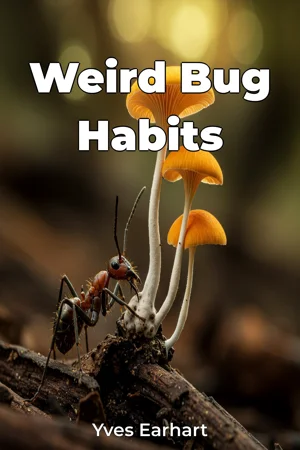
Why would an ant willingly become a zombie? And what compels a female mantis to devour her mate? "Weird Bug Habits" is a fascinating exploration into the bizarre and often unsettling behaviors found within the insect world. This book delves into the hidden lives of insects, revealing the complex, and sometimes gruesome, strategies they employ for survival, reproduction, and social dominance. These behaviors, far from being random, are driven by evolutionary pressures and provide valuable insights into the fundamental principles of biology and ecology. This book will primarily focus on three core areas: parasitic manipulation, reproductive strategies, and social dynamics. Parasitic manipulation will examine instances where parasites control the behavior of their insect hosts, such as the Ophiocordyceps fungus turning ants into zombies. Reproductive strategies will uncover the diverse and sometimes brutal methods insects use to ensure the continuation of their genes, including cannibalism and elaborate mating rituals. Social dynamics explores the complex social structures of insects like ants, bees, and termites, highlighting the cooperative and competitive behaviors that govern their colonies. These topics are important because they challenge our understanding of agency, behavior, and the very definition of survival in the natural world. Understanding insect behavior requires a foundation in evolutionary biology, ecology, and entomology. While no prior expertise is necessary, a basic grasp of these areas will enhance the reader's appreciation of the book's themes. For instance, concepts like natural selection, adaptation, and niche partitioning play critical roles in shaping the weird habits observed in insects. The central argument of "Weird Bug Habits" is that seemingly bizarre insect behaviors are not anomalies but rather logical outcomes of evolutionary pressures acting on a diverse and adaptable group of organisms. These behaviors, while unsettling to human sensibilities, are often highly effective strategies for survival and reproduction. Understanding these strategies can provide valuable insights into the workings of natural selection and the interconnectedness of ecosystems. The book is structured to progressively build upon this argument. It begins with an introduction to the diversity of insect life and an overview of the key concepts in behavioral ecology. Subsequent sections delve into each of the core areas – parasitic manipulation, reproductive strategies, and social dynamics – providing detailed examples and analyses. The book culminates with a discussion of the broader implications of insect behavior for understanding evolution, ecology, and even human society. Practical applications of this knowledge are also explored, such as using insect behavior to develop new pest control strategies. The book’s arguments are supported by a wealth of scientific research, including field observations, laboratory experiments, and genomic analyses. It draws upon data from peer-reviewed publications, entomological databases, and the author's own research experiences. The book also incorporates stunning photographs and illustrations to bring the weird world of insect behavior to life. "Weird Bug Habits" connects to various scientific disciplines, including parasitology, evolutionary psychology, and behavioral economics. The study of parasitic manipulation can shed light on the neural mechanisms underlying behavior control. The exploration of insect social dynamics provides insights into the evolution of cooperation and altruism. The analysis of insect reproductive strategies can inform our understanding of sexual selection and mate choice. This book takes a unique approach by focusing on the most unusual and unsettling aspects of insect behavior, presenting them in a way that is both informative and engaging. It avoids jargon and technical language, making the science accessible to a broad audience while maintaining scientific rigor. The tone is conversational yet authoritative, aiming to educate and entertain readers. The writing style is narrative non-fiction, incorporating anecdotes and real-life examples to illustrate complex scientific concepts and make the book accessible and engaging. The target audience includes anyone with an interest in science, nature, and the weird and wonderful aspects of the natural world. This book would be valuable to students, educators, and general readers seeking to expand their knowledge of insect behavior and evolutionary biology. As a work of fact-based, non-fiction, "Weird Bug Habits" will adhere to the conventions of scientific accuracy, clear presentation of evidence, and objective analysis. It avoids sensationalism and presents the information in a balanced and nuanced manner. The scope of the book is limited to insect behavior, focusing on the most unusual and well-documented examples. It does not attempt to provide a comprehensive overview of all insect species or behaviors. The geographic scope is global, drawing examples from around the world. The information in "Weird Bug Habits" can be applied practically in various ways. For example, understanding insect communication can help develop new strategies for pest control. Studying insect social behavior can provide insights into organizational dynamics and teamwork. While the book strives to present a balanced view of insect behavior, there are ongoing debates in the field regarding the interpretation of certain behaviors and the role of specific genes or environmental factors. These debates are acknowledged and discussed where relevant. The book also delves into ethical questions surrounding insect research and conservation.
Why would an ant willingly become a zombie? And what compels a female mantis to devour her mate? "Weird Bug Habits" is a fascinating exploration into the bizarre and often unsettling behaviors found within the insect world. This book delves into the hidden lives of insects, revealing the complex, and sometimes gruesome, strategies they employ for survival, reproduction, and social dominance. These behaviors, far from being random, are driven by evolutionary pressures and provide valuable insights into the fundamental principles of biology and ecology. This book will primarily focus on three core areas: parasitic manipulation, reproductive strategies, and social dynamics. Parasitic manipulation will examine instances where parasites control the behavior of their insect hosts, such as the Ophiocordyceps fungus turning ants into zombies. Reproductive strategies will uncover the diverse and sometimes brutal methods insects use to ensure the continuation of their genes, including cannibalism and elaborate mating rituals. Social dynamics explores the complex social structures of insects like ants, bees, and termites, highlighting the cooperative and competitive behaviors that govern their colonies. These topics are important because they challenge our understanding of agency, behavior, and the very definition of survival in the natural world. Understanding insect behavior requires a foundation in evolutionary biology, ecology, and entomology. While no prior expertise is necessary, a basic grasp of these areas will enhance the reader's appreciation of the book's themes. For instance, concepts like natural selection, adaptation, and niche partitioning play critical roles in shaping the weird habits observed in insects. The central argument of "Weird Bug Habits" is that seemingly bizarre insect behaviors are not anomalies but rather logical outcomes of evolutionary pressures acting on a diverse and adaptable group of organisms. These behaviors, while unsettling to human sensibilities, are often highly effective strategies for survival and reproduction. Understanding these strategies can provide valuable insights into the workings of natural selection and the interconnectedness of ecosystems. The book is structured to progressively build upon this argument. It begins with an introduction to the diversity of insect life and an overview of the key concepts in behavioral ecology. Subsequent sections delve into each of the core areas – parasitic manipulation, reproductive strategies, and social dynamics – providing detailed examples and analyses. The book culminates with a discussion of the broader implications of insect behavior for understanding evolution, ecology, and even human society. Practical applications of this knowledge are also explored, such as using insect behavior to develop new pest control strategies. The book’s arguments are supported by a wealth of scientific research, including field observations, laboratory experiments, and genomic analyses. It draws upon data from peer-reviewed publications, entomological databases, and the author's own research experiences. The book also incorporates stunning photographs and illustrations to bring the weird world of insect behavior to life. "Weird Bug Habits" connects to various scientific disciplines, including parasitology, evolutionary psychology, and behavioral economics. The study of parasitic manipulation can shed light on the neural mechanisms underlying behavior control. The exploration of insect social dynamics provides insights into the evolution of cooperation and altruism. The analysis of insect reproductive strategies can inform our understanding of sexual selection and mate choice. This book takes a unique approach by focusing on the most unusual and unsettling aspects of insect behavior, presenting them in a way that is both informative and engaging. It avoids jargon and technical language, making the science accessible to a broad audience while maintaining scientific rigor. The tone is conversational yet authoritative, aiming to educate and entertain readers. The writing style is narrative non-fiction, incorporating anecdotes and real-life examples to illustrate complex scientific concepts and make the book accessible and engaging. The target audience includes anyone with an interest in science, nature, and the weird and wonderful aspects of the natural world. This book would be valuable to students, educators, and general readers seeking to expand their knowledge of insect behavior and evolutionary biology. As a work of fact-based, non-fiction, "Weird Bug Habits" will adhere to the conventions of scientific accuracy, clear presentation of evidence, and objective analysis. It avoids sensationalism and presents the information in a balanced and nuanced manner. The scope of the book is limited to insect behavior, focusing on the most unusual and well-documented examples. It does not attempt to provide a comprehensive overview of all insect species or behaviors. The geographic scope is global, drawing examples from around the world. The information in "Weird Bug Habits" can be applied practically in various ways. For example, understanding insect communication can help develop new strategies for pest control. Studying insect social behavior can provide insights into organizational dynamics and teamwork. While the book strives to present a balanced view of insect behavior, there are ongoing debates in the field regarding the interpretation of certain behaviors and the role of specific genes or environmental factors. These debates are acknowledged and discussed where relevant. The book also delves into ethical questions surrounding insect research and conservation.
"Weird Bug Habits" explores the often bizarre world of insect behavior, revealing the evolutionary strategies behind their unsettling habits. From parasitic manipulation, like ants becoming zombie hosts to fungi, to cannibalistic reproductive rituals, the book delves into the intricate lives of insects. These behaviors, driven by natural selection, offer valuable insights into biology and ecology. The book uniquely focuses on the strangest aspects of insect life, examining reproductive strategies, social dynamics, and parasitic manipulation. It highlights how seemingly odd behaviors are crucial for survival, such as the complex social structures of ant colonies. These societies exhibit both cooperation and competition, providing a microcosm of evolutionary forces at play. The book's approach avoids technical jargon, making complex science accessible to a broad audience. Structured to progressively build understanding, the book begins with an overview of insect diversity and behavioral ecology. Subsequent sections explore core areas with detailed examples and analyses, culminating in a discussion of insect behavior's implications for evolution and ecology. The book also touches on practical applications, such as using insect behavior for innovative pest control.
Book Details
ISBN
9788233967130
Publisher
Publifye AS
Your Licenses
You don't own any licenses for this book
Purchase a license below to unlock this book and download the EPUB.
Purchase License
Select a tier to unlock this book
Need bulk licensing?
Contact us for enterprise agreements.