
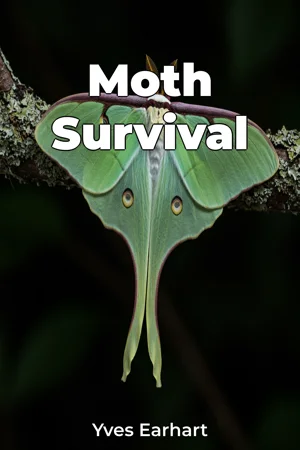
About This Book
Have you ever wondered how moths, creatures of the night, thrive in a world seemingly designed for diurnal beings? "Moth Survival" delves into the intricate lives of these often-overlooked insects, revealing the secrets behind their remarkable navigation skills, predator evasion tactics, and resilience in the face of challenging environmental conditions. This book is significant because it sheds light on the complex adaptations that allow moths to not only survive but also play a crucial, yet often underappreciated, role in ecosystems worldwide. The book explores three primary areas of moth survival: orientation in darkness, defense mechanisms against predators, and physiological adaptations to extreme environments. We will examine how moths navigate using celestial cues, pheromones, and other sensory inputs, providing a detailed look into their sensory biology. We will also investigate the diverse range of defense strategies they employ, from camouflage and mimicry to chemical defenses and startle displays. Finally, the book analyzes how moths have adapted to survive in deserts, high altitudes, and other demanding habitats, focusing on their thermoregulation, water conservation, and metabolic adjustments. "Moth Survival" argues that the evolutionary success of moths is a testament to their remarkable adaptability and highlights the importance of these insects in maintaining biodiversity and ecosystem health. This argument is crucial in light of increasing environmental challenges, such as habitat loss and climate change, which threaten moth populations globally. Understanding the mechanisms that underpin their survival is essential for developing effective conservation strategies. The book begins with an introduction to the world of moths, providing an overview of their diversity, life cycle, and ecological roles. The first section addresses moth navigation, detailing the sensory mechanisms they use to find food, mates, and suitable habitats in the dark. This includes an analysis of their visual systems, olfactory senses, and sensitivity to magnetic fields. The second section focuses on predator-prey interactions, examining the various defense strategies moths have evolved to avoid being eaten. This includes case studies of specific moth species and the predators they face. The third section explores the physiological adaptations that allow moths to thrive in extreme environments, such as deserts and mountains. This section delves into their metabolic processes, water balance, and thermal regulation. The book concludes with a discussion of the conservation challenges facing moths and the steps that can be taken to protect these vital insects. The arguments presented in "Moth Survival" are supported by a wealth of scientific evidence, including data from field studies, laboratory experiments, and genomic analyses. We will draw on published research from leading entomologists and ecologists, as well as original data collected through observational studies and experimental investigations. The book also incorporates imagery and detailed diagrams to illustrate key concepts and findings. "Moth Survival" connects to several other fields, including ecology, evolutionary biology, and conservation biology. The book's exploration of moth navigation relates to the field of animal behavior, while its discussion of predator-prey interactions has implications for community ecology. The analysis of physiological adaptations draws on principles from comparative physiology and environmental science. It provides additional insights into evolutionary adaptation in extreme cases of camouflage, mimicry, and deceptive signals. The book utilizes an analytical and descriptive approach to convey information, maintaining a professional tone yet remaining accessible to a broad audience. "Moth Survival" is intended for anyone with an interest in insects, ecology, or evolutionary biology. This book provides a comprehensive and accessible overview of the lives of moths, making it valuable to students, researchers, and nature enthusiasts alike. While the book covers a wide range of topics related to moth survival, it primarily focuses on their behavioral and physiological adaptations. The book does not delve into the taxonomy or evolutionary history of moths in great detail but focuses on the mechanisms that allow them to thrive in diverse environments. The information presented in "Moth Survival" has practical applications in conservation efforts, pest management, and biomimicry. By understanding how moths navigate and evade predators, we can develop more effective strategies for protecting them from threats such as habitat loss and pesticide use. The book also addresses ongoing debates in the field, such as the relative importance of different sensory cues in moth navigation and the effectiveness of various defense mechanisms.
Have you ever wondered how moths, creatures of the night, thrive in a world seemingly designed for diurnal beings? "Moth Survival" delves into the intricate lives of these often-overlooked insects, revealing the secrets behind their remarkable navigation skills, predator evasion tactics, and resilience in the face of challenging environmental conditions. This book is significant because it sheds light on the complex adaptations that allow moths to not only survive but also play a crucial, yet often underappreciated, role in ecosystems worldwide. The book explores three primary areas of moth survival: orientation in darkness, defense mechanisms against predators, and physiological adaptations to extreme environments. We will examine how moths navigate using celestial cues, pheromones, and other sensory inputs, providing a detailed look into their sensory biology. We will also investigate the diverse range of defense strategies they employ, from camouflage and mimicry to chemical defenses and startle displays. Finally, the book analyzes how moths have adapted to survive in deserts, high altitudes, and other demanding habitats, focusing on their thermoregulation, water conservation, and metabolic adjustments. "Moth Survival" argues that the evolutionary success of moths is a testament to their remarkable adaptability and highlights the importance of these insects in maintaining biodiversity and ecosystem health. This argument is crucial in light of increasing environmental challenges, such as habitat loss and climate change, which threaten moth populations globally. Understanding the mechanisms that underpin their survival is essential for developing effective conservation strategies. The book begins with an introduction to the world of moths, providing an overview of their diversity, life cycle, and ecological roles. The first section addresses moth navigation, detailing the sensory mechanisms they use to find food, mates, and suitable habitats in the dark. This includes an analysis of their visual systems, olfactory senses, and sensitivity to magnetic fields. The second section focuses on predator-prey interactions, examining the various defense strategies moths have evolved to avoid being eaten. This includes case studies of specific moth species and the predators they face. The third section explores the physiological adaptations that allow moths to thrive in extreme environments, such as deserts and mountains. This section delves into their metabolic processes, water balance, and thermal regulation. The book concludes with a discussion of the conservation challenges facing moths and the steps that can be taken to protect these vital insects. The arguments presented in "Moth Survival" are supported by a wealth of scientific evidence, including data from field studies, laboratory experiments, and genomic analyses. We will draw on published research from leading entomologists and ecologists, as well as original data collected through observational studies and experimental investigations. The book also incorporates imagery and detailed diagrams to illustrate key concepts and findings. "Moth Survival" connects to several other fields, including ecology, evolutionary biology, and conservation biology. The book's exploration of moth navigation relates to the field of animal behavior, while its discussion of predator-prey interactions has implications for community ecology. The analysis of physiological adaptations draws on principles from comparative physiology and environmental science. It provides additional insights into evolutionary adaptation in extreme cases of camouflage, mimicry, and deceptive signals. The book utilizes an analytical and descriptive approach to convey information, maintaining a professional tone yet remaining accessible to a broad audience. "Moth Survival" is intended for anyone with an interest in insects, ecology, or evolutionary biology. This book provides a comprehensive and accessible overview of the lives of moths, making it valuable to students, researchers, and nature enthusiasts alike. While the book covers a wide range of topics related to moth survival, it primarily focuses on their behavioral and physiological adaptations. The book does not delve into the taxonomy or evolutionary history of moths in great detail but focuses on the mechanisms that allow them to thrive in diverse environments. The information presented in "Moth Survival" has practical applications in conservation efforts, pest management, and biomimicry. By understanding how moths navigate and evade predators, we can develop more effective strategies for protecting them from threats such as habitat loss and pesticide use. The book also addresses ongoing debates in the field, such as the relative importance of different sensory cues in moth navigation and the effectiveness of various defense mechanisms.
"Moth Survival" unveils the fascinating world of moths, highlighting their remarkable adaptations for thriving in diverse and challenging environments. It explores how these nocturnal insects utilize sophisticated navigational skills, employing celestial cues and pheromones to locate food, mates, and suitable habitats in darkness. The book also delves into the diverse predator evasion tactics moths have evolved, such as camouflage, mimicry, and chemical defenses, showcasing the intricate interplay between predator and prey in insect ecology. This exploration of moth behavior and physiological adaptations reveals how moths have conquered extreme habitats, from deserts to high altitudes, through thermoregulation, water conservation, and metabolic adjustments. The book emphasizes the critical role moths play in maintaining biodiversity and ecosystem health, arguing that their evolutionary success is a testament to their adaptability. Beginning with an overview of moth diversity and ecological roles, the book progresses through sections on navigation, defense, and physiological adaptations, culminating in a discussion of conservation challenges and strategies.
Book Details
ISBN
9788233967093
Publisher
Publifye AS
Your Licenses
You don't own any licenses for this book
Purchase a license below to unlock this book and download the EPUB.
Purchase License
Select a tier to unlock this book
Need bulk licensing?
Contact us for enterprise agreements.