
About This Book
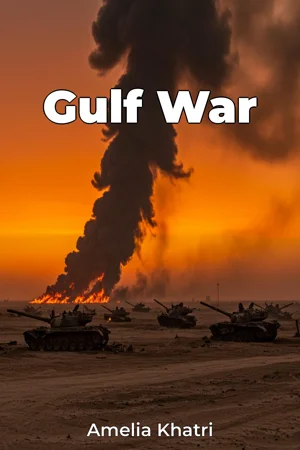
How did a swift, decisive military campaign reshape the geopolitical landscape of the Middle East and redefine modern warfare? This book, "Gulf War," delves into the intricate details of the 1990-1991 Persian Gulf War, providing a comprehensive analysis of the conflict's origins, execution, and lasting consequences. The book primarily focuses on Operation Desert Storm, the liberation of Kuwait, and the evolution of military strategy during this pivotal event. These topics are crucial for understanding not only the Gulf War itself, but also the broader dynamics of international relations, military technology, and the ongoing challenges of regional stability in the Middle East. The book situates the Gulf War within its historical context, examining the complex relationship between Iraq and Kuwait, the legacy of pan-Arab nationalism, and the economic factors driving Saddam Hussein’s decision to invade. Understanding these factors is essential to grasping the underlying causes of the conflict and the motivations of the key players involved. The central argument of "Gulf War" is that the conflict represented a paradigm shift in military affairs, showcasing the effectiveness of precision-guided weaponry, air power, and coalition warfare in a way that fundamentally altered the balance of power and set the stage for future military interventions. The book will demonstrate how the Gulf War served as a proving ground for new technologies and doctrines that continue to shape military strategy today. The book is structured logically, beginning with an introduction to the historical and political context of the conflict. It then proceeds to analyze the Iraqi invasion of Kuwait, detailing the international response and the formation of the coalition led by the United States. A significant portion of the book is dedicated to Operation Desert Storm, examining the air campaign, the ground offensive, and the strategic decisions made by both sides. The book culminates with an assessment of the war's consequences, including its impact on Kuwait, Iraq, and the broader Middle East, as well as its implications for international security and the future of warfare. The book relies on a wide range of sources, including official military documents, firsthand accounts from soldiers and civilians, diplomatic records, and scholarly analyses. It also incorporates data on military expenditures, casualty figures, and the performance of various weapons systems to provide a comprehensive and data-driven analysis of the conflict. "Gulf War" connects to several other fields of study, including political science (analyzing the role of international organizations and diplomacy), economics (assessing the impact of the war on oil markets and global trade), and sociology (examining the social and cultural consequences of the conflict). These interdisciplinary connections enrich the book's argument and provide a more holistic understanding of the Gulf War's significance. The book offers a nuanced perspective on the Gulf War, avoiding simplistic narratives and exploring the complexities and contradictions of the conflict. It moves beyond a purely military history to examine the war's broader political, economic, and social dimensions. The tone of the book is informative and analytical, presenting complex information in a clear and accessible manner. The writing style is geared towards a broad audience, including students, scholars, policymakers, and anyone interested in military history or Middle Eastern affairs. This book is aimed at readers interested in military history, political science, and Middle Eastern studies. It would be valuable to anyone seeking a deeper understanding of the Gulf War, its causes, consequences, and its lasting impact on the world. As a work in the military history genre, the book provides a detailed account of the strategies, tactics, and technologies employed during the conflict, adhering to accepted standards of historical accuracy and analysis. The scope of the book is limited to the period from the Iraqi invasion of Kuwait in 1990 to the end of Operation Desert Storm in 1991, with some discussion of the war's long-term consequences. It does not delve into the subsequent Iraq War or other related conflicts. The information in the book can be applied to the study of contemporary military strategy, international relations, and conflict resolution. It offers valuable insights into the challenges of coalition warfare, the use of military force in the 21st century, and the complexities of the Middle East. Finally, the book will address some of the ongoing debates surrounding the Gulf War, such as the effectiveness of the air campaign, the decision to halt the ground offensive short of Baghdad, and the long-term consequences of the war for the region.
How did a swift, decisive military campaign reshape the geopolitical landscape of the Middle East and redefine modern warfare? This book, "Gulf War," delves into the intricate details of the 1990-1991 Persian Gulf War, providing a comprehensive analysis of the conflict's origins, execution, and lasting consequences. The book primarily focuses on Operation Desert Storm, the liberation of Kuwait, and the evolution of military strategy during this pivotal event. These topics are crucial for understanding not only the Gulf War itself, but also the broader dynamics of international relations, military technology, and the ongoing challenges of regional stability in the Middle East. The book situates the Gulf War within its historical context, examining the complex relationship between Iraq and Kuwait, the legacy of pan-Arab nationalism, and the economic factors driving Saddam Hussein’s decision to invade. Understanding these factors is essential to grasping the underlying causes of the conflict and the motivations of the key players involved. The central argument of "Gulf War" is that the conflict represented a paradigm shift in military affairs, showcasing the effectiveness of precision-guided weaponry, air power, and coalition warfare in a way that fundamentally altered the balance of power and set the stage for future military interventions. The book will demonstrate how the Gulf War served as a proving ground for new technologies and doctrines that continue to shape military strategy today. The book is structured logically, beginning with an introduction to the historical and political context of the conflict. It then proceeds to analyze the Iraqi invasion of Kuwait, detailing the international response and the formation of the coalition led by the United States. A significant portion of the book is dedicated to Operation Desert Storm, examining the air campaign, the ground offensive, and the strategic decisions made by both sides. The book culminates with an assessment of the war's consequences, including its impact on Kuwait, Iraq, and the broader Middle East, as well as its implications for international security and the future of warfare. The book relies on a wide range of sources, including official military documents, firsthand accounts from soldiers and civilians, diplomatic records, and scholarly analyses. It also incorporates data on military expenditures, casualty figures, and the performance of various weapons systems to provide a comprehensive and data-driven analysis of the conflict. "Gulf War" connects to several other fields of study, including political science (analyzing the role of international organizations and diplomacy), economics (assessing the impact of the war on oil markets and global trade), and sociology (examining the social and cultural consequences of the conflict). These interdisciplinary connections enrich the book's argument and provide a more holistic understanding of the Gulf War's significance. The book offers a nuanced perspective on the Gulf War, avoiding simplistic narratives and exploring the complexities and contradictions of the conflict. It moves beyond a purely military history to examine the war's broader political, economic, and social dimensions. The tone of the book is informative and analytical, presenting complex information in a clear and accessible manner. The writing style is geared towards a broad audience, including students, scholars, policymakers, and anyone interested in military history or Middle Eastern affairs. This book is aimed at readers interested in military history, political science, and Middle Eastern studies. It would be valuable to anyone seeking a deeper understanding of the Gulf War, its causes, consequences, and its lasting impact on the world. As a work in the military history genre, the book provides a detailed account of the strategies, tactics, and technologies employed during the conflict, adhering to accepted standards of historical accuracy and analysis. The scope of the book is limited to the period from the Iraqi invasion of Kuwait in 1990 to the end of Operation Desert Storm in 1991, with some discussion of the war's long-term consequences. It does not delve into the subsequent Iraq War or other related conflicts. The information in the book can be applied to the study of contemporary military strategy, international relations, and conflict resolution. It offers valuable insights into the challenges of coalition warfare, the use of military force in the 21st century, and the complexities of the Middle East. Finally, the book will address some of the ongoing debates surrounding the Gulf War, such as the effectiveness of the air campaign, the decision to halt the ground offensive short of Baghdad, and the long-term consequences of the war for the region.
"Gulf War" explores the 1990-1991 Persian Gulf War, focusing on Operation Desert Storm and its profound impact. It analyzes the war's origins, triggered by Iraq's invasion of Kuwait, revealing the complex interplay of historical, political, and economic factors that fueled Saddam Hussein's aggression. The book argues that the swift and decisive victory of the coalition forces, led by the United States, showcased the transformative power of precision-guided weaponry and air power, fundamentally altering modern military strategy. It highlights how the conflict served as a proving ground for new technologies and doctrines, impacting the balance of power and setting the stage for future military interventions. The book examines the formation of the international coalition and the execution of Operation Desert Storm, detailing both the air campaign and the ground offensive. It provides a comprehensive analysis of the strategic decisions made by both sides, based on official documents, firsthand accounts, and scholarly research. The book progresses logically, starting with the historical context, moving through the military operations, and concluding with an assessment of the war's consequences, including its impact on regional stability and international relations. It offers a nuanced perspective, exploring the complexities and contradictions of the conflict while avoiding simplistic narratives.
Book Details
ISBN
9788233966799
Publisher
Publifye AS
Your Licenses
You don't own any licenses for this book
Purchase a license below to unlock this book and download the EPUB.
Purchase License
Select a tier to unlock this book
Need bulk licensing?
Contact us for enterprise agreements.